
Scaly-breasted Munia
Lonchura punctulata
Description
How to identify
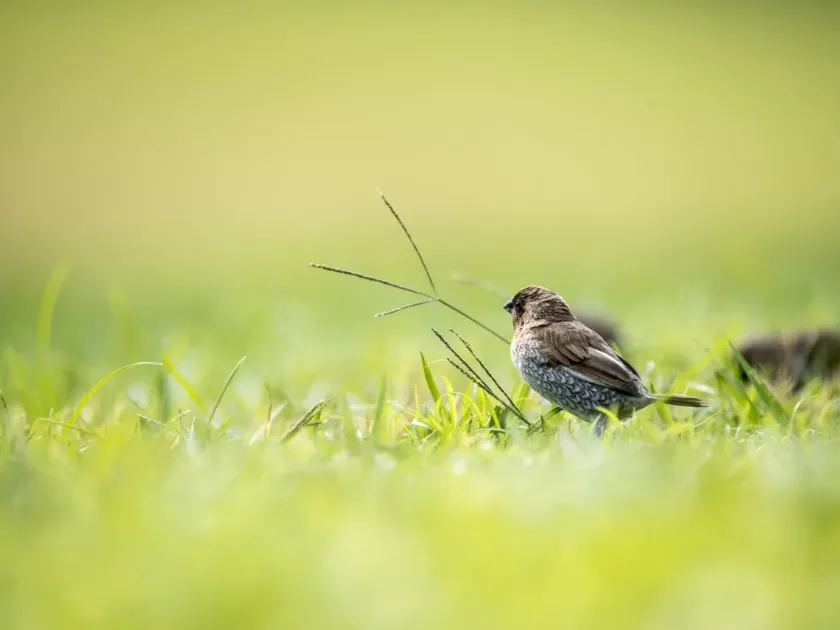
The Scaly-breasted Munia (Lonchura punctulata) is a small passerine bird from the Estrildidae family, known for its destructive impact on cereal crops in various regions.
The bird is easily identified by its brown upperparts and the distinctive dark, scale-like markings on its white breast and belly, which give it its common name.
It possesses a strong, conical, dark-colored bill that is perfectly adapted for husking and consuming various types of grass seeds and cultivated grains.
Adults measure approximately 10 to 12 centimeters in length. The plumage is consistent across both sexes, while juveniles are plain brown with paler underparts.
These birds are highly gregarious and typically forage in large, noisy flocks, which exacerbates the damage they cause to agricultural fields.
What it damages
The Scaly-breasted Munia is a notorious pest of rice, particularly during the milk and dough stages of grain development, when the grain is soft and nutrient-rich.
Besides rice, they also attack other cultivated cereals, including wheat, sorghum, millet, and maize, often causing substantial yield losses in small-scale farming.
The birds forage by stripping seeds directly from the panicles, often knocking down stalks in the process and increasing the difficulty of mechanical harvesting.
In addition to feeding on standing crops, they are known to raid grain stores if these facilities are not adequately protected or enclosed.
Local populations can expand rapidly in agricultural areas, leading to significant economic damage that necessitates active pest management strategies.
When it appears
Damage is most prevalent during the ripening phase of crops. As cereals mature, the flock activity increases, targeting the most vulnerable fields.
In tropical and subtropical regions where multiple crops are grown throughout the year, the Scaly-breasted Munia can remain a threat during all growing seasons.
Foraging activity is strictly diurnal, with peaks occurring in the early morning and late afternoon as birds commute between nesting sites and feeding grounds.
Seasonal migrations are usually local and related to the availability of food sources, moving from one harvest area to another once a field is depleted.
The presence of water sources near agricultural lands further increases the risk of infestation, as these birds require water and often roost in nearby vegetation.
Signs of infestation
A primary sign of infestation is the presence of large, dense flocks that flush from the field when disturbed, creating a distinctive communal sound.
Panicles show clear evidence of bird feeding, with empty glumes and missing grains occurring in sections or entirely across the seed head.
Significant amounts of chaff and partially eaten grain kernels found on the ground beneath the crop indicate heavy foraging activity by a resident flock.
Broken stalks and stems within the field, often caused by the collective weight of multiple birds perching on them, are reliable indicators of concentrated damage.
Frequent sightings of small, dark birds in nearby hedges or trees, coupled with continuous chirping, are early warning signs that a flock is scouting the fields.
Control measures
Effective management involves the use of visual scaring tactics, such as reflective tape, streamers, and life-like models of birds of prey, though these require rotation.
Acoustic deterrents, including broadcasted predator calls or distress signals, are widely utilized, although birds may habituate to these sounds over time.
Cultural control measures, such as uniform planting and synchronized harvesting, help to reduce the window of vulnerability for the crop.
Removing nesting habitats, such as tall grasses, reeds, and dense shrubs near the fields, is crucial for reducing the local population pressure.
- Installing bird-proof netting for high-value research or seed multiplication plots.
- Regular field monitoring during the maturation phase to detect early arrivals.
- Promoting community-level bird control programs to discourage flocks from settling in the area.
Taxonomy
- Latin name
- Lonchura punctulata
- Family
- Estrildidae
- EPPO code
- LONCPU
Discussion
No discussions yet — be the first.