
Chestnut munia
Lonchura atricapilla
Description
How to identify
The Chestnut munia (scientific name: Lonchura atricapilla) is a small passerine bird in the estrildid finch family known for causing significant damage to cereal agriculture.
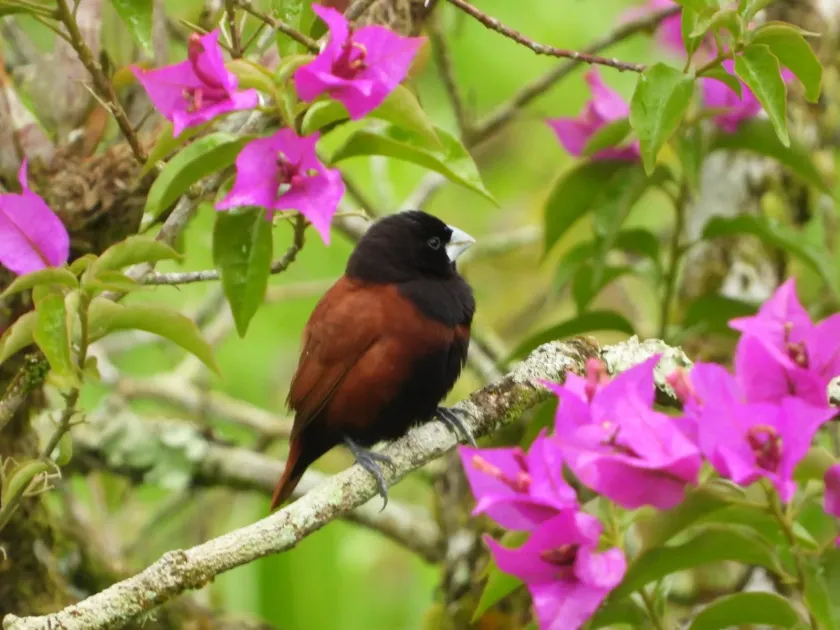
The adult bird is distinguished by its jet-black head and deep chestnut-brown body, which provides excellent camouflage within dense marshy vegetation.
With an average body length of about 11 cm, it is small but equipped with a thick, conical bill specifically evolved for husking and consuming tough seeds.
These birds are highly gregarious and are almost always found in large flocks, a behavior that allows them to overwhelm and devastate crops in a short period.
Their natural habitats include wetlands, tall grasses, and reeds, making rice paddies an ideal environment for foraging and nesting near water sources.
What it damages
The primary agricultural threat posed by the Chestnut munia is its appetite for ripening rice, particularly during the milk and dough stages of grain development.
Besides rice, they are known to attack other grain crops such as millet and sorghum, often causing localized but total crop loss in susceptible areas.
The damage is not limited to seed consumption; flocks often land on the stalks, causing them to bend or break, which interferes with mechanical harvesting and reduces yield.
Because they feed collectively, the concentration of damage is usually high in specific spots, leaving behind shredded husks and damaged stalks throughout the field.
In regions where multiple rice crops are grown annually, the Chestnut munia can maintain a persistent presence, preventing the recovery of damaged stalks.
When it appears
The peak periods of harmful activity occur during the grain-filling stages of the rice cycle, when the soft kernels are most palatable to the birds.
Breeding cycles of the munia are often synchronized with the monsoon or rainy seasons, which also correlate with increased crop susceptibility in many regions.
They exhibit strong daily rhythms, with the highest levels of feeding activity occurring in the early morning and late afternoon hours.
Migratory movements within the local landscape allow flocks to track crop maturity, effectively moving from one field to another as the rice ripens.
Timing the harvest is critical; delayed harvesting in areas with high munia populations can result in rapid and severe crop depletion by scavenging flocks.
Signs of infestation
The most obvious sign of infestation is the frequent sighting of brown-bodied birds with black heads flying in organized, noisy flocks over the rice fields.
Observation of the crop reveals empty or partially hollowed-out husks hanging on the panicles, showing clear bite marks from the birds' bills.
The presence of large amounts of waste, including bird droppings and stripped husks on the water or soil surface, indicates a major feeding site.
Physical damage, such as bent stems and lodged plants, frequently occurs in areas where large flocks have congregated for prolonged feeding sessions.
Frequent, loud chirping and sudden mass movements of birds when a person approaches are reliable indicators of an active threat to the crop.
Control measures
Effective management requires integrated bird control, combining mechanical deterrents such as reflective tapes, spinning devices, and scarecrows.
Bio-acoustic deterrents that broadcast alarm calls can be effective, provided that the sounds are varied to prevent the birds from habituating to the noise.
Good agricultural practices, such as removing tall weeds and dense thickets surrounding the fields, help eliminate nesting sites and reduce bird attraction.
In high-value crops, installing protective netting is the most reliable method for total exclusion, though it is often impractical for large-scale operations.
Constant monitoring of the population density and early-stage deterrent application are essential to prevent the establishment of large foraging flocks.
Taxonomy
- Latin name
- Lonchura atricapilla
- Family
- Estrildidae
- EPPO code
- LONCAT
Discussion
No discussions yet — be the first.