
Munias
Lonchura
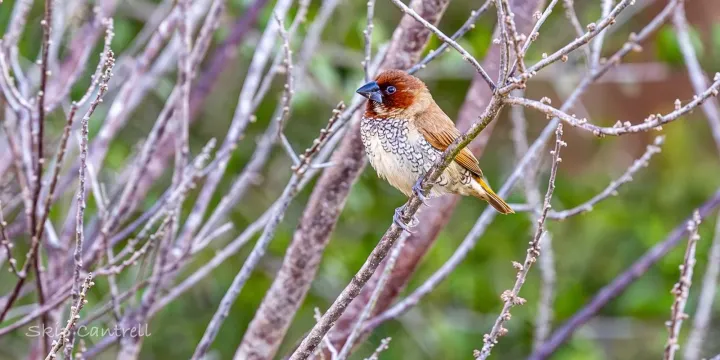
Description
How to identify
Munias, belonging to the genus Lonchura, are small birds of the Estrildidae family, order Passeriformes.
They are characterized by a short, robust, conical beak, specifically evolved for husking and consuming various hard-seeded cereal grains.
These birds often form large, highly coordinated flocks, which significantly increases their impact on agricultural fields during the ripening season.
They typically inhabit open grasslands and wetlands, where the close proximity of water and forage makes them particularly persistent pests.
Their physical agility and social behavior allow them to rapidly exploit food sources and escape from potential threats within the field environment.
What it damages
Rice is the primary target for Lonchura species, which can cause severe losses during the developmental stages of the crop.
Beyond rice, these birds are known to damage millet, sorghum, and other small-seeded crops, frequently destroying the yield during the milk and dough stages.
Damage is characterized by the systematic consumption of maturing grains, which leads to substantial decreases in the overall harvest volume.
Furthermore, the physical weight of large flocks settling on crops causes lodging, which makes mechanized harvesting extremely difficult and causes further loss.
The economic impact can be devastating, especially in regions where multiple crop cycles occur throughout the year, supporting stable bird populations.
When it appears
The activity of Munias is strictly synchronized with the phenological cycles of local agricultural crops.
The most critical window of vulnerability occurs when grains reach the stage of high nutritional value, attracting large numbers of feeding birds.
Bird activity intensifies during the reproductive season, as they require high-energy food sources to sustain their nesting and chick-rearing processes.
Post-harvest periods often see shifts in bird distribution as they seek new forage areas, moving from harvested fields to late-maturing crops.
Daily activity patterns peak during the early morning and late afternoon hours, coinciding with the most intensive feeding bouts of the flocks.
Signs of infestation
Signs of infestation include empty husks remaining on the panicles or ears of grain crops, indicating that the birds have removed the kernel.
Patches of flattened, broken stalks within the crop field are clear indications of where large flocks have gathered for extended feeding.
Increased noise levels near the fields, caused by the vocalizations of large bird groups, serve as a reliable indicator of their presence in the area.
Over time, the damage spreads from focal points, resulting in jagged, uneven sections of the field where the crop has been partially destroyed.
Frequent observations of bird movement between nearby perching sites and the crop field suggest an active threat to the standing yield.
Control measures
Acoustic deterrents, such as propane cannons or ultrasonic devices, are widely used to scare flocks away from vulnerable agricultural fields.
Small-scale protection can be achieved through the use of protective netting or reflective materials designed to disrupt the birds' feeding behavior.
Integrated strategies include synchronizing planting times across regional landscapes to prevent the concentration of birds on specific early-ripening crops.
Biological control, including the encouragement of local raptor populations, can help manage the size of Munia flocks in the surrounding area.
Efficient harvesting techniques that minimize the duration of the crop's exposure in the field are crucial for reducing the risk of bird-related losses.
Taxonomy
- Latin name
- Lonchura
- Family
- Estrildidae
- EPPO code
- LONCSP
Discussion
No discussions yet — be the first.