
Scaly-breasted munia
Lonchura malacca
Description
How to identify
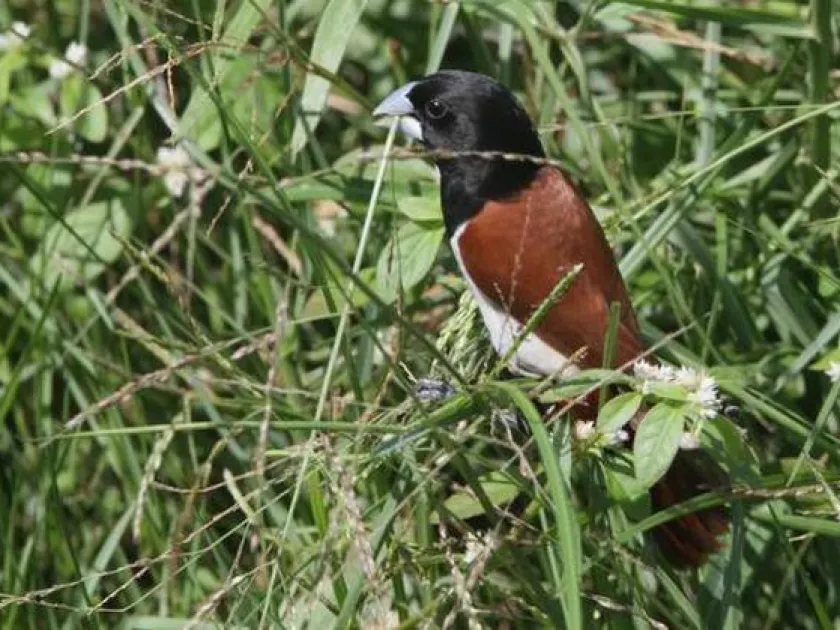
The Scaly-breasted munia (Lonchura malacca) is a small passerine bird from the Estrildidae family. It is easily recognized by its distinctive black head and throat, white underparts, and chestnut-brown back and wings.
Adult birds typically measure 11 to 12 centimeters in length. They possess a stout, cone-shaped, bluish-grey bill specifically adapted for cracking open the husks of small seeds and grains.
These birds are highly gregarious and thrive in large flocks. This social behavior increases their potential impact on agricultural landscapes, as they forage in coordinated groups.
They prefer wetland habitats such as marshes, grasslands, and especially irrigated rice paddies, which provide an ideal environment for feeding and nesting throughout the year.
This species is highly adaptable and can quickly exploit human-modified environments, particularly those where intensive cereal grain cultivation occurs near dense cover.
What it damages
The primary target of the Scaly-breasted munia is the rice crop (Oryza sativa), especially during the milk and dough stages of grain development. Flocks can cause significant yield losses.
Beyond rice, they also target millet, sorghum, and other small-seeded cereals. Feeding involves stripping grains directly from the panicles, leading to substantial reductions in harvest volume.
The physical damage caused by the weight and movement of a large flock on rice stalks can result in lodging and mechanical breakage, further complicating the mechanical harvesting process.
Economic damage is exacerbated by their tendency to feed intensively during peak maturation periods, leaving behind ruined panicles that are susceptible to subsequent fungal infections.
The level of damage is directly linked to the population density of the munia flocks; in areas with high infestation rates, entire sections of a rice field can be decimated.
When it appears
Damage activity peaks during the grain maturation phase of rice crops. Birds congregate on fields as soon as the grains begin to form, extending until the final harvest.
The timing of infestation often coincides with the bird's breeding cycle, as the nutritional demands for raising offspring drive them to seek energy-rich cereal grains.
Daily activity is characterized by morning and late afternoon foraging bouts, during which flocks travel between their roosting sites and the feeding grounds on the fields.
In regions with year-round rice production, the threat remains constant, though it shifts between different plots based on the varying growth stages of the crops.
Migration and movement between fields are often triggered by the onset of dry seasons when wild seed sources become scarce, forcing birds to rely entirely on agricultural produce.
Signs of infestation
The most prominent sign of infestation is the presence of large, noisy flocks flying low over the fields. Their incessant chirping and flapping are audible indicators of their arrival.
Visual inspection of the plants reveals panicles with empty or half-eaten grains. The husks are often left behind on the stems, displaying clear marks from the birds' bills.
Significant accumulations of discarded husks and grain debris beneath the plants or at the edges of the field are strong indicators of prolonged feeding activity.
Patches of flattened or broken stems within the field often mark the areas where large flocks have spent considerable time resting and feeding on the rice heads.
- Discarded grain husks found at the base of plants.
- Visible "gaps" in the panicles where grains were removed.
- Presence of bird droppings on the leaves of the rice crop.
Control measures
Visual deterrents such as reflective tape, flashing mirrors, and scarecrows are commonly used to discourage flocks, though they must be relocated regularly to prevent habituation.
Acoustic deterrents, including broadcasted alarm calls or predator sounds, can be highly effective in dispersing large groups and preventing them from settling in a specific area.
For high-value or seed-producing plots, physical barriers such as netting are the only foolproof method to completely exclude the birds and protect the crop.
Agrotechnical strategies focus on synchronized planting and early harvesting to shorten the duration that the vulnerable grain is exposed to potential avian pests.
Integrated pest management (IPM) involving a rotation of deterrent techniques is recommended to keep the birds from adapting to any single protective measure over time.
Taxonomy
- Latin name
- Lonchura malacca
- Family
- Estrildidae
- EPPO code
- LONCML
Discussion
No discussions yet — be the first.