
Small periwinkle
Littorina neritoides
Description
How to identify
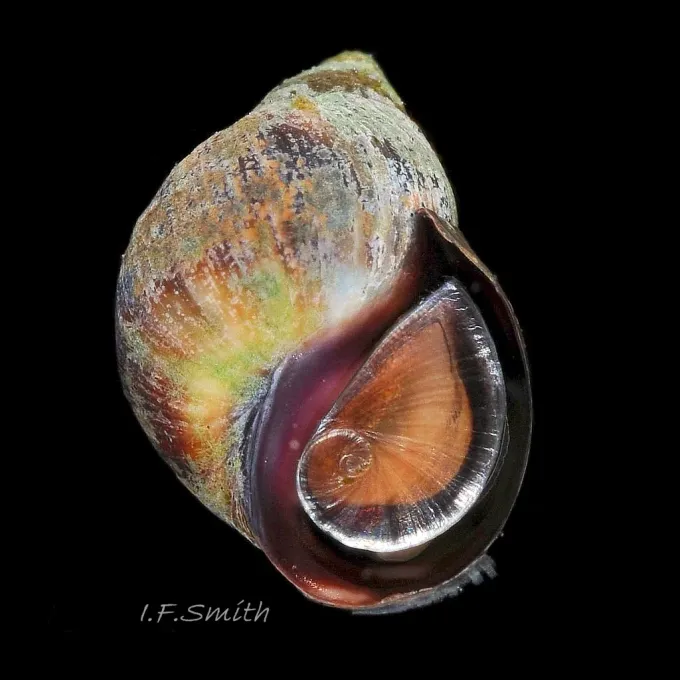
The small periwinkle (Littorina neritoides) belongs to the phylum Mollusca, class Gastropoda, and family Littorinidae. It is a tiny marine gastropod with a conical shell reaching 8–10 mm in height.
The shell color varies from dark gray to brownish-black, with a smooth surface or faint growth lines. The aperture is round and protected by a dense horny operculum, allowing the animal to survive long periods of exposure to air.
Unlike terrestrial pests, this species leads a strictly coastal life. It possesses a unique ability to endure prolonged air exposure, inhabiting the spray zone of rocky shores.
The biology of the species is closely linked to the marine environment. Reproduction occurs in the water column, where females release pelagic eggs that hatch into free-swimming veliger larvae.
After metamorphosis, juveniles move to a sedentary life in the supralittoral zone, where they actively scrape microalgae from rock surfaces using their radula.
What it damages
It is important to note that the small periwinkle is not an agricultural pest. In agronomic practice, this object poses no threat to field, horticultural, or garden crops as it is an obligate marine dweller.
Its diet consists exclusively of organic films (diatoms and lichens) on rocks. Attempts to introduce this mollusk into soil conditions will lead to its rapid death due to the lack of salt water.
Damage can only be indirect if seaweed or substrates collected from the mollusk's habitat are used as fertilizers without proper processing.
The presence of large numbers of shells in marine fertilizers may slightly affect soil acidity but does not cause direct harm to plants as a phytophage.
Thus, for crop production, this species is biologically neutral and does not require the development of chemical or biological protection strategies.
When it appears
The activity of adult Littorina neritoides is observed year-round, although the peak of reproduction depends on water temperature within its range.
Mollusks are most active during periods of high humidity and tides when they can move across the substrate to feed. During dry periods, they enter a state of dormancy by attaching firmly to rocks.
The seasonality of larval development is tied to spring and autumn water temperature increases, typical for the Atlantic and Mediterranean coasts.
In the natural habitat, populations can reach high density, covering rocks like a carpet, which serves as an indicator of coastal water quality.
For an agronomist, it is essential to understand that the phenology of this species does not overlap with the development stages of crops, so no monitoring is required.
Signs of infestation
The sign of a periwinkle population is a characteristic cluster of tiny dark shells on coastal cliffs, breakwaters, and piers located above the sea level.
If they enter soil via marine fertilizers, empty shells might be visually identified, which eventually break down due to soil acids.
Live individuals lose turgor rapidly outside salt water and die, making their detection in fields virtually impossible.
When using substrates from marine environments, no characteristic signs of plant tissue consumption are observed.
The main sign of "contamination" may only be the presence of lime shell residues in organic mixtures, which has no pathological significance for crops.
Control measures
No special plant protection measures are required against this object, as the small periwinkle is not a parasite or a pest of agricultural crops.
When using marine organics (seaweed) as fertilizer, it is recommended to wash the material with fresh water to remove excess salt and incidental marine organisms.
Composting organic fertilizers completely eliminates the risk of marine mollusk survival in soil environments.
Mechanical removal of shells from fertilizer mixtures is performed solely for aesthetic or agrotechnical considerations to prevent changes in soil composition.
- Adherence to organic preparation rules.
- Rinsing substrates with fresh water.
- No need for pesticide application.
Taxonomy
- Latin name
- Littorina neritoides
- Order
- Molluscs
- Family
- Littorinidae
- EPPO code
- LITTNE
Discussion
No discussions yet — be the first.