
Daubenton's bat
Leuconoe daubentonii
Description
How to identify
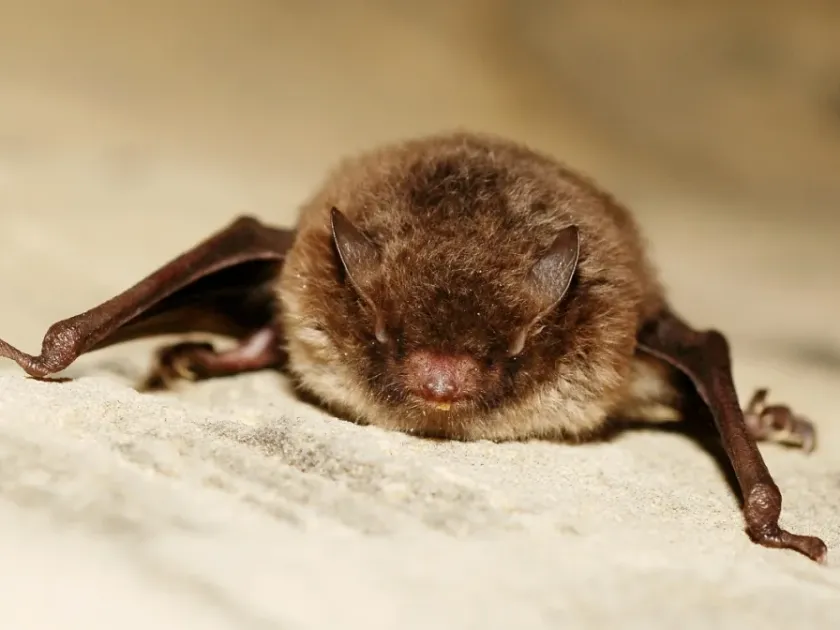
Daubenton's bat (Leuconoe daubentonii) is a species of vesper bat widely distributed across Eurasia. It is a small mammal characterized by its dense, grey-brown fur and a wingspan of approximately 25 centimeters.
The defining feature of this species is its relatively large feet, which are specifically adapted for hunting insects just above the surface of ponds and streams. These bats are nocturnal and rely on echolocation to navigate and capture prey in the dark.
During the day, Daubenton's bats roost in tree hollows, cracks in rocks, or occasionally in human-made structures such as bridges or dark attic spaces. They are social animals that often form colonies to regulate body temperature and social behavior.
It is critical to note that this species is not an agricultural pest. In fact, it provides significant ecological services by consuming large numbers of insects, many of which can be detrimental to crops or livestock.
Therefore, any attempt to classify Daubenton's bat as a threat to plant health is factually incorrect, as they strictly inhabit the trophic level of insectivorous predators.
What it damages
Daubenton's bat causes zero damage to agricultural crops. They possess no morphological traits that would allow them to feed on plant tissues, seeds, fruits, or roots, as their diet is exclusively composed of insects.
By hunting insects near irrigation canals and fields, these bats act as natural biological agents that help manage populations of mosquitoes, gnats, and other dipteran species. This helps maintain a balance within the farm's local ecosystem.
There are no recorded instances of these animals causing physical harm to vegetation. Farmers who encourage the presence of these bats benefit from reduced insect pressure without the use of chemical sprays.
Labeling this species as a pest is a misunderstanding of their role in the food web. Their activity is purely predatory toward insects and harmless toward vegetation.
In essence, the economic impact of Daubenton's bat on agriculture is positive, contributing to natural pest suppression and ecological sustainability.
When it appears
The activity cycle of Daubenton's bat begins in early spring, as temperatures rise and insect life becomes abundant. They are most active from late spring through late summer.
As autumn approaches and temperatures drop, these bats begin accumulating fat reserves to prepare for hibernation. Their metabolism slows down significantly during this transitional period.
They spend the winter months in a state of torpor within stable, cool environments such as caves, mines, or deep cellars where the temperature remains consistent and frost-free.
The seasonal success of these colonies is directly linked to the availability of insect prey. A warm, productive summer season generally correlates with higher survival and reproduction rates.
Farmers are most likely to observe them during the peak summer months, especially during calm, warm evenings when they forage over open water surfaces near crop fields.
Signs of infestation
Since Daubenton's bat is not a crop pest, there are no "signs of infestation" or damage markers to look for on plants. Their presence is detected solely through direct observation of their hunting habits.
Observers might notice them flying in low, rapid patterns just a few centimeters above the water surface of ponds or irrigation channels at dusk. Their ability to "trawl" for insects is their hallmark behavior.
The absence of crop damage symptoms, such as chewed leaves or stems, confirms that these mammals are not targeting agricultural products. Their roosting sites may contain guano, but this is an ecological indicator rather than a crop issue.
Their presence is a positive biological indicator of good water quality and high biodiversity in the surrounding area, which generally benefits the broader health of the agricultural landscape.
No scouting protocols for this species are needed, as they do not threaten the yield or the health of any cultivated plant species.
Control measures
There is no control method for Daubenton's bat because they are protected species in many jurisdictions and provide essential ecosystem services. Any lethal control is ecologically damaging and often illegal.
Agricultural management should focus on preserving the natural habitat, such as maintaining riparian vegetation and water quality. Protecting trees with natural cavities is a great way to encourage these beneficial mammals.
Farmers should minimize the use of broad-spectrum insecticides, especially in the evening, to avoid poisoning the insects that these bats rely on for food, which in turn keeps the bat population healthy.
Integrated Pest Management (IPM) strategies often acknowledge the role of natural predators. Including bats in the farm's conservation plan can enhance long-term sustainability.
- Maintain water bodies and surrounding vegetation near fields.
- Avoid broad-spectrum pesticide spraying near bat hunting grounds.
- Educate farm staff on the ecological value of local bat species.
Taxonomy
- Latin name
- Leuconoe daubentonii
- Family
- Vespertilionidae
- EPPO code
- LEOEDA
Discussion
No discussions yet — be the first.