
Silver-haired bat
Lasionycteris
Description
How to identify
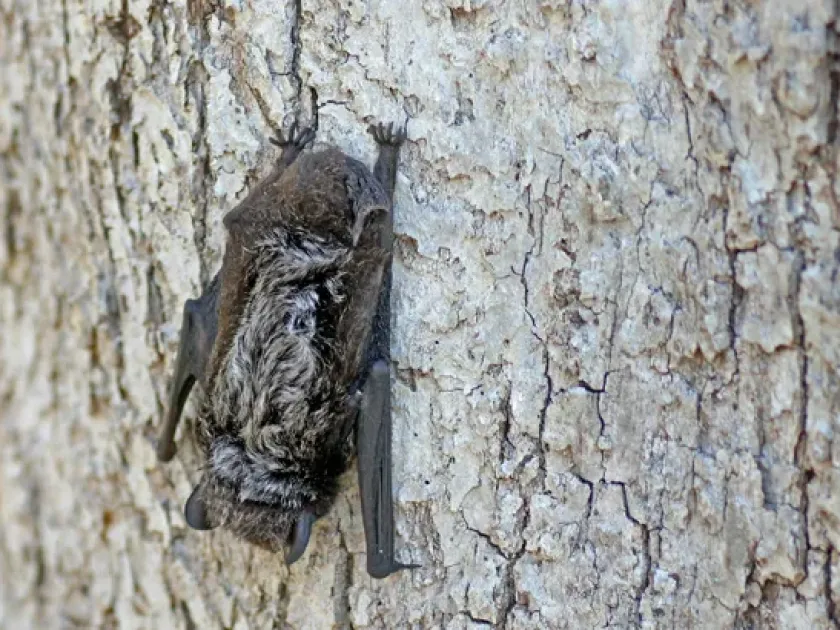
The silver-haired bat (Lasionycteris noctivagans) is a medium-sized bat species belonging to the Vespertilionidae family. Its most distinctive feature is its black or dark brown fur, tipped with silver, giving it a frosty appearance.
An adult typically weighs between 8 and 12 grams, with a wingspan of about 27 to 31 centimeters. They have relatively short, rounded ears compared to other bat species.
They are primarily forest-dwellers, often found in old-growth forests where they utilize tree cavities, loose bark, and sometimes abandoned nests for their daytime roosting.
Silver-haired bats are known for being solitary or found in very small groups, unlike many colonial bat species that congregate in large caves or buildings.
This species is widely distributed across North America, showcasing a high degree of adaptation to various woodland environments and seasonal changes.
What it damages
It is important to clarify that the silver-haired bat is not a crop pest. It does not feed on vegetation, fruits, roots, or any part of agricultural plants.
Instead, they are prolific insectivores, consuming a large number of nocturnal insects every night, including many beetles, moths, and mosquitoes.
By preying on various agricultural and forestry pests, these bats serve as essential natural predators that help manage insect populations in farming landscapes.
There is no mechanism for these animals to cause physical harm to plant tissues, as they lack the biology to feed on botanical matter.
The misconception that they are pests often stems from a general fear of bats or the occasional nuisance of finding their roosts in man-made structures.
When it appears
The activity cycle of the silver-haired bat is closely tied to the seasonal availability of their insect prey and local weather conditions.
During the spring and summer months, they are highly active, foraging through the night to meet their high metabolic demands during the reproductive season.
As temperatures begin to drop in the autumn, these bats undertake significant migrations to warmer latitudes to ensure their survival through the winter.
Winter is characterized by a period of torpor or hibernation, during which the bats significantly slow their heart rate and metabolism to conserve energy.
Farmers can expect increased bat activity during peak pest season, as the abundance of prey attracts more bats to forage over fields and orchards.
Signs of infestation
Observing their presence usually involves identifying their unique silhouette and flight pattern during dusk as they emerge from woodland roosts.
One may find guano deposits in specific areas; however, bat guano is rich in nitrogen and insect fragments, making it easily distinguishable from herbivore droppings.
The use of ultrasonic acoustic detectors allows researchers and landowners to identify the specific frequency pulses of the silver-haired bat.
They are quiet neighbors, though one might hear soft chattering or scratching noises if they are roosting under shingles or in building crevices.
The absence of any damage to vegetation or leaves is a reliable indicator that these bats are strictly insectivorous and pose no threat to plant life.
Control measures
As silver-haired bats are beneficial insectivores, management efforts should focus on conservation rather than control or eradication.
If they become a nuisance by roosting in undesirable man-made structures, exclusion methods are recommended to prevent them from entering while ensuring they are not trapped.
To discourage roosting, seal entry points with mesh or netting, which allows airflow but prevents access to the building structure.
Maintaining healthy populations of these bats provides free biological pest control services, which can reduce the reliance on chemical insecticides.
- Install bat houses to attract them away from buildings;
- Avoid the use of broad-spectrum pesticides;
- Preserve large, dead trees in rural areas;
- Seal small cracks in roofs with one-way exit devices;
- Educate your community on the benefits of local bat species.
Taxonomy
- Latin name
- Lasionycteris
- Family
- Vespertilionidae
- EPPO code
- LSNYSP
Discussion
No discussions yet — be the first.