
Sickle-bearing bush-cricket
Leptophyes albovittata
Description
How to identify
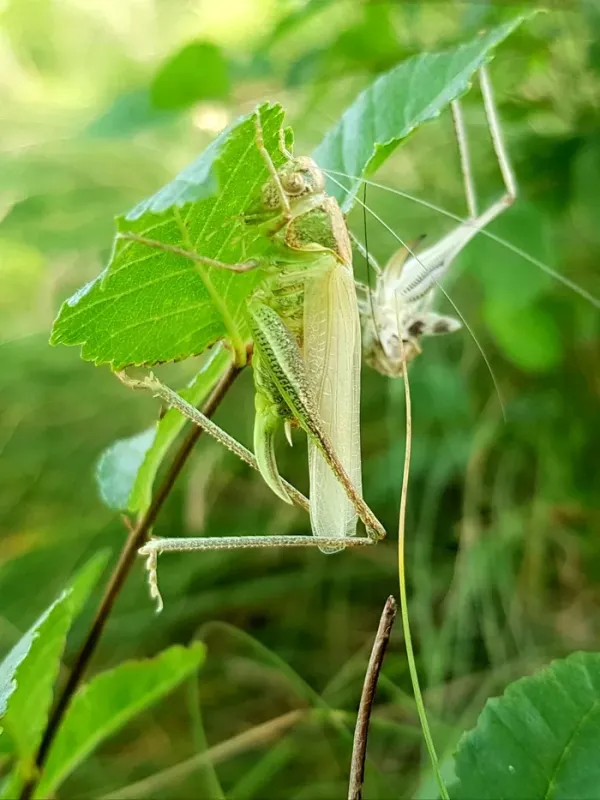
The sickle-bearing bush-cricket (Leptophyes albovittata) is a member of the order Orthoptera and the family Tettigoniidae (bush-crickets). Adult individuals are relatively small, typically measuring between 10 and 15 mm, and possess a distinct green coloration with a pale longitudinal stripe along the back.
Both males and females of this species exhibit vestigial, very short wing covers (tegmina), which renders them completely flightless. Females are easily distinguished by their prominent, sickle-shaped ovipositor, which gives them a unique appearance.
Nymphs resemble smaller versions of the adults but lack developed reproductive organs and wings. They lead a secretive lifestyle, hiding predominantly within dense herbaceous vegetation or shrub canopies to avoid predation.
These insects are primarily active during the day, yet they remain very elusive and quickly seek cover when disturbed. Their coloration serves as excellent camouflage, allowing them to blend seamlessly with the green foliage of their host plants.
This species prefers warm, sun-exposed habitats, forest edges, and meadows, from which it frequently migrates into cultivated areas. Agricultural ecosystems often provide the ideal conditions for its population growth and feeding.
What it damages
The sickle-bearing bush-cricket is a polyphagous insect, meaning it feeds on a wide range of plant species. In horticultural and gardening settings, it causes damage to both ornamental plants and fruit-bearing crops.
Commonly affected plants include grapevines, various types of raspberries, blackberries, and ornamental shrubs such as roses and lilacs. The foliage of these crops often serves as the primary food source for the insect.
Damage is mainly inflicted on the leaves, where the insects chew holes of various shapes and sizes, often consuming the leaf blade from the edges inward. In cases of high population density, this leads to significant plant stress and weakened growth.
In addition to leaves, these bush-crickets may occasionally damage tender young shoots and even developing fruit, which negatively impacts overall yield and the commercial appearance of the produce. Damage occurring during early growth stages is the most critical.
The primary threat arises during years of favorable climatic conditions, which can lead to mass reproduction. During such periods, the damage can become intense and localized, requiring immediate monitoring and intervention.
When it appears
The life cycle of this pest involves a single generation per year. The insect typically overwinters in the egg stage, with eggs deposited by females into plant tissues or bark crevices.
Nymphs emerge in the spring, usually during May or early June. During this phase, they begin feeding actively on young, succulent vegetation, undergoing several molts before reaching sexual maturity.
Adult activity peaks in the second half of the summer, specifically July and August. It is during this timeframe that the most intensive damage to the leaf apparatus of crops is observed.
By autumn, the number of adult individuals gradually declines as they enter the mating and egg-laying period before naturally dying off. Ambient temperature plays a significant role in the speed of development for each life stage.
Optimal conditions for survival include a moderately warm and humid summer. Prolonged rainfall may reduce nymph survival rates, while extreme heat might slow down their activity, though it is usually insufficient to eradicate the entire population.
Signs of infestation
The first indicator of the pest's presence is the characteristic "holey" damage on leaf blades. Unlike caterpillars, bush-crickets often leave rougher, more jagged edges around the bite marks.
During a visual inspection of plants in daylight, one can often find the insects themselves resting on the underside of leaves or along leaf stems. Due to their green color, they can be difficult to spot without careful scrutiny.
The presence of excrement, appearing as tiny dark granules on leaf surfaces below feeding sites, also serves as an indirect sign of bush-cricket activity within the garden.
If a massive presence of the insect occurs, the distinctive stridulation (chirping) of the males can be heard, which becomes more intense during sunny hours. This is a clear signal that population monitoring should be initiated.
The wilting or distortion of young shoot tips, which have been heavily chewed, is often a sign of an advanced infestation that requires immediate control measures.
Control measures
The primary approach is through agrotechnical management: maintaining cleanliness in the garden, and regularly mowing weed vegetation around the perimeter, where bush-crickets often find shelter and breeding grounds.
Manual collection of the pests is effective only on small scales and during early stages of infestation. This helps to reduce pressure on plants without the need for synthetic chemical applications.
Biological control methods include the use of entomopathogenic products based on fungi or bacteria, which target the nymphs while remaining safe for humans, pets, and beneficial insects.
If the damage threshold is exceeded, broad-spectrum insecticides approved for use on fruit and berry crops may be applied. It is crucial to conduct such treatments strictly before the fruit ripening period to avoid residue issues.
Encouraging natural predators, such as insectivorous birds, hedgehogs, and beneficial insects, helps keep the population of the sickle-bearing bush-cricket at a controlled level in the long term, reducing the reliance on chemical pesticides.
Taxonomy
- Latin name
- Leptophyes albovittata
- Order
- Orthoptera (locusts)
- Family
- Phaneropteridae
- EPPO code
- LPTPAL
Discussion
No discussions yet — be the first.