
Rice ear bug
Leptocorisa oratorius
Description
How to identify
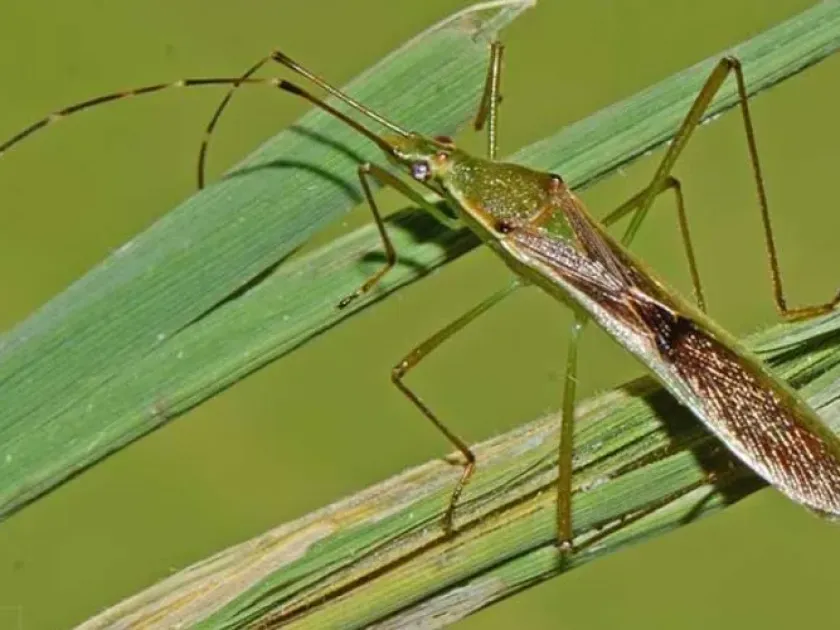
The Rice ear bug (Leptocorisa oratorius) belongs to the family Alydidae within the order Hemiptera. These insects are characterized by their elongated, slender bodies, typically reaching 14 to 17 mm in length, and varying in color from light green to brownish-yellow.
They are easily recognizable by their unusually long legs and thin antennae, which help them remain agile while moving through the dense rice canopy. Their head is elongated, and they possess a specialized piercing-sucking mouthpart.
The life cycle involves an egg stage, five nymphal instars, and the adult phase. Females deposit eggs in rows, usually on the leaves of host plants, securing them with a strong adhesive substance.
Development from egg to adult takes approximately three to five weeks, depending on ambient temperature and humidity levels. Warm and humid conditions are ideal for rapid population growth.
Adults are strong fliers and are highly mobile. They often move between fields when conditions become unfavorable or when the crop reaches full maturity, making localized control sometimes difficult.
What it damages
Rice is the primary host crop for Leptocorisa oratorius. However, they also feed on various wild grasses, millet, sorghum, and occasionally maize, utilizing them as alternative food sources.
Both nymphs and adults cause damage by piercing the glumes of developing rice grains during the milky stage. They inject digestive enzymes that break down the grain content, rendering it useless for the plant.
The resulting damage includes shriveled, empty, or discolored grains. This significant loss in grain weight and quality directly affects marketability and nutritional value.
Feeding punctures also serve as entry points for pathogens, including bacteria and fungi, which can lead to further decay of the panicle and secondary infections that worsen the yield loss.
The most critical window for damage is the flowering and grain-filling stage. Even a low population density can cause severe yield reductions during this sensitive period.
When it appears
The activity of the rice ear bug is closely linked to the phenology of the rice plant. They typically appear in fields as soon as the rice plants begin the heading process.
In tropical climates, breeding can occur throughout the year. In regions with distinct dry and wet seasons, they often survive the adverse season in a state of diapause, hiding in vegetation or soil debris.
The pest population typically peaks in the middle to late reproductive stages of the crop. High moisture levels often correlate with increased egg-laying and nymphal survival.
As the rice grains mature and harden, the bug population naturally declines because the grains become difficult to pierce. At this point, the insects migrate to wild grasses or other late-season hosts.
Effective management requires tracking the timing of grain development, as this helps in predicting the arrival of the pest and initiating control measures at the right time.
Signs of infestation
The presence of the bug is often signaled by the appearance of empty or partially filled grains on the panicle, which remain pale and light after harvest.
A distinctive, unpleasant, and pungent odor is often noticeable in infested fields, caused by the defensive glands of the bugs, especially when they are disturbed.
Visual observation requires careful checking of the rice stems and panicles during early morning or late afternoon, as the bugs tend to hide or fly away when disturbed during peak sunlight.
Leaves may show signs of yellowing or spotting, which is a symptom of the bug feeding on the stem juices before the grains are fully developed.
- Presence of discolored or empty grains.
- Characteristic unpleasant, metallic, or pungent odor.
- Visible adults on the stems or panicles.
- Reduced yield quality and lower grain weight.
Control measures
Cultural control is essential. This includes keeping the field bunds and surrounding areas clean by removing weeds, which act as alternate hosts and refuges for the bugs during the off-season.
Preserving natural enemies is highly effective. Spiders, predatory bugs, and specific egg-parasitizing wasps can significantly suppress the bug population if the ecosystem is not disrupted by overuse of pesticides.
Chemical control should be implemented only when the pest density exceeds the economic threshold. Insecticides should be applied during the early stages of grain filling to prevent damage.
Application techniques should ensure thorough coverage of the panicles, where the pests reside. Rotating active ingredients is crucial to manage and prevent resistance buildup in the insect population.
Monitoring using sweep nets is a standard practice to accurately estimate the population density and determine whether control measures are necessary to protect the yield.
Taxonomy
- Latin name
- Leptocorisa oratorius
- Order
- Hemiptera (bugs, aphids, leafhoppers)
- Family
- Alydidae
- EPPO code
- LEPROR
Discussion
No discussions yet — be the first.