
Leptocera fontinalis
Leptocera fontinalis
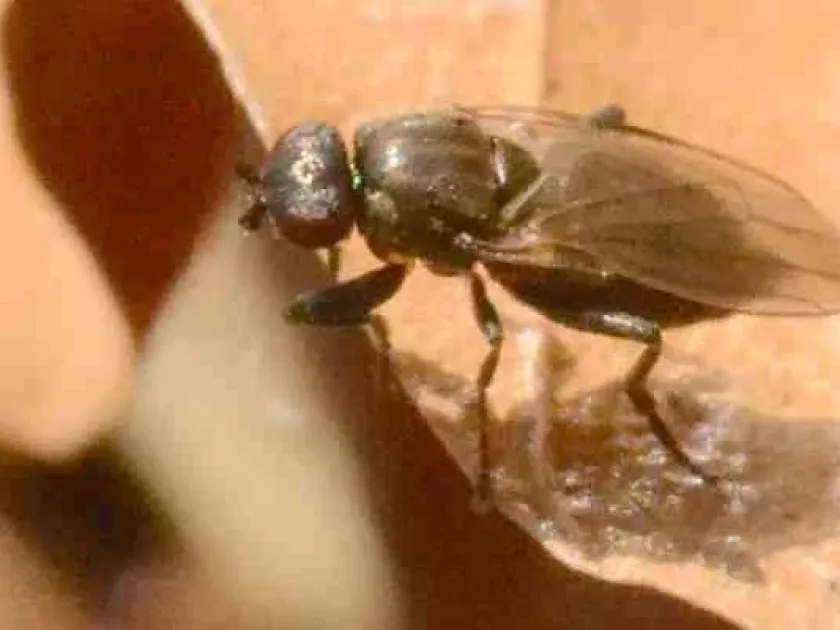
Description
How to identify
Leptocera fontinalis belongs to the Sphaeroceridae family (lesser dung flies) within the order Diptera. These are minute insects, typically measuring 2–3 mm in length, characterized by a dark, brownish-black body.
The adults possess a distinct wing structure with reduced venation, which is a key identification feature for this family. The head is mobile, and the antennae are short with a characteristic plumose arista.
The larvae appear as small, pale, maggot-like creatures lacking a clearly defined head. They lead a cryptic life, predominantly developing in moist, organic-rich substrates.
As typical saprophages, their presence is strongly correlated with decaying plant matter and areas where moisture levels remain consistently high.
Reliable identification usually requires microscopic examination of the male genitalia, as external morphological differences between related species are very subtle.
What it damages
Damage caused by Leptocera fontinalis is most significant in greenhouse environments and vegetable storage facilities where high humidity and decaying organic waste occur.
These flies are often found in crops like tomatoes, cucumbers, and lettuce, especially when poor agricultural practices lead to waterlogged soil or substrate.
While not a primary parasite of healthy plant tissues, the larvae can damage weakened plants by burrowing into stem micro-cracks or the root system.
The greatest threat is the transmission of various phytopathogens, including fungi and bacteria, which the flies carry on their bodies as they move between plants.
In storage conditions, adult flies may lay eggs on vegetable surfaces, accelerating decay processes and significantly reducing the market value of the harvested crop.
When it appears
The fly's activity is closely tied to moisture levels and ambient temperature, allowing for year-round reproduction in protected environments like greenhouses.
Adult activity peaks during the spring and summer months, facilitating rapid dispersion and infestation of new crops and areas.
In field conditions, populations tend to surge following periods of prolonged rainfall, as wet soil provides the necessary environment for larval development.
The life cycle is rapid under optimal temperature conditions, enabling several generations to emerge within a relatively short timeframe.
Indoor infestations are often noticed in autumn when crops are moved into storage, especially if ventilation is inadequate and rot spots develop.
Signs of infestation
The primary indication of an infestation is the presence of numerous small black flies hovering above the soil surface or around vegetable crates.
Visible signs on the plants include localized rot at the base of the stem, which can eventually spread and compromise the structural integrity of the plant.
When inspecting the substrate, small larvae can be observed moving through decaying organic material, confirming the source of the infestation.
Plants may show general signs of stress, such as yellowing of lower leaves and stunted growth, indicating damage to the root system by the larvae.
- Necrotic rot patches on fruits that come into contact with wet soil.
- Presence of insect excrement on leaf surfaces and fruit skins.
- A characteristic musty or rotting odor in the greenhouse or storage area.
Control measures
The foundation of effective control is strict sanitation and the prompt removal of all plant residues that provide breeding grounds for the pests.
It is essential to manage irrigation systems correctly to avoid waterlogging and prevent the accumulation of stagnant moisture in pots or along rows.
Using yellow sticky traps is an effective way to monitor adult populations and detect early signs of an infestation before it becomes uncontrollable.
Biological control agents, such as entomopathogenic nematodes or fungi, can be applied to the soil to suppress larval populations safely and sustainably.
In cases of severe outbreaks, targeted applications of approved insecticides for Diptera may be required, provided that safety guidelines and pre-harvest intervals are followed.
Taxonomy
- Latin name
- Leptocera fontinalis
- Order
- Diptera (flies)
- Family
- Sphaeroceridae
- EPPO code
- LPTCFO
Discussion
No discussions yet — be the first.