
Coproica ferruginata
Coproica ferruginata
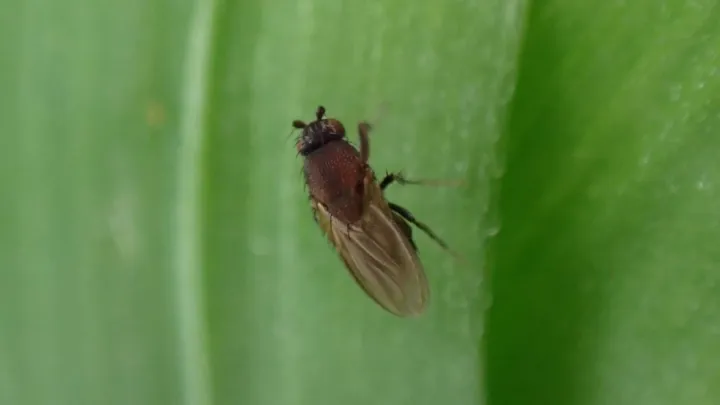
Description
How to identify
Coproica ferruginata is a small dipteran insect belonging to the family Sphaeroceridae, commonly known as lesser dung flies. Adult flies are typically 1.5 to 2 mm in length with a distinct rusty-brown coloration.
These flies have clear wings with a characteristic venation pattern typical for the Sphaeroceridae family. Their heads are rounded with dark eyes, facilitating navigation in low-light indoor environments.
Larvae are small, white, and legless, appearing very similar to those of other fungus-feeding flies. They possess a high degree of mobility, allowing them to navigate efficiently through damp organic substrates.
Due to their microscopic size, identifying the species often requires professional morphological analysis of male genitalia to distinguish them from sciarids or phorids.
The insects are highly adapted to breeding in decaying organic matter, making them common inhabitants of mushroom growing facilities and compost piles.
What it damages
The primary economic impact of Coproica ferruginata occurs in commercial mushroom production. Larvae feed directly on the mycelium and the fruit bodies of mushrooms like Agaricus and Pleurotus.
By tunneling into the mushroom caps and stalks, the larvae destroy the structure of the fungi, leading to rot and rendering the produce unsaleable.
Adult flies act as vectors for various diseases, transporting fungal spores and pathogenic bacteria across the growing facility, which causes widespread infection.
A heavy infestation in the substrate depletes nutrients and compromises the substrate integrity, significantly reducing the total yield per growing cycle.
The presence of larvae encourages secondary infestations by other pests and mold growth, creating a negative feedback loop that is difficult to stop without intervention.
When it appears
In the controlled environment of a mushroom farm, Coproica ferruginata can reproduce year-round. They thrive in temperatures between 20°C and 25°C, provided humidity levels are high.
Their life cycle is relatively short, allowing for multiple overlapping generations in a single month, which leads to sudden and massive population spikes.
The flies are most active during periods of high moisture, which is necessary for their larval development in the substrate.
In outdoor environments, their activity fluctuates with seasonal changes, but indoor production facilities provide a stable refuge regardless of external weather conditions.
The migration between rooms is facilitated by human activity and airflow, allowing the pest to colonize a facility quickly if sanitation is neglected.
Signs of infestation
The most noticeable sign of an infestation is the presence of adult flies hovering around mushroom beds, especially during the harvesting process.
Visual inspection of the mushrooms may reveal small boreholes or tunneling in the stalk tissue, often accompanied by soft, decaying areas.
An unpleasant, musty, or sour odor emanating from the mushroom substrate usually indicates active decomposition caused by a high density of larvae.
On the surface of the substrate, one might see slimy spots or clusters of larvae migrating, especially if the substrate becomes oversaturated with water.
A decrease in mushroom growth or the appearance of necrotic patches in the mycelium growth is a strong indicator of underground pest activity.
Control measures
Hygiene is the cornerstone of management. Strict sterilization of the substrate through proper pasteurization is essential to eliminate eggs and larvae before spawning.
Installing fine-mesh screens on ventilation units and entryways is a simple yet effective method to prevent adult flies from entering the growing rooms.
Regular monitoring using sticky yellow traps is crucial for detecting population growth early, allowing for timely intervention before an outbreak occurs.
Biological control agents, particularly entomopathogenic nematodes applied to the substrate, provide an effective and safe way to suppress larval populations.
- Maintain a dry, clean environment between production cycles.
- Promptly remove and dispose of all debris or damaged mushrooms.
- Restrict traffic and disinfect tools between different growth chambers.
Taxonomy
- Latin name
- Coproica ferruginata
- Order
- Diptera (flies)
- Family
- Sphaeroceridae
- EPPO code
- COPAFE
Discussion
No discussions yet — be the first.