
Wood White
Leptidea sinapis
Description
How to identify
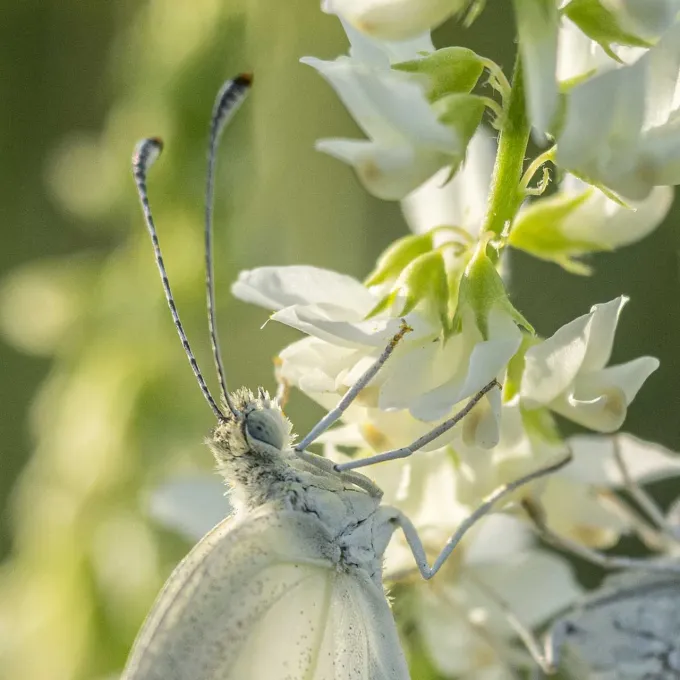
The Wood White (Leptidea sinapis) is a small butterfly belonging to the Pieridae family. Adults have a wingspan of 35-45 mm, characterized by white wings with dark, rounded tips, giving them a delicate appearance.
The body of the butterfly is slender and slightly hairy. Their flight pattern is typically slow and fluttering, which makes them easy to distinguish from more energetic butterfly species.
Larvae are vibrant green with light lateral stripes, providing them with excellent camouflage against the stems and leaves of their host plants. Mature larvae grow up to 30 mm in length.
The pupa of the species is spindle-shaped and emerald green, making it extremely difficult to detect on plants. It overwinters attached to stems or dried vegetation near the soil surface.
Wood Whites are commonly found in woodland edges, meadows, and adjacent agricultural fields where leguminous plants are abundant.
What it damages
The primary damage is caused by larvae, which feed on the foliage of host plants. They chew irregular holes in the leaves, significantly reducing the surface area available for photosynthesis.
The list of damaged crops includes various legumes such as vetches, peas, and other wild or cultivated pulses depending on their proximity to the butterfly's breeding grounds.
Severe defoliation can weaken plants, resulting in stunted growth and a noticeable reduction in pod production. Plants weakened by larvae are also more susceptible to secondary diseases.
While often considered a secondary pest rather than a primary economic threat, in years of high population density, they can cause measurable losses in small-scale vegetable gardens.
The feeding habits of the larvae can interfere with the nutrient uptake of the plants, ultimately affecting the quality and quantity of the harvested seeds.
When it appears
The species usually completes two generations per year. The first brood of adults emerges in spring, typically from April through May, coinciding with the early growth stage of legumes.
A second generation of adults appears in mid-summer, specifically in July and August. Larvae from this second brood are often the most damaging to developing legume crops.
Egg development takes approximately 7 to 10 days, depending on environmental temperature. Optimal larval development occurs at temperatures ranging between 20°C and 25°C.
Adult butterflies have a lifespan of several weeks, during which females deposit eggs singly on the underside of host plant leaves, spreading them across the field.
The species overwinters as a pupa. These pupae are remarkably hardy, capable of surviving harsh winter temperatures, which ensures the continuity of the population season after season.
Signs of infestation
The first signs of infestation are ragged leaf edges and holes in the foliage. Larvae often reside along the central vein, where their green coloration provides optimal blending with the leaf structure.
The presence of larval frass (droppings) on the leaves or in the axils of the plant is a clear indication that caterpillars are feeding nearby.
Increased activity of light-colored butterflies flying over legume fields on sunny days is a strong warning that eggs are being laid and larvae will soon appear.
Careful inspection of the undersides of leaves reveals small, yellowish, cone-shaped eggs. These are usually laid individually, making them subtle but detectable.
As the larvae mature, they become larger but retain their green color, requiring a thorough visual inspection of the plant canopy to identify and assess the level of infestation.
Control measures
Cultural control methods involve autumn plowing, which helps destroy the pupae overwintering in crop residues and surrounding weeds.
Effective weed management, especially targeting wild legumes, reduces the availability of secondary food sources and discourages the butterflies from congregating near crops.
Biological control can be implemented by encouraging natural predators, such as parasitic wasps (Trichogrammatidae), which effectively target the eggs of the butterflies.
If population levels exceed economic thresholds, the use of targeted insecticides is advised. Always ensure the chosen products are approved for use on the specific legume crop.
- Utilize crop rotation to interrupt the butterfly's reproductive cycle.
- Monitor field margins where larvae often survive before moving to crops.
- Install physical barriers like fine mesh covers for small-scale garden legumes.
Taxonomy
- Latin name
- Leptidea sinapis
- Order
- Lepidoptera (butterflies)
- Family
- Pieridae
- EPPO code
- LPTDSI
Discussion
No discussions yet — be the first.