
Wood white
Leptidea
Description
How to identify
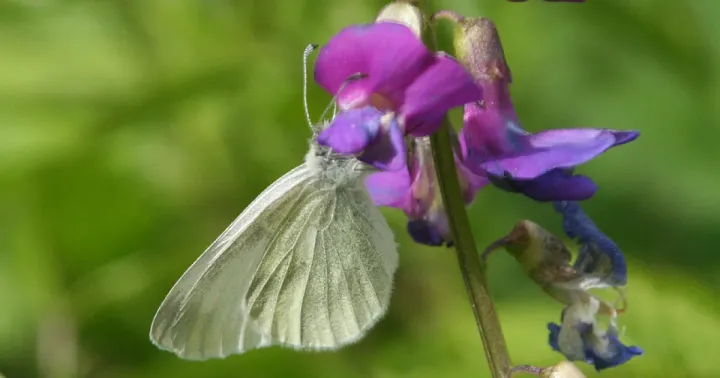
The Wood white butterfly (scientific name: Leptidea sinapis) belongs to the Pieridae family. It is a delicate, small butterfly with a wingspan typically ranging from 30 to 45 mm, known for its slow, fluttering flight pattern.
The wings are predominantly white or creamy in color, characterized by rounded tips. Male specimens often exhibit darker grey or black patches at the tips of the forewings, which serves as a key visual distinction from females.
The body is covered with fine, dense hairs, a common trait among this butterfly family. Because of its distinct slow flight, it is relatively easy to identify when observing it over fields or meadow borders.
The larvae, or caterpillars, are cylindrical and display a vibrant green coloration. This camouflage allows them to blend in perfectly with the foliage of their host plants, making them difficult to spot.
The pupae are spindle-shaped and exhibit a green hue with subtle reddish lines, effectively mimicking stems and ensuring survival during the dormant phase on plant structures.
What it damages
The larvae are the primary cause of agricultural damage, feeding extensively on the foliage of leguminous plants including peas, vetches, and various wild legumes. They consume the leaf tissue, starting from the edges.
By grazing on the leaf margins, the caterpillars significantly reduce the plant's photosynthetic capacity. In severe infestations, large portions of the leaves are consumed, leaving only the primary veins.
This reduction in leaf area directly leads to stunted plant growth and decreased vigor. Consequently, the plants become more susceptible to secondary environmental stresses and diseases.
In large-scale farming, the cumulative damage caused by Wood white caterpillars can lead to a notable drop in grain and forage yield, negatively impacting the total output of the crop.
Furthermore, the physical wounds created on the plants provide easy access for various fungal and bacterial pathogens, which can exacerbate the overall damage to the crop field.
When it appears
The Wood white typically undergoes two generations per year, which extends its period of potential threat to agricultural crops from late spring through late summer.
The first generation of adult butterflies emerges in May, marking the beginning of the oviposition period where eggs are laid on the undersides of host plant leaves.
A second generation of adults becomes active during mid-to-late summer, ensuring that the pest population persists and reproduces throughout the peak growing season of the legumes.
The species survives the winter in the pupal stage, attaching itself to stalks or crop residues. This allows the insect to safely endure harsh cold temperatures until the cycle restarts.
Development speed and population density are highly sensitive to temperature and local humidity levels, making certain seasons more favorable for significant outbreaks.
Signs of infestation
The most prominent sign of infestation is the appearance of irregular, ragged notches along the leaf margins, which are caused by the feeding behavior of the caterpillars.
On close inspection of the field, tiny, elongated, yellowish eggs can be found on the undersides of leaves, usually laid individually by the female butterflies.
The caterpillars themselves are often hidden due to their green color, but can be located during early morning hours when they are most active on the leaf surfaces.
The presence of frass (larval droppings) on the leaves or the soil surface beneath the plants serves as a clear indication of active pest infestation and development.
In addition, observing adult butterflies hovering around legume fields during the flight periods is a strong indicator that the crop may be at risk of caterpillar colonization.
Control measures
Integrated pest management strategies are essential, starting with cultural practices like the removal of wild legume weeds from field perimeters to eliminate secondary food sources.
Crop rotation remains a fundamental practice to break the pest life cycle, preventing the build-up of pupae in the soil from one season to the next.
If economic thresholds are exceeded, the application of targeted, low-toxicity insecticides is recommended to manage caterpillar populations while protecting beneficial insects.
Biological control methods, including the use of entomopathogenic bacteria or encouraging natural predators and parasitoids, can offer a more sustainable approach to suppression.
- Regular scouting of fields during May and July.
- Deep autumn plowing to destroy pupating sites in the soil.
- Selective use of biological control agents to manage larval stages.
Taxonomy
- Latin name
- Leptidea
- Order
- Lepidoptera (butterflies)
- Family
- Pieridae
- EPPO code
- LPTDSP
Discussion
No discussions yet — be the first.