
Silverfish
Lepisma saccharina
Description
How to identify
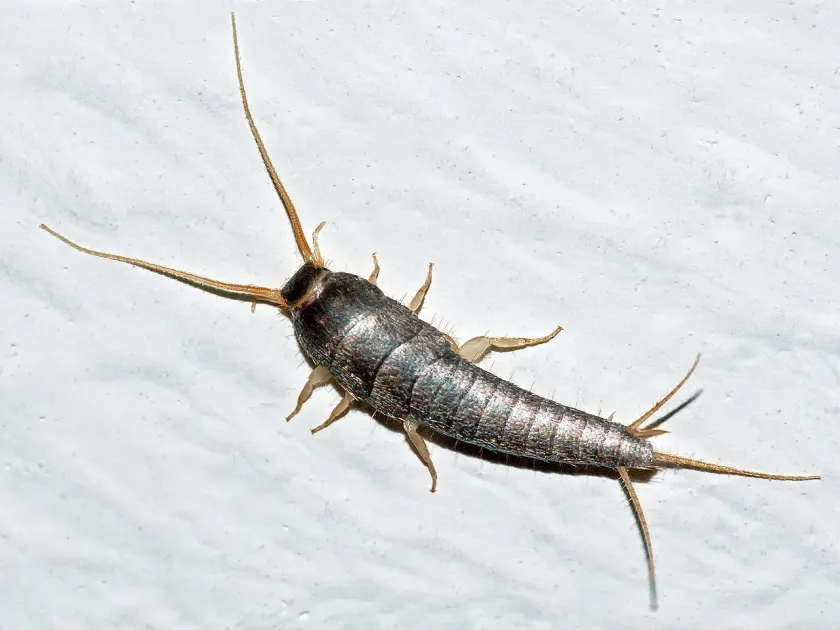
The silverfish (Lepisma saccharina) belongs to the order Zygentoma and the family Lepismatidae. It is a wingless insect, typically 10–12 mm long, covered in metallic, silver-grey scales.
The body is tapered towards the rear, ending in three long caudal filaments. These structures are highly sensitive to air currents, allowing the insect to detect threats quickly.
Silverfish are nocturnal, light-avoiding creatures. They thrive in environments with temperatures between 18°C and 25°C and prefer areas with high relative humidity.
Their lifespan is remarkably long compared to other household pests, often reaching 3 to 5 years, which allows for persistent infestations if conditions are ideal.
The species reproduces by laying small batches of eggs in cracks and crevices, which develop into nymphs that look like miniature adults.
What it damages
While silverfish are not considered a primary agricultural pest in open fields, they are significant pests of stored products and stored seeds in warehouses.
They feed on materials rich in carbohydrates, particularly starch and dextrin. This includes cereals, flour, dried fruits, sugar, and stored plant-based samples.
Beyond food, they frequently damage paper products, cardboard boxes, book bindings, and labels, as the adhesives used in these items are often starch-based.
The primary economic damage is caused by the contamination of products with scales, excrement, and cast-off skins, which renders food items unsuitable for sale or consumption.
High populations can lead to secondary damage by creating moist micro-environments, which facilitate the growth of mold and attract other pests.
Signs of infestation
The most common sign of an infestation is observing irregular, scraped patches or small holes on the surfaces of paper, labels, or cardboard storage containers.
Small, pepper-like black droppings found near baseboards, in cabinets, or around stored goods are a clear indicator of a silverfish population.
The presence of yellowish, translucent cast-off skins (exuviae) in hidden areas provides evidence of recent molting and active population growth.
The physical sighting of the insect darting rapidly towards dark crevices when a light is turned on in a storage area is a definitive sign of an infestation.
Damage marks on book spines or adhesive-bound labels are characteristic, as the insects specifically graze on the glue content of these materials.
Control measures
Moisture control is the most effective preventative measure. Reducing humidity in storage areas via ventilation prevents the insects from thriving.
Stored goods should be kept in airtight containers made of glass or hard plastic to physically prevent the pests from accessing their food sources.
Regular sanitation, particularly vacuuming crevices and dark corners, is essential to remove eggs and nymphs from the facility environment.
Application of food-grade diatomaceous earth in dry crevices or using non-toxic gel baits can significantly reduce infestation levels without chemical contamination.
Sticky traps placed in suspected high-activity areas serve as an excellent monitoring tool to detect early signs of infestation and determine where to focus control efforts.
Taxonomy
- Latin name
- Lepisma saccharina
- Family
- Lepismatidae
- EPPO code
- LEPISA
Discussion
No discussions yet — be the first.