
Lebia viridis
Lebia viridis
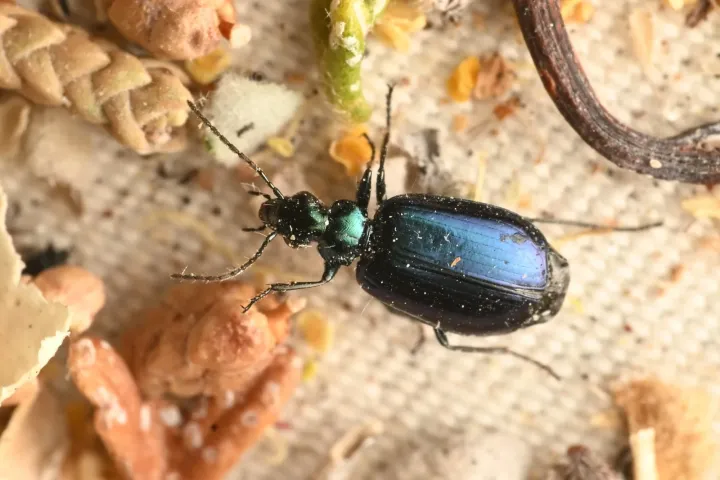
Description
How to identify
Lebia viridis belongs to the Carabidae family, commonly known as ground beetles, within the order Coleoptera. This beetle is characterized by its brilliant green or metallic-green elytra, which allows it to blend perfectly into lush vegetation.
Adult beetles typically range from 6 to 8 millimeters in length. Their bodies have a classic ground beetle structure, with finely striated elytra and legs that are often brownish or dark in color.
The larvae undergo several developmental stages and are well-adapted for movement within the soil substrate or among plant debris, where they seek out their food sources.
While most Carabidae species are strictly predatory, Lebia viridis displays omnivorous tendencies, meaning it can feed on plant tissues, causing damage to crops when alternative prey is scarce.
These insects prefer environments with moderate climates, high humidity, and dense vegetation cover, which provide excellent shelter from predators and excessive heat during the day.
What it damages
This pest primarily affects vegetable crops, including members of the Solanaceae family, as well as various legumes and certain field crops grown in industrial settings.
Adult beetles frequently damage young leaves and tender shoots, chewing small holes or skeletonizing the leaf blades, which impairs the plant's ability to perform photosynthesis efficiently.
The larval stage is particularly hazardous to root systems; larvae often gnaw on the roots of young seedlings, leading to wilting, stunted growth, and in severe cases, the death of the plants.
During dry spells, the beetles become more aggressive in seeking moisture, piercing plant stems to access sap, which creates mechanical injury and weakens the plant's structural integrity.
Heavy infestations can lead to yield losses of up to 15-20%, affecting both the total mass of the harvest and the market quality of the produce due to scarring and secondary infections.
When it appears
Activity of Lebia viridis typically begins in early spring, as soon as the soil warms up and overwintering adults emerge to seek food sources in the budding plant populations.
The peak activity occurs during late May and throughout June, coinciding with the most rapid growth phase of crops. This is also when mating and oviposition take place in the soil.
A second generation may appear in late July, depending on weather conditions, which necessitates continued monitoring throughout the mid-summer season to prevent secondary infestations.
As autumn approaches, the adults enter diapause and move deeper into the soil or under dense plant debris to survive the winter, making them less visible and harder to treat during the fall months.
Environmental factors, such as unusually wet or hot seasons, can influence the timing of their lifecycle, but the general seasonal pattern of emergence remains consistent across most temperate regions.
Signs of infestation
The most prominent sign of infestation is the appearance of numerous small, irregular holes across the leaves of the affected crops, which can often be mistaken for other leaf-chewing insects.
Wilting of terminal shoots and yellowing of the foliage are common indicators that larvae have compromised the plant's root or vascular system, preventing adequate nutrient uptake.
- Observation of metallic-green beetles at the base of plants during early morning or late evening hours.
- Presence of insect excrement on leaf surfaces in areas where feeding has occurred.
- Secondary rot or infection developing at the site of deep bites on stems or roots.
If field checks reveal the presence of these green beetles under the foliage or in the topsoil, it is a clear indicator that the pest population has reached an economic threshold.
Widespread damage leads to visible thinning of crop stands, which can be observed during routine field scouting, signaling the need for immediate management actions.
Control measures
Effective control starts with strict crop rotation, which disrupts the lifecycle of Lebia viridis by depriving the population of a consistent food source on the same plot for consecutive years.
Deep plowing after harvest is a vital cultural practice that exposes overwintering larvae and pupae to predators and adverse weather conditions, significantly reducing the next season's population.
Chemical control using systemic or contact insecticides should be applied only when the economic threshold is reached, ensuring that applications do not harm beneficial pollinators in the area.
Maintaining clean fields by removing weeds and crop residues eliminates potential hiding spots for the beetles, making the environment less favorable for them to thrive near the main crop.
Biological monitoring and the promotion of natural enemies, such as birds or predatory insects that feed on ground beetles, can be integrated into an overall pest management strategy to minimize chemical reliance.
Taxonomy
- Latin name
- Lebia viridis
- Order
- Coleoptera (beetles)
- Family
- Carabidae
- EPPO code
- LEBAVI
Discussion
No discussions yet — be the first.