
Lebia chlorocephala
Lebia chlorocephala
Description
How to identify
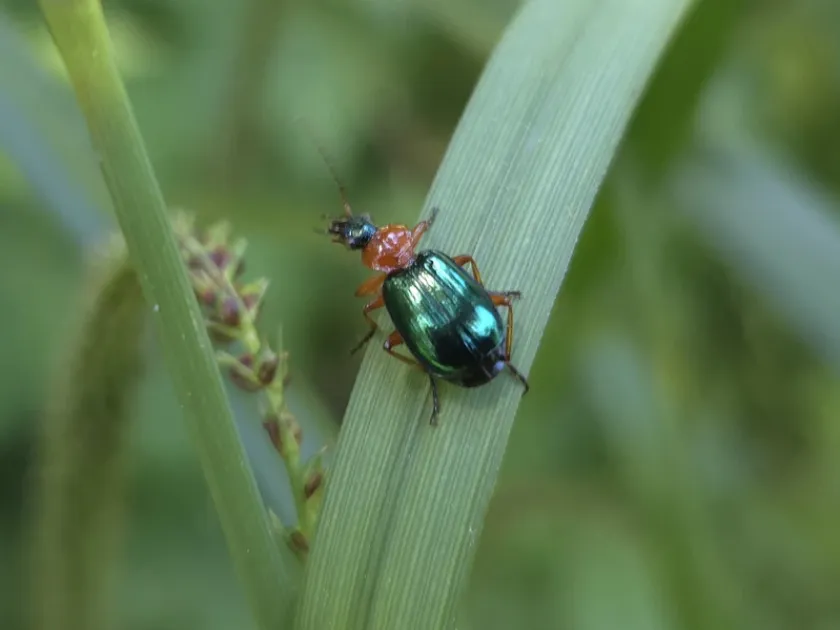
Lebia chlorocephala is a species of ground beetle (Carabidae) known for its distinctive appearance, featuring a reddish-orange head and pronotum with vibrant, metallic green elytra.
Adult beetles measure between 5 and 7 millimeters in length, possessing a flattened body structure that enables them to move efficiently through crop canopies and soil crevices.
Unlike many ground beetles that remain on the ground, this species is highly mobile and often found on the flowers and leaves of various herbaceous plants during the day.
The biological nature of this beetle is primarily predatory, feeding on small insects, which makes its role in the agro-ecosystem complex and dual-natured.
The species possesses well-developed wings and is capable of flight, allowing for rapid colonization of agricultural fields during the favorable spring and summer periods.
What it damages
While primarily a predator, Lebia chlorocephala can cause damage to crops when natural prey populations are scarce, leading it to feed on plant reproductive organs.
The beetle primarily targets flowers, pollen, and developing ovaries, which can result in reduced seed set and yield losses in legumes and oilseed crops.
Feeding damage typically manifests as small, irregular holes or ragged edges on flower petals and filaments, compromising the structural integrity of the blooms.
Such wounds create entry points for opportunistic fungal pathogens, leading to premature flower drop or necrotic spots on the floral tissue.
In seed production fields, the presence of these beetles requires careful monitoring, as even minor damage can affect the quality and uniformity of the seed harvest.
When it appears
The active life cycle of Lebia chlorocephala begins in the spring as soil temperatures rise, prompting adults to emerge from their overwintering sites.
Adult beetles hibernate in the soil, under plant debris, or within dense crop residues, which provide protection against extreme winter temperatures.
Peak emergence typically occurs in April and May, coinciding with the early growth stages of most major agricultural crops in their region.
The highest population density is generally observed during the flowering period, as the beetles are attracted to the abundant pollen and floral resources available.
As autumn approaches and temperatures drop, the beetles gradually seek shelter in the soil or protected areas, entering a state of dormancy to survive the winter.
Signs of infestation
Identifying the beetle in the field is straightforward; it involves visual inspection of the crop canopy, where the metallic green insects are easily spotted on flowers.
Signs of infestation include mechanical damage to the reproductive parts of the plant, such as chewed petals and partially consumed pollen sacs.
Agricultural scouts often use sweep nets to sample populations, which provides a reliable estimate of density and the potential for economic damage to the crop.
Beetles are frequently aggregated near field borders, hedgerows, or uncultivated patches, where they find refuge and secondary food sources before moving into crops.
In hot weather, the beetles are often found hiding deep within the floral base or in the axils of leaves, necessitating a thorough check of the plants.
Control measures
Management strategies focus on cultural practices and targeted interventions to minimize crop damage while preserving the beetle's potential as a natural predator.
Effective weed control in and around fields significantly reduces the habitat for the beetle, discouraging it from establishing large populations near vulnerable crops.
Insecticide applications should be reserved for scenarios where economic thresholds are exceeded, utilizing selective chemicals that minimize harm to pollinators.
- Tillage practices to disrupt overwintering habitats.
- Rigorous weed management along field margins.
- Regular population monitoring using sweep net sampling.
- Targeted application of insecticides at the flowering stage.
Because Lebia chlorocephala also preys on other crop pests, farmers should carefully weigh the pros and cons of chemical intervention to ensure integrated pest management success.
Taxonomy
- Latin name
- Lebia chlorocephala
- Order
- Coleoptera (beetles)
- Family
- Carabidae
- EPPO code
- LEBACH
Discussion
No discussions yet — be the first.