
Lebia
Lebia
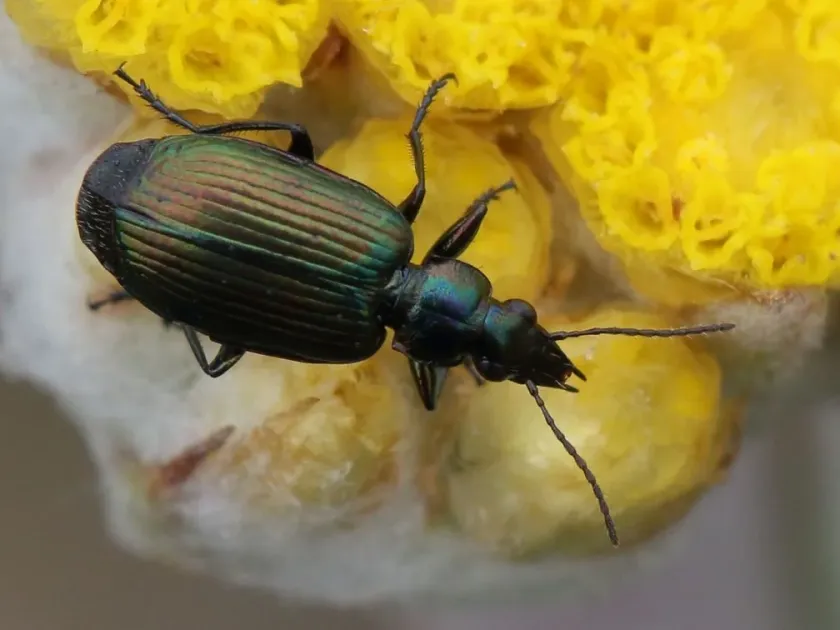
Description
How to identify
Lebia is a genus of ground beetles (Carabidae) known for their agility and predatory behavior. Unlike many other ground beetles, members of this genus are frequently found above ground on vegetation rather than just in the soil layer.
These beetles exhibit a flattened body structure and often possess vibrant colors, with elytra that can be metallic blue, green, or bicolored, complemented by reddish-orange legs and pronotums. Their morphology allows them to move swiftly across leaves.
The life cycle involves complete metamorphosis: eggs are laid in the environment, developing into larvae that often act as specialized predators or ectoparasites of other insects, followed by a pupal stage and the emergence of the adult beetle.
Adult Lebia are highly mobile and possess wings, enabling them to colonize various crops rapidly. They are often spotted by farmers during routine field inspections as they actively search for prey among the foliage.
Accurate identification requires careful examination of the head and mouthparts, as their predatory nature is supported by strong mandibles designed for capturing smaller insects in the canopy layer.
What it damages
In an agricultural context, Lebia species are generally not considered pests. On the contrary, they are valued as beneficial entomophagous insects that contribute to the natural suppression of various agricultural pests.
They feed on a wide variety of prey, including aphids, leaf beetle larvae, and the eggs of various insects that cause damage to commercial crops. By doing so, they provide a form of biological control that minimizes the impact of potential outbreaks.
There is no evidence of Lebia causing economic damage to plant tissues, roots, or fruit. They do not consume plant material as a primary food source and are not a threat to yield quantity or quality.
Misclassification often occurs when these beetles are found on damaged plants. In such cases, the damage is typically caused by other pests, while the Lebia beetle is present simply because it is hunting the culprit.
Therefore, their presence in a field is a positive indicator of a functional ecosystem capable of providing natural checks and balances against common crop pests.
Control measures
Control measures against Lebia are neither necessary nor recommended, as these insects are essential allies in integrated pest management (IPM) strategies for various farming systems.
Farmers should focus on preserving these populations by avoiding the overuse of non-selective broad-spectrum insecticides, which can non-target kill these beneficial predatory beetles alongside the pests.
Sustainable agricultural practices, such as providing field margins with natural vegetation, create essential habitats for Lebia, ensuring they remain in the agroecosystem throughout the growing season.
When selecting pesticides, agricultural professionals should prioritize products that have minimal impact on beneficial arthropods to protect the natural predator population that helps manage the pest density.
Ongoing monitoring and identifying local populations of predators like Lebia help farmers make more informed decisions, reducing the reliance on chemical treatments and promoting healthier, more resilient crops.
Taxonomy
- Latin name
- Lebia
- Order
- Coleoptera (beetles)
- Family
- Carabidae
- EPPO code
- LEBASP
Discussion
No discussions yet — be the first.