
Southern Fiscal
Lanius collaris
Description
How to identify
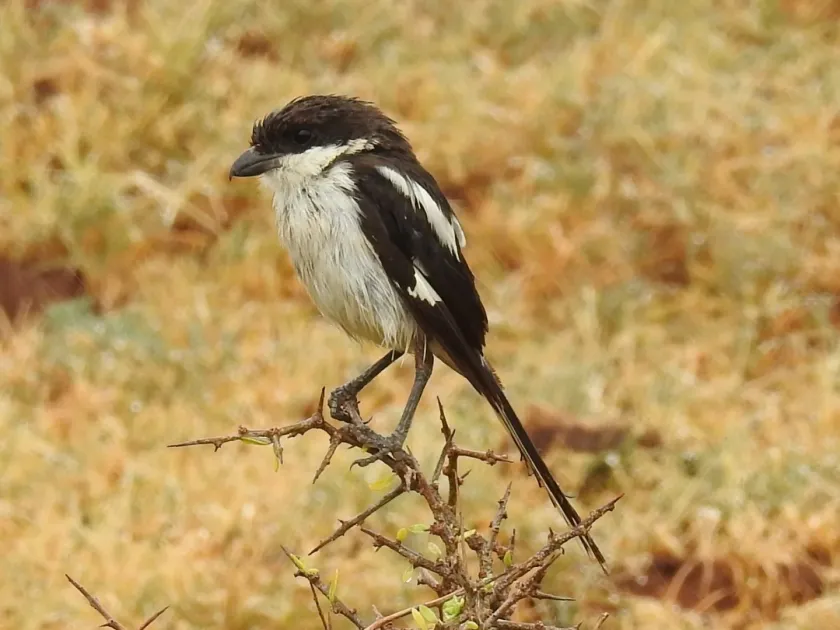
The Southern Fiscal (Lanius collaris) belongs to the order Passeriformes and the family Laniidae. It is a distinctive predatory bird known for its robust bill, which features a sharp hook at the tip of the upper mandible, specialized for capturing and tearing prey.
Visually, the bird displays a striking black-and-white plumage. Adults typically have black upperparts, a black head and wings, and a white underbelly. A key diagnostic feature is the broad black stripe extending through the eye, creating a mask-like appearance.
These birds prefer open habitats scattered with thorny shrubs or isolated trees, which serve as vantage points for hunting. They are highly territorial and engage in defensive behaviors to protect their designated home range.
A unique behavioral trait is the tendency to impale prey items on thorns or barbed wire, creating a larder. This strategy allows the bird to manage food supplies effectively during periods of low prey availability.
During the breeding season, pairs construct cup-shaped nests hidden within dense, thorny thickets to shield their offspring from potential predators, showcasing an evolutionary adaptation to their environment.
What it damages
Despite being occasionally mislabeled, the Southern Fiscal is not a pest of agricultural crops. It is strictly a carnivore and poses no threat to seeds, leaves, or fruits of cultivated plants.
The diet consists mainly of large insects, including grasshoppers and beetles, as well as small vertebrates like lizards and rodents. Consequently, these birds act as natural pest controllers in agricultural landscapes.
Their role in the ecosystem is beneficial to farmers, as they actively reduce the populations of insects that might otherwise damage crop yields. Their presence is generally considered an indicator of a healthy environment.
Negative impacts on agricultural productivity are virtually non-existent. Any concern regarding their predation on smaller, beneficial birds is largely outweighed by their positive contribution to controlling rodent and insect infestations.
Therefore, the species should be viewed as an ally rather than an opponent in integrated pest management programs, as they provide free, natural biological regulation of common agricultural pests.
Control measures
No specific control measures are required for the Southern Fiscal in agricultural settings. Because they do not harm crops, any attempt to eradicate them would be unnecessary and detrimental to local biodiversity.
Farmers are encouraged to maintain hedgerows and natural vegetation, as these support populations of predatory birds that naturally suppress pest numbers without the need for additional chemical interventions.
If the birds are observed in areas where their presence is inconvenient, non-lethal deterrents such as reflective tape or specialized ultrasonic devices can be used to gently discourage them from specific zones.
Cultural practices, such as pruning or thinning dense thorny vegetation near sensitive crop areas, may naturally shift the bird's hunting grounds away from the immediate vicinity of the field.
The overall management strategy should focus on the conservation of beneficial wildlife, recognizing the Southern Fiscal's role as a biological agent in maintaining the balance of the agro-ecosystem.
Taxonomy
- Latin name
- Lanius collaris
- Family
- Laniidae
- EPPO code
- LANICO
Discussion
No discussions yet — be the first.