
Black-headed gonolek
Laniarius erythrogaster
Description
How to identify
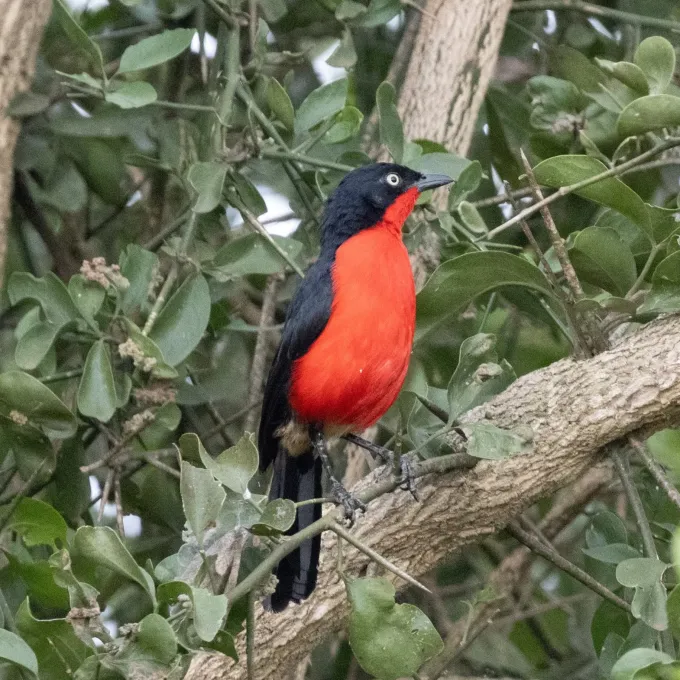
The Black-headed gonolek (lat. Laniarius erythrogaster) is a bird species belonging to the bushshrike family (Malaconotidae) within the order Passeriformes.
It is easily recognized by its striking appearance, featuring a deep black back and crown contrasting sharply with a bright, vibrant red belly.
Reaching a body length of 20–23 centimeters, these birds are typically found in dense shrubbery or thick vegetation near water sources or forest edges.
They exhibit strong territorial behavior and are often observed in pairs, frequently communicating through loud, distinct vocalizations that reveal their presence.
Though they are shy, their unique plumage and persistent calls make them a distinctive species within their native African habitats.
What it damages
While primarily insectivorous, the Black-headed gonolek can act as an agricultural pest when natural insect populations are low or when orchards are readily available.
The birds damage crops by pecking at soft fruits and berries, creating deep punctures that compromise the physical integrity of the produce.
These puncture wounds serve as entry points for secondary pathogens, including bacteria and fungi, which lead to rapid fruit decay and loss of marketability.
In high-density fruit production areas, the cumulative impact of these feeding behaviors can result in significant financial losses during the harvest season.
Their habit of visiting the same trees repeatedly can concentrate the damage, turning a minor nuisance into a localized crop management challenge.
When it appears
The intensity of bird activity often peaks during their breeding season, as the demand for high-energy food sources increases to support fledgling development.
During dry seasons when insect availability drops, these birds are more inclined to shift their dietary focus toward succulent, sugar-rich cultivated fruits.
The harvest period, if it coincides with the post-breeding peak of the population, represents the highest risk window for fruit crop damage.
Since the species is not migratory, local populations remain a constant factor in orchard management throughout the entire growing season.
Agricultural monitoring should be intensified starting from the fruit-setting stage to identify potential hotspots of bird activity before ripening occurs.
Signs of infestation
The most immediate indicator of their presence is their loud and distinctive duet-like calls, which are characteristic of the bushshrike family.
Visual signs on crops include small, deep, funnel-shaped punctures on the skin of the fruit, indicating where the bird has sampled the pulp.
Farmers may observe discarded fruit remains or partially consumed berries beneath the canopy of trees favored by these birds.
Droppings found on foliage or fruit clusters provide clear evidence of consistent bird activity within specific sections of the plantation.
Direct sightings of birds near orchards, especially in the early morning hours, often confirm the source of the identified puncture damage.
Control measures
Physical exclusion, such as the installation of high-quality netting over fruit trees, is the most reliable method for preventing direct bird damage.
Visual deterrents, including reflective tape, holographic strips, or periodically relocated scarecrows, can reduce the frequency of bird visits to the area.
Acoustic deterrent systems that broadcast distress calls or predator sounds are effective if they are programmed to vary frequency and timing.
Maintaining a clean orchard by promptly removing overripe or fallen fruit eliminates secondary food sources that attract birds to the cultivation area.
Developing non-commercial buffer zones or planting alternative native forage trees at the perimeter can serve as a diversion, drawing birds away from valuable crops.
Taxonomy
- Latin name
- Laniarius erythrogaster
- Family
- Laniidae
- EPPO code
- LANRER
Discussion
No discussions yet — be the first.