
Tropical boubou
Laniarius aethiopicus
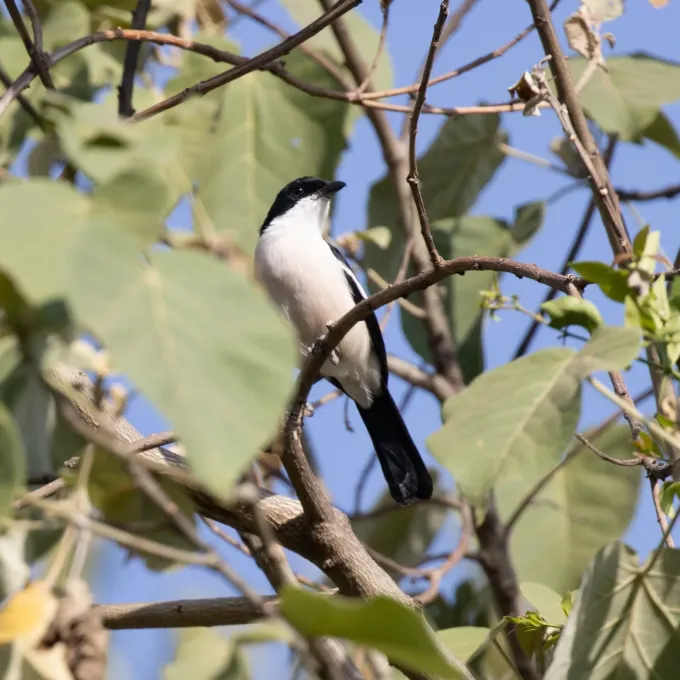
Description
How to identify
The tropical boubou (Laniarius aethiopicus) is a bushshrike species within the Laniidae family, widely distributed across sub-Saharan Africa.
It is a medium-sized, black-and-white passerine bird known for its striking appearance and highly vocal nature, often found in dense vegetation.
These birds are recognized by their distinct, complex duets, which serve as a primary indicator of their presence within an orchard or garden.
While primarily insectivorous, they exhibit opportunistic feeding habits that can lead them to target agricultural produce when insect populations decline.
Their adaptive behavior allows them to thrive in human-modified landscapes, making them frequent visitors to fruit-bearing plantations.
What it damages
The economic impact of the tropical boubou arises from its tendency to pierce the skin of ripening fruits, including berries and small tree fruits.
These pecking actions damage the fruit tissue, causing direct loss of market value and increasing susceptibility to secondary fungal infections.
Frequent attacks on blossoms and young fruitlets can reduce the overall yield potential of the orchard significantly over the growing season.
By breaking the fruit's protective barrier, the birds create entry points for various pests, including wasps and flies, which exacerbate crop destruction.
In regions where these birds are abundant, high-value crops can suffer substantial aesthetic and quality degradation due to their opportunistic feeding.
When it appears
The period of greatest activity and potential crop damage aligns with the breeding season, which often coincides with the onset of the rainy season.
During the fruit ripening stage, the demand for easily accessible energy makes the orchard an attractive target for these birds to feed their offspring.
Seasonal fluctuations in local food resources dictate the intensity of the bird's presence; as native insect prey becomes scarce, fruit consumption increases.
Morning and evening hours are the peak times for foraging, making these periods critical for surveillance and monitoring activities by growers.
Knowledge of their nesting cycle is essential for proactive management, as bird activity levels surge during the chick-rearing phase.
Signs of infestation
Signs of damage include deep, clean-cut peck marks on fruits, often leading to rapid decomposition at the site of the injury.
The consistent sound of their complex duets in the canopy serves as a reliable auditory cue for the presence of nesting pairs on the premises.
Accumulation of droppings on branches surrounding specific fruit clusters often points to frequently visited feeding spots.
Visible decline in the health of fruit batches, starting from small punctures, clearly indicates avian intervention rather than insect or disease causes.
- Distinct puncture marks on fruit surfaces.
- Rapid onset of rot in partially eaten fruit.
- Loud duetting sounds in the early morning.
- Bird nests located in perimeter shrubs.
Control measures
Exclusion methods, such as installing high-quality bird netting, remain the most reliable solution for protecting fruit trees from avian pests.
Visual and acoustic deterrents can be employed to create an inhospitable environment, though these require rotation to avoid habituation.
Good orchard sanitation practices, including the prompt removal of fallen or damaged fruit, help reduce the appeal of the area to opportunistic feeders.
Integrating mechanical protections with landscape management helps maintain bird populations at a tolerable level without causing unnecessary environmental damage.
Professional monitoring during the ripening phase allows for the timely application of deterrent strategies, minimizing the risk of significant yield losses.
Taxonomy
- Latin name
- Laniarius aethiopicus
- Family
- Laniidae
- EPPO code
- LANRAE
Discussion
No discussions yet — be the first.