
Goat moth
Lamellocossus
Description
How to identify
The Goat moth (Lamellocossus terebra) belongs to the Cossidae family within the order Lepidoptera. It is a large moth with a wingspan reaching 70–90 mm, featuring a cryptic grey-brown marbled pattern.
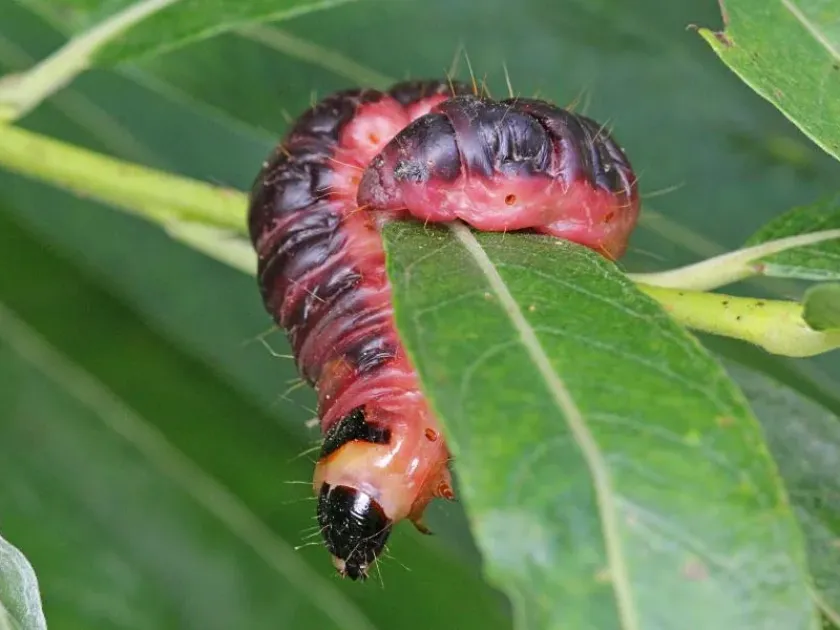
The larvae are remarkably large, growing up to 80–100 mm in length. They are easily recognizable by their dark red or cherry-colored dorsal side and yellowish-white flanks.
The larvae possess a strong, unpleasant odor, often compared to wood vinegar or goat, which gives the species its common name. This scent is produced throughout their development.
The life cycle of this pest is long, typically lasting 2 to 3 years. The insect spends the vast majority of its existence deep within the woody tissue of its host plant.
Adult moths are nocturnal and are rarely seen during the day, as they rest motionless on tree trunks, perfectly blending in with the bark texture.
What it damages
This species is a polyphagous borer that targets various deciduous trees, including poplar, willow, alder, elm, and birch, which are the primary hosts in nature.
In orchards, the Goat moth infests stone and pome fruits such as apple, pear, plum, and cherry trees, particularly those that are already weakened by stress or age.
The damage is caused entirely by the larvae, which bore complex, winding galleries through the bark, cambium, and deep into the heartwood of the trunk and branches.
Persistent feeding leads to the destruction of the tree's vascular system, preventing the flow of nutrients and moisture, which eventually causes the tree to decline.
Structurally compromised trees become highly vulnerable to secondary infestations by fungi and wood-destroying beetles, as well as breaking during windstorms.
When it appears
The flight period for adult Goat moths occurs during the summer months, typically ranging from early June through the end of July, depending on the latitude.
Females deposit their eggs in small clusters within crevices of the tree bark, usually favoring the base of the trunk or around the root collar.
Upon hatching, the young larvae immediately begin to penetrate the bark layers. They spend the following seasons feeding and enlarging their tunnels inside the wood.
Feeding activity is most intense during the warmer months of the year when sap circulation is high and the larvae can grow rapidly.
Pupation occurs within the larval gallery inside the wood. After completing its development, the pupa pushes itself toward the exit hole before the adult moth emerges.
Signs of infestation
The most visible sign of an infestation is the accumulation of frass — dark, granular waste material ejected by the larvae — near the base of the tree.
Exudation of tree sap from circular or oval holes in the bark, often mixed with frass, creates a distinct dark, wet trail on the surface of the trunk.
Affected branches or the entire canopy may show signs of yellowing, premature leaf drop, and stunted growth compared to healthy trees nearby.
In hot weather, a strong, pungent vinegar-like smell may be detected near the infested tree, which is a clear indicator of active larval presence inside.
- Dark frass piles at the base of the tree.
- Sap bleeding from entrance holes.
- Dying branches or crown dieback.
- Presence of characteristic exit holes in the bark.
Control measures
Maintaining tree vigor through proper irrigation and nutrition is the first line of defense, as healthy trees are better able to cope with or resist borer attacks.
Mechanical control involves inserting a flexible wire into the galleries to kill the larvae directly. This is effective if the tunnel openings can be located.
Injecting systemic or contact insecticides into the galleries using a syringe, followed by sealing the entrance with grafting wax or clay, is a highly recommended practice.
Regular trunk cleaning and the application of lime-based whitewash help to minimize the number of suitable crevices where moths can deposit their eggs.
If a tree is severely infested and shows extensive structural damage, it should be removed and destroyed to prevent the pest from spreading to neighboring healthy trees.
Taxonomy
- Latin name
- Lamellocossus
- Order
- Lepidoptera (butterflies)
- Family
- Cossidae
- EPPO code
- LAMESP
Discussion
No discussions yet — be the first.