
Ground beetle
Laemostenus terricola
Description
How to identify
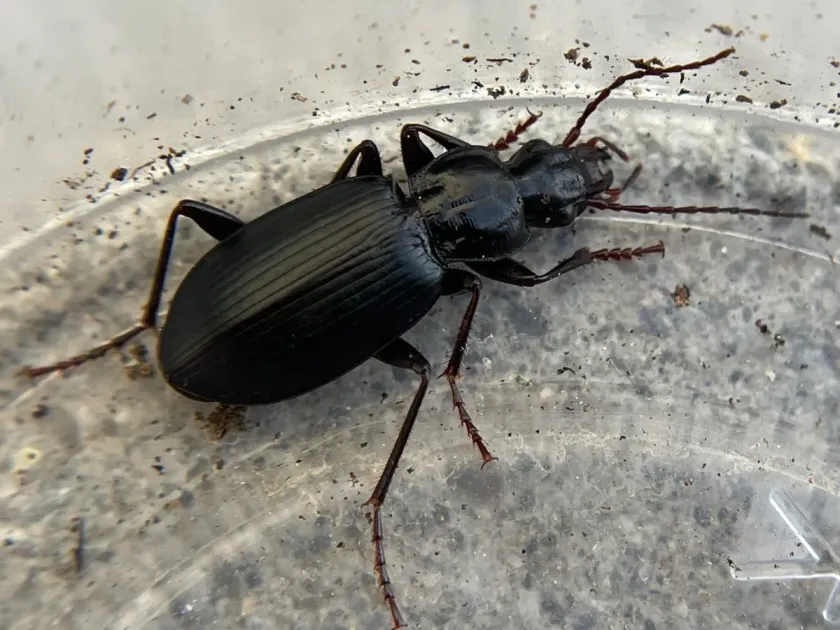
The ground beetle (Laemostenus terricola) belongs to the order Coleoptera and the family Carabidae. Adult insects are typically 12 to 16 mm long, featuring an elongated body that ranges in color from dark brown to black, often with a metallic sheen.
A distinctive physical feature is the narrow "waist" connecting the pronotum and the elytra. Their legs are strong and built for running, which allows them to move quickly across the soil surface or escape into crevices when disturbed.
The larvae are campodeiform, meaning they are active and mobile, equipped with well-developed mouthparts for chewing. They generally have a light grey or brownish color, which helps them camouflage within the soil layers.
These beetles are primarily nocturnal. During the day, they remain hidden under soil clods, debris, or stones to avoid desiccation and predators, making them difficult to spot during routine field inspections.
The life cycle encompasses four stages: egg, larva, pupa, and imago. They can overwinter as either adults or late-stage larvae, providing the species with a high survival rate in fluctuating climate conditions.
What it damages
The ground beetle primarily affects cereal crops, including winter wheat, rye, and barley. Both adults and larvae can consume seeds in the ground, preventing successful germination and leading to sparse crop stands.
In addition to cereals, the pest can damage seedlings of vegetable crops and sugar beets. By chewing on young stems near the base, they cause the plants to wilt, yellow, and eventually die.
Significant damage usually occurs in patches where the soil conditions are favorable for the beetle's activity. When the population density is high, the overall yield can be drastically reduced due to loss of plant population.
The severity of the damage is highly dependent on weather conditions. Wet autumns often lead to increased beetle activity during the critical sowing period of winter cereals, making these crops particularly susceptible.
The mechanical damage caused by these insects often serves as a pathway for secondary infections, such as root rots, caused by various soil-borne fungi and bacteria that further weaken the crop.
When it appears
Activity of adults typically begins in early spring as the soil temperature rises. This period is crucial for the beetle's dispersal and the start of the breeding cycle, coinciding with the early growth stages of spring crops.
During the peak summer months, activity may decrease if the weather becomes excessively hot or dry. However, if there is sufficient moisture, the population remains active throughout the growing season.
Autumn is the period of highest risk for winter cereal crops. Adult beetles, having completed their breeding phase, actively seek food before entering their winter dormancy, which often results in damage to young shoots.
Overwintering occurs deep within the soil or under dense surface cover. The ability to endure cold temperatures by slowing down metabolic processes allows the population to persist from year to year.
The most vulnerable window for crops is the stage from seed germination to the appearance of the first true leaves. Rapid early growth is often the best defense against beetle feeding pressure.
Signs of infestation
The most noticeable sign of a ground beetle infestation is the appearance of thin or bare patches in a field. Upon closer inspection, seeds in these areas may show clear evidence of gnawing or complete destruction.
Visible feeding marks on the stems of young seedlings near the soil line are a classic indicator. These plants are often weakened and can be easily pulled from the soil due to damage at the base.
Nocturnal monitoring is the most effective way to confirm the presence of beetles. Using a flashlight after dark, one can observe the beetles moving across the soil surface, especially in moist conditions.
Soil sampling by digging into the ground in affected areas is another method to identify the presence of larvae. If larvae are found in significant numbers, it indicates a high risk for the current crop.
The presence of beetle remains or frass near damaged seedlings can also act as an indicator for farmers to take immediate action to assess the extent of the damage.
Control measures
Crop rotation is the fundamental approach for controlling ground beetles. By avoiding continuous monoculture, farmers break the pest's cycle and significantly reduce the local population over time.
Mechanical tillage, such as deep plowing, is very effective for controlling the population. It disrupts the beetles' habitat and exposes larvae and pupae to predators or unfavorable environmental conditions.
Seed treatment with insecticides is widely considered the most efficient way to protect seeds and seedlings from early-stage damage. This provides a chemical barrier that protects the plant during its most susceptible phase.
- Monitor fields using pitfall and light traps.
- Remove weeds that serve as alternative food sources for the beetle.
- Ensure rapid and uniform germination through proper soil preparation.
- Apply contact insecticides during the vegetative stage if populations exceed thresholds.
Biological controls, such as the application of entomopathogenic fungi, are becoming increasingly important in integrated pest management strategies, offering an environmentally friendly alternative to chemical pesticides.
Taxonomy
- Latin name
- Laemostenus terricola
- Order
- Coleoptera (beetles)
- Family
- Carabidae
- EPPO code
- LEAMTE
Discussion
No discussions yet — be the first.