
Flat grain beetle
Laemophloeus testaceus
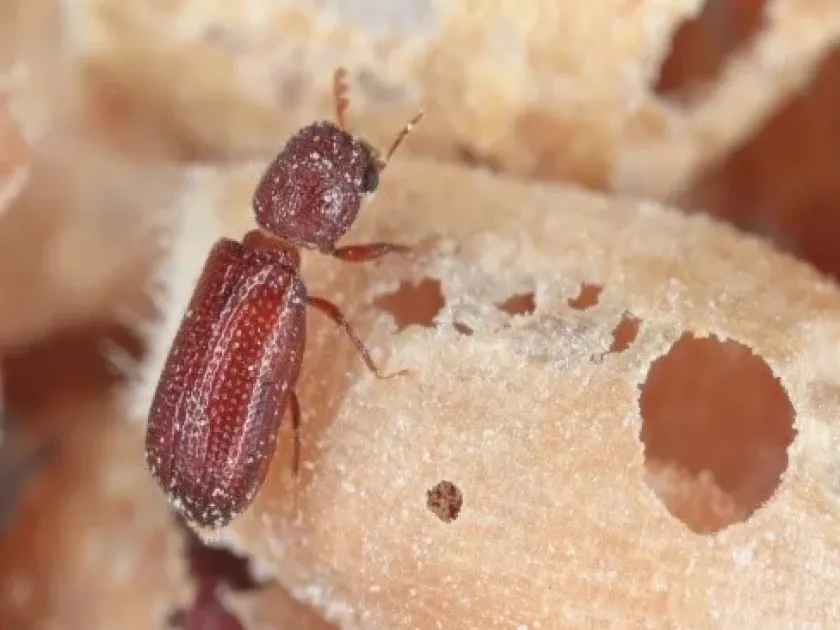
Description
How to identify
The flat grain beetle is an extremely small insect, with adults measuring between 1.5 and 2.5 mm in length. Its body is noticeably flattened, which allows the insect to hide in the smallest cracks, crevices, and gaps within grain storage structures.
The coloration of the adult beetle ranges from light reddish-brown to a darker, shiny reddish-brown. The head is large, featuring very long, thread-like antennae that can reach the middle of the body or beyond, serving as a key diagnostic feature for identification.
The pronotum is characterized by fine longitudinal lines along its sides, while the elytra (wing covers) feature visible longitudinal grooves. The larvae are slender, creamy-white in color, and reach approximately 3 mm in length, possessing two characteristic tail-like projections at the rear.
Systematically, this species belongs to the order Coleoptera and the family Laemophloeidae. It is recognized as a secondary pest, meaning it typically infests grain products that are already compromised by mechanical damage or existing primary pest infestations.
Adult beetles are capable of flight, which aids in their rapid dispersal between storage facilities during warm months. They are secretive insects that prefer to remain hidden, rarely venturing onto the surface of the grain bulk under normal lighting conditions.
What it damages
The flat grain beetle primarily damages cereal grains, legumes, and oilseeds during storage. It also infests processed food products, including flour, semolina, bran, and various types of dried fruits and vegetables.
Since the beetles cannot penetrate the hard, undamaged outer coat of whole kernels, they rely on existing damage caused by primary pests or mechanical handling. They thrive in grain dust and broken kernels, which accumulate in storage equipment.
When populations reach high densities, the beetles can contribute to the "hot spotting" of grain masses. Their combined metabolic activity increases the temperature and moisture content of the grain, creating favorable conditions for mold growth and further degradation.
Significant damage occurs in flour mills and processing plants, where the pests congregate within machinery, conveyor systems, and elevators. Their excrement and shed skins contaminate the food supply, causing distinct, unpleasant odors and lowering commercial value.
Economic losses arise not only from the consumption of grain but also from the degradation of its quality, making it unsuitable for human consumption. Heavy infestations often require the disposal of large batches of grain products.
When it appears
In temperature-controlled storage facilities, the flat grain beetle can reproduce throughout the year. In unheated structures, their activity is strictly regulated by ambient temperature, with development slowing down significantly below 15°C.
The optimal conditions for development are temperatures between 25°C and 30°C combined with relative humidity above 60%. Under these ideal circumstances, the life cycle from egg to adult can be completed in as little as 3–4 weeks.
During the summer months, beetles may migrate out of storage buildings to seek food in nature, such as in bird nests or under tree bark. As temperatures drop in autumn, they move back into buildings to overwinter in cracks and floor debris.
The presence of primary pests acts as a trigger for population growth. As primary pests damage the grain, the resulting debris provides a perfect habitat and food source for the flat grain beetle to thrive and expand its population rapidly.
Monitoring should be intensified during the spring as rising temperatures stimulate beetle activity. This is the optimal time to implement trapping programs to detect any incipient infestations before they spread through the bulk.
Signs of infestation
A primary indicator of an infestation is a noticeable musty or moldy odor emanating from the storage facility. This smell results from the insects' metabolic activities and the associated degradation of the stored grain.
Live adults can be spotted by examining grain samples, especially after agitation. Because of their flat bodies, they may hide within the grain itself, often requiring the use of specialized sieves to confirm their presence accurately.
Accumulations of "dust" or debris inside equipment like elevators and conveyors are classic signs of a colony. This dust is actually a mixture of flour, larval skins, and insect excrement, serving as a focal point for the infestation.
Localized increases in grain temperature are critical red flags. If a specific section of the grain bulk shows an unexplained temperature rise, it is highly likely that a pest colony is active and generating heat through its life processes.
- Discovery of small, reddish-brown beetles in grain samples.
- Presence of fine, powdery dust in grain corners.
- Reduced flowability of grain due to webbing and debris accumulation.
Control measures
Strict sanitation is the foundation of effective control. Before receiving new grain, storage facilities must undergo thorough cleaning and professional disinfestation to remove any residual pests living in cracks or structural joints.
Maintaining proper grain storage conditions, such as cooling the grain mass to below 10°C, is highly effective. Low temperatures suppress metabolic processes and prevent the insects from reproducing, effectively keeping the population under control.
If an infestation is confirmed, fumigation is the most effective solution. Using registered fumigants (typically phosphine-based) in a tightly sealed environment ensures that all life stages of the beetle, including those deep within the grain, are eliminated.
Mechanical cleaning using grain separators is a crucial preventative step. Removing dockage, broken kernels, and fine dust reduces the available food supply and physically removes a large portion of the insect population from the batch.
Regular inspection routines, including grain probe sampling and the use of pheromone traps, are essential. Early detection allows for targeted interventions, which are significantly cheaper and less invasive than emergency fumigations.
Taxonomy
- Latin name
- Laemophloeus testaceus
- Order
- Coleoptera (beetles)
- Family
- Cucujidae
- EPPO code
- CRYLTE
Discussion
No discussions yet — be the first.