
Flat grain beetle
Laemophloeus
Description
How to identify
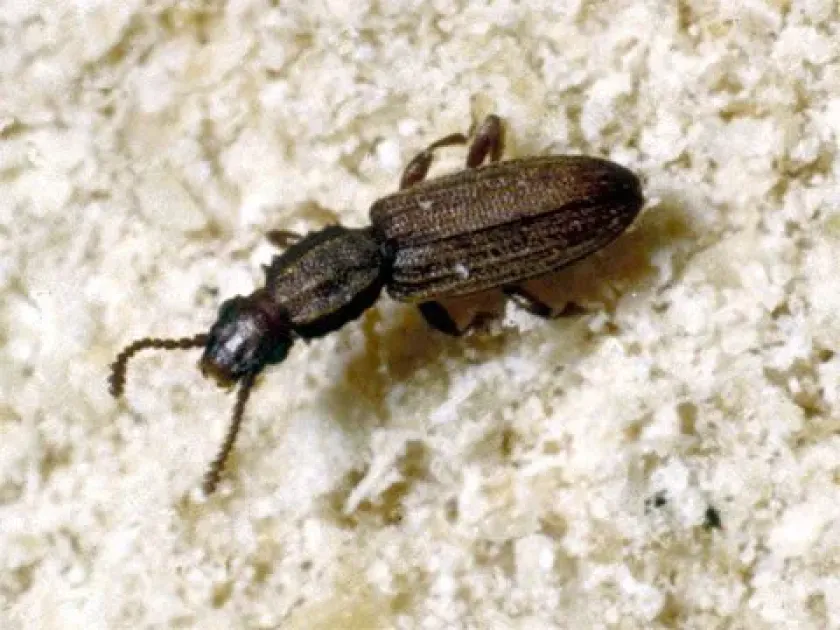
The flat grain beetle (genus Laemophloeus) belongs to the family Laemophloeidae within the order Coleoptera. These are extremely small insects, typically measuring between 1.5 and 3 mm in length.
As their common name suggests, they possess a characteristically flattened body, which allows them to easily conceal themselves within narrow crevices, under machinery, or inside damaged kernels.
The coloration of these beetles ranges from light yellowish-brown to dark reddish-brown. They are easily recognized by their long, thread-like antennae that can extend significantly across their body.
Larvae are elongated, slender, and pale, with a darker head capsule. They are highly mobile and thrive in the dust and debris often found in poorly maintained storage facilities.
The life cycle encompasses four distinct stages: egg, larva, pupa, and adult. Given optimal environmental conditions, they can complete their life cycle in just a few weeks.
What it damages
Flat grain beetles are notorious stored-product pests that primarily attack cereals, flour, processed grain products, oilseeds, and various dried food commodities.
They are frequently encountered in grain elevators, flour mills, and warehouses where they exploit spilled grain and dusty corners as their primary breeding grounds.
The beetles feed on the germ of the grain, significantly reducing its germination potential, while larvae also consume flour and broken kernels, contributing to rapid product loss.
Heavy infestations lead to significant quality degradation. The presence of beetles, along with their cast skins and excrement, makes the product unsuitable for human consumption or processing.
Their feeding activity often creates hot spots in the grain mass, which encourages the growth of molds and fungi, further ruining the market value of the stored inventory.
When it appears
In temperature-controlled storage facilities, flat grain beetles can remain active and continue to reproduce throughout the entire year without a seasonal dormancy period.
The optimal environment for their population growth includes temperatures ranging from 22 to 30 degrees Celsius and grain moisture levels above 14 percent.
In unheated grain stores, their activity naturally decreases during colder winter months, though the beetles are resilient and can survive as adults in sheltered environments.
Activity levels surge significantly during the spring and summer months as internal grain temperatures rise, necessitating more frequent monitoring of stored lots.
Development rates are highly dependent on thermal conditions; higher temperatures drastically shorten the generation time, leading to exponential population growth during the peak season.
Signs of infestation
The most direct sign of an infestation is the visual detection of small, flat, reddish-brown beetles crawling on the surface of the grain or on the walls of storage bins.
The presence of fine "dust," fragmented grain, and webbing within the product mass is a clear indicator of a significant established colony of pests.
A musty or rancid odor emanating from the grain often signals advanced stages of pest infestation and the accompanying development of mold resulting from their metabolism.
Inspection of grain handling equipment, such as conveyors, elevators, and bagging areas, often reveals high concentrations of beetles in areas where debris accumulates.
Official laboratory testing of grain samples through mechanical sieving remains the most reliable method for confirming infestation levels in commercial stocks.
Control measures
Good sanitation practices, including the removal of residual grain and dust from all storage areas, are the foundation for preventing flat grain beetle infestations.
Maintaining low grain moisture levels (below 13 percent) is a critical physical barrier that limits the ability of the beetles to thrive and reproduce.
- Fumigation of storage units using phosphine-based chemicals is the primary method for eradicating existing severe infestations.
- Surface treatment of empty storage bins with approved residual contact insecticides before new grain is brought in.
- Utilizing aeration systems to cool the grain mass, which significantly slows down beetle activity and population development.
Routine monitoring using insect traps and regular sampling of grain batches are essential to detect early signs of pest presence before they cause major economic damage.
In cases of heavy infestation, grain cleaning (using sieves or air separators) combined with professional chemical treatment is necessary to preserve the remaining product quality.
Taxonomy
- Latin name
- Laemophloeus
- Order
- Coleoptera (beetles)
- Family
- Cucujidae
- EPPO code
- LAEOSP
Discussion
No discussions yet — be the first.