

Pest · Hemiptera (bugs, aphids, leafhoppers) · affects Winter rapeseed, Winter wheat, Apple
Especially harmful
Crucifer shield bugs
Eurydema sp.
Description
How to identify
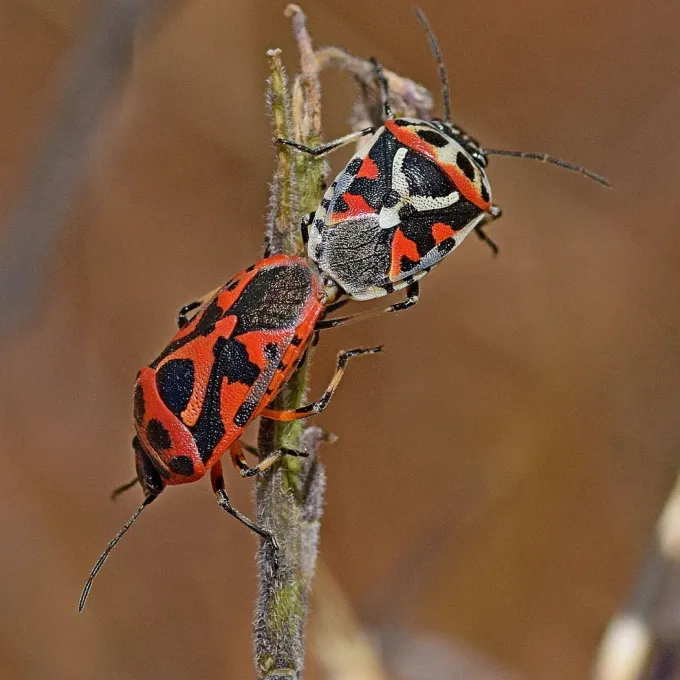
Crucifer shield bugs (genus Eurydema) are common agricultural pests belonging to the Pentatomidae family. Adult bugs are recognized by their distinct shield-shaped bodies featuring bold, warning patterns of red, orange, or yellow against a dark, metallic background.
Adult insects typically measure between 7 to 10 millimeters in length. The head is snugly tucked into the pronotum, which gives the insect a streamlined appearance for efficient movement on plant surfaces.
They lay barrel-shaped eggs, usually arranged in neat rows of 12 to 14 on the undersides of leaves. Nymphs closely resemble adults but lack wings and are smaller in size throughout their development stages.
These insects overwinter as adults, finding shelter in leaf litter, debris, or field margins. They emerge in early spring, signaling the start of the primary infestation cycle for the season.
They are primarily diurnal and thrive in warm, sunny conditions, which allows them to migrate efficiently and rapidly between wild host plants and cultivated crops.
What it damages
The primary hosts for these bugs are members of the Brassicaceae family, particularly winter and spring rapeseed. They also frequently damage forage beet, soybean, tobacco, and grapevines.
When primary food sources are limited, these pests may migrate to winter wheat fields, where they pierce developing grain kernels, resulting in shriveled and lower-quality yields.
In orchards, they can attack young fruit sets, including those of apple trees, causing damage that leads to premature fruit drop and significant yield loss.
The bugs feed by using a needle-like proboscis to pierce plant tissues and inject salivary enzymes. These enzymes dissolve cell contents, leading to localized necrosis and metabolic stress within the plant.
Young seedlings are particularly vulnerable. Infestations during the cotyledon stage can result in total crop failure as the plants are unable to sustain the damage caused by the bugs' feeding activity.
When it appears
Adult bugs emerge from their overwintering sites in spring once temperatures consistently exceed 10–12 degrees Celsius. Initially, they feed on wild weeds before moving to agricultural fields.
Peak migration and egg-laying activity occur during May and June. During this time, the population density increases rapidly as successive generations begin to develop.
In favorable conditions, the life cycle of one generation is completed within 30 to 40 days. In warmer southern climates, it is common to observe two generations per season.
The period of most severe damage corresponds with the flowering and seed-setting stages of rapeseed, as the bugs aggregate on the most nutrient-rich parts of the plant.
As autumn approaches, the bugs begin to search for overwintering sites, retreating into protected areas such as thickets or forest edges to survive the cold winter months.
Signs of infestation
The initial signs of an infestation include the appearance of pale or yellowish spots on leaves, which gradually turn into necrotic, translucent holes surrounded by dark margins.
Stunted plant growth and the deformation of young leaves are clear indicators of severe feeding. Plants often show significant distress and reduced vigor after sustained attacks.
Feeding on stems and stalks often results in swellings or internal tissue death, which weakens the plant structure and makes it more susceptible to lodging and secondary infections.
Harvested seeds often show distinct pockmarks and shriveling, significantly impacting the market value and viability of the seeds for future planting.
- Chlorotic and necrotic spots on foliage.
- Curling and distortion of leaves.
- Premature dropping of blossoms and developing pods.
- Visible pockmarks on seeds and fruit surfaces.
Control measures
The most effective cultural practice is the management of cruciferous weeds, such as shepherd's purse and pennycress, which serve as essential breeding grounds for the bugs early in the season.
Crop rotation and maintaining spatial isolation between new rapeseed crops and previous season fields significantly reduce the likelihood of early infestations.
Early planting allows crops to pass through their most vulnerable growth stages before the peak population of the shield bugs develops later in the spring.
If population levels exceed economic thresholds, farmers should apply registered systemic or contact insecticides, following all safety guidelines for pollinators.
Regular field scouting along the edges of the crops is essential, as this is where the initial migration of the insects into the field is most frequently detected.
In brief
7
Damages crops
Content graph
Damages crops · 7
Content graph
Connections · Crucifer shield bugs
Most often together:
Marketplace
Products · 4


Dragun
Nanjing No.1 Pesticide Factory of Red Sun Group Co., Ltd.
Insecticides
0
1
·
2.3K
No offers
—
Details

Superkil 440, EC, (chlorpyrifos, 400 g/l + cypermethrin, 40 g/l)
Агріфар С.А.(Бельгія
Insecticides
0
0
·
47
No offers
—
Details
Biology
Taxonomy
- Latin name
- Eurydema sp.
- Order
- Hemiptera (bugs, aphids, leafhoppers)
- Family
- Pentatomidae
- EPPO code
- EURDSP
Community
Discussion
No discussions yet — be the first.