
Bishop's mitre
Aelia acuminata
Description
How to identify
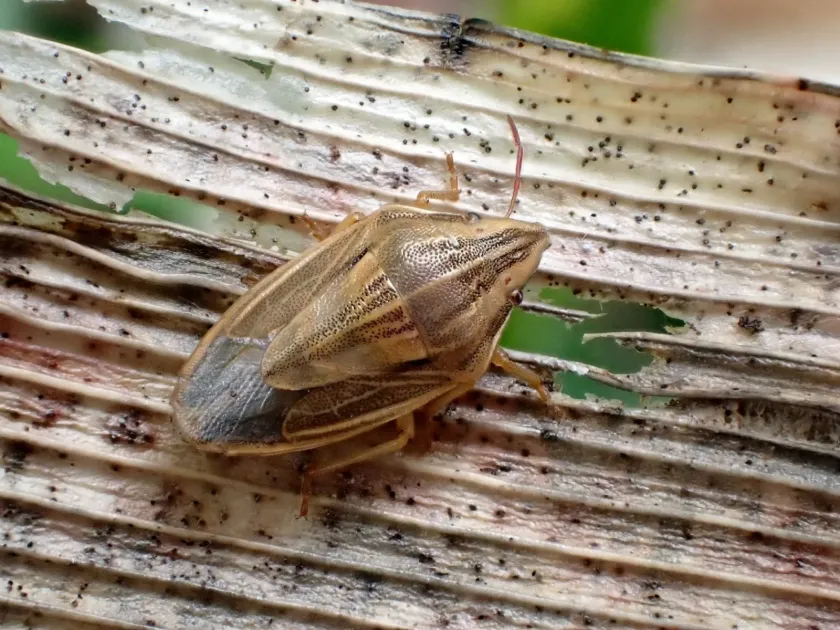
Aelia acuminata, commonly known as the Bishop's mitre, is a shield bug belonging to the Pentatomidae family. Adult bugs are characterized by their elongated, pointed head and body, typically measuring 8 to 10 mm in length.
The body is colored in shades of grayish-yellow or light brown with distinct longitudinal dark stripes. The scutellum covers a significant portion of the abdomen, which is a key diagnostic feature.
Eggs are barrel-shaped and are usually deposited in clusters on the underside of host plant leaves. Nymphs closely resemble adults but lack functional wings and are generally smaller in size.
The lifecycle follows incomplete metamorphosis, meaning nymphs pass through several instars before reaching adulthood. The insects overwinter in sheltered areas like field borders, leaf litter, and tall grass.
In spring, as temperatures rise, the overwintered adults emerge from dormancy and migrate towards cereal fields to begin feeding and reproduction cycles.
What it damages
The Bishop's mitre primarily feeds on cereal crops, including wheat, barley, rye, and oats. In the absence of crops, they can sustain themselves on various wild grasses.
Both adults and nymphs use their piercing-sucking mouthparts to feed on the sap of stems, leaves, and developing grain kernels. This feeding disrupts the plant's vascular system.
Feeding during the grain-filling stage is particularly damaging because the insect injects saliva containing enzymes that degrade gluten. This significantly reduces the baking quality of the harvested grain.
Damage to the stems often leads to yellowing and premature drying of the spikes, commonly known as whitehead, which fail to develop plump, healthy kernels.
High infestations can lead to significant reductions in yield and grain quality, making it a serious economic pest in major cereal-producing regions.
Signs of infestation
The most visible sign of infestation is the appearance of white, empty spikes within the crop canopy. These spikes stand out against healthy green plants due to localized nutrient transport blockage.
During field inspection, one can find the adults and nymphs directly on the wheat heads or stems. They are often most active during the cooler parts of the day.
Physical inspection of the kernels may reveal small, dark puncture marks surrounded by discolored areas, indicating where the insect has fed and injected enzymes.
Observing leaf surfaces, especially in the early spring, can reveal the presence of egg clusters. Their unique barrel shape makes them distinguishable from other insect eggs.
Heavy infestations may also lead to the presence of shed nymphal skins (exuviae) clinging to the leaves or stems of the host plants.
Control measures
Effective management begins with cultural practices, such as removing weeds from field perimeters and surrounding areas to reduce the insect's initial host range.
Post-harvest plowing of fields helps to bury overwintering sites, significantly reducing the survival rate of the bug population before the following season.
If population densities exceed the economic threshold, chemical intervention is necessary. Broad-spectrum insecticides, particularly pyrethroids, are commonly used for control.
Integrated Pest Management (IPM) encourages the preservation of natural egg parasitoids like Telenomus species, which can provide significant biological control if population spikes are managed.
Farmers should monitor their fields regularly and alternate between different chemical modes of action to prevent the development of resistance in the pest population.
Taxonomy
- Latin name
- Aelia acuminata
- Order
- Hemiptera (bugs, aphids, leafhoppers)
- Family
- Pentatomidae
- EPPO code
- AELIAC
Discussion
No discussions yet — be the first.