
Oak kermes scale
Kermes roboris
Description
How to identify
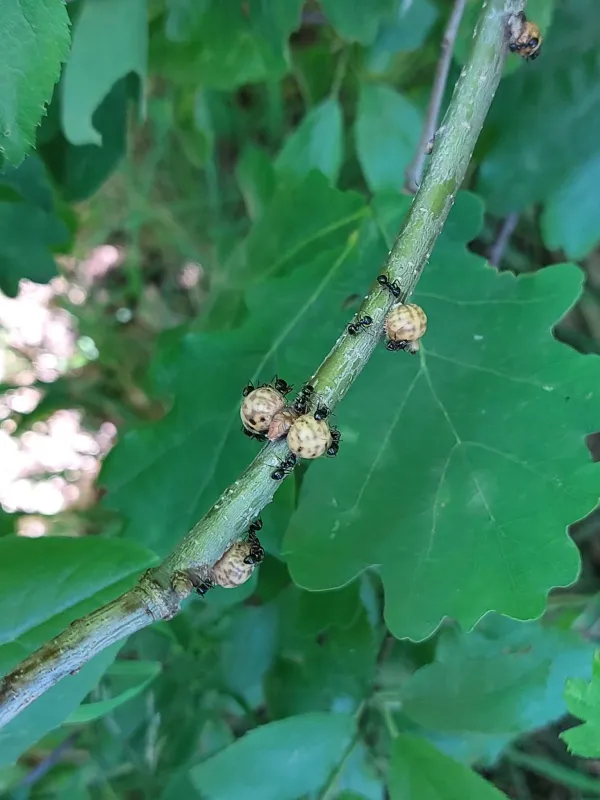
The Oak kermes scale, scientifically known as Kermes roboris, belongs to the family Kermesidae. The adult females are spherical and often resemble small galls or buds on the bark.
Measuring about 4–8 mm in diameter, the female's body is smooth, globose, and ranges in color from reddish-brown to dark brown, providing excellent camouflage.
The life cycle involves a dispersal stage known as crawlers. These tiny, mobile first-instar nymphs possess legs and are responsible for spreading the infestation to new branches.
The species reproduces primarily through parthenogenesis, meaning males are rarely observed. Once the female settles, she remains fixed for the rest of her life.
The exoskeleton of the adult female hardens significantly, forming a protective shield that defends the insect against environmental stress and predators.
What it damages
This pest primarily infests oak species. It is commonly found in woodlands, parks, and ornamental landscapes where oak trees are present.
The scale feeds on the phloem sap of young twigs and small branches. This continuous extraction of nutrients weakens the structural integrity of the affected shoots.
Feeding sites are often susceptible to secondary infections, including fungal pathogens that can lead to localized necrosis and dieback of the twigs.
Heavy infestations result in reduced annual growth, thinning of the canopy, and premature leaf drop, which significantly impacts the tree's photosynthesis.
Under severe conditions, persistent feeding can cause branch dieback, eventually leading to the decline or death of the entire tree if left untreated.
When it appears
Activity begins in early spring as temperatures rise, with overwintered females resuming feeding and expanding rapidly in size.
Egg-laying occurs within the protection of the female's hardened body during late spring. The crawlers typically emerge in mid-to-late June.
The crawler stage is the most active phase, as nymphs search for suitable feeding sites on the current year's growth to settle permanently.
By autumn, the nymphs transition into a dormant stage. They spend the winter hiding in bark crevices, well-protected from cold weather conditions.
Warm, dry summer weather is particularly conducive to population growth, as it shortens development time and increases the survival rate of the crawlers.
Signs of infestation
The most distinctive sign is the presence of small, spherical, bud-like growths along the bark of twigs, which are actually the mature females.
Honey-dew, a sticky substance excreted by the scales, often coats the leaves. This substance attracts ants and provides a substrate for other organisms.
The growth of sooty mold, a black fungus that thrives on honeydew, is a strong indicator of an active and potentially heavy scale infestation.
Visible yellowing of foliage and general loss of vigor throughout the canopy are standard symptoms of nutritional deficiency caused by the scale.
Dead twigs at the tips of branches and patches of thinning bark are common signs that the infestation has reached a critical stage for the tree.
Control measures
Control strategies should focus on timing, particularly during the crawler stage in June, when insects are most susceptible to systemic insecticides.
Pruning out and disposing of heavily infested branches is a highly effective way to reduce the immediate population pressure on the tree.
Maintaining tree health through proper irrigation and balanced fertilization helps the tree withstand scale feeding and recover from damage more effectively.
Encouraging natural predators, such as lady beetles and parasitic wasps, can provide long-term biological control in larger landscapes.
- Apply systemic insecticides during the crawler emergence in June.
- Prune and destroy heavily infested branches in early spring.
- Promote oak vigor through adequate hydration and soil management.
- Monitor trees for honeydew and sooty mold during routine inspections.
Taxonomy
- Latin name
- Kermes roboris
- Order
- Hemiptera (bugs, aphids, leafhoppers)
- Family
- Kermesidae
- EPPO code
- KERMRO
Discussion
No discussions yet — be the first.