
Oak kermes scale
Kermes grandis
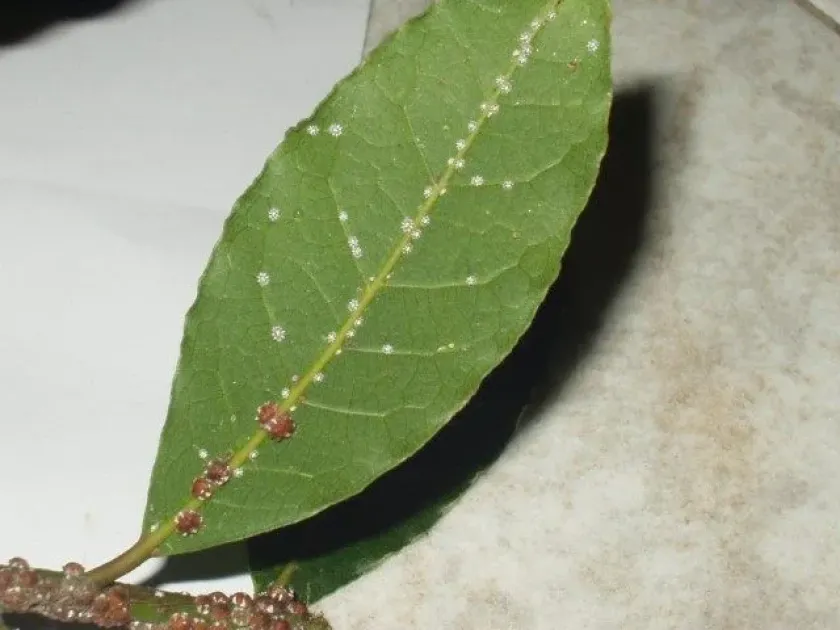
Description
How to identify
The Oak kermes scale (Kermes grandis) belongs to the family Kermesidae, order Hemiptera. Adult females are distinguished by their globular, gall-like appearance, resembling oak buds.
The coloration of the female ranges from yellowish-brown to reddish-brown, often featuring a mottled or marbled pattern. A mature female can measure between 6 to 10 mm in diameter, making them quite visible on the bark.
Males are rarely observed; they are winged and mobile, facilitating the search for females to mate. First-instar nymphs, known as crawlers, are very small, highly mobile, and possess well-developed legs.
Unlike many other scale insects, this species does not produce a hard protective shield but instead relies on a waxy secretion. The female's body fits snugly against the bark, allowing it to blend in with the texture of the tree.
Proper identification requires careful inspection of the underside of twigs and the bases of young shoots, where these insects tend to aggregate during their development.
What it damages
The primary host for this pest is the genus Quercus (Oak). It specifically favors weakened or young trees, although it can be found on mature specimens in urban forests and parks.
The insects feed by sucking sap from the bark tissues of young twigs and shoots. This continuous extraction of nutrients leads to general tree decline and disrupts the tree's internal circulation.
Mass infestations often cause the deformation and stunted growth of new shoots. Furthermore, feeding sites can develop cracks in the bark, creating entry points for opportunistic fungal pathogens.
Affected branches eventually die back, reducing the aesthetic appeal and biological vigor of the tree. In forest management, this can lead to premature leaf drop and dieback of the canopy.
Indirect damage occurs through the development of sooty mold on the honeydew secreted by the scales. This black fungal growth inhibits photosynthesis by covering the surface of the leaves.
When it appears
The life cycle of this species is univoltine, meaning there is one generation per year. Fertilized females overwinter in protected areas, typically within bark crevices.
In the spring, as sap flow begins, the females resume feeding and grow rapidly. This period is critical for the development of their eggs, which are carried within the female's body.
Egg laying usually occurs in early summer. The female deposits her eggs underneath her own body, which creates a protective chamber for the offspring until they are ready to emerge.
Crawler emergence occurs in mid-summer. These nymphs actively migrate across the tree canopy to find suitable, tender bark for feeding.
By autumn, the nymphs settle, anchor themselves to the bark, and undergo molting, entering a dormant state to survive the winter and restart the cycle the following year.
Signs of infestation
The most prominent sign of infestation is the presence of brown, globular structures on young oak twigs that look suspiciously like dormant buds.
Sticky honeydew residues found on leaves and stems are a strong indicator of scale activity. This substance often promotes the growth of black sooty mold.
Yellowing leaves and premature shedding on specific branches are clear indicators of localized stress caused by the feeding colonies of these scales.
- Brown, bud-like female scales on bark.
- Sticky honeydew deposits on the foliage.
- Visible black sooty mold crusts.
- Increased ant activity near feeding sites.
- Deformation and dieback of young twigs.
Regular monitoring of the lower canopy is essential for detecting the presence of these pests before they reach population levels that cause severe damage to the tree.
Control measures
Management strategies combine mechanical, cultural, and chemical approaches. Maintaining tree vigor is the most effective preventative measure against scale infestation.
Sanitation practices, including the removal and destruction of heavily infested branches, can significantly reduce the pest population in public parklands.
Chemical control is most effective when applied during the crawler emergence phase in mid-summer, using systemic insecticides that are absorbed by the tree.
For smaller ornamental trees, horticultural oils can be applied; these oils smother the scales by blocking their respiratory pores without leaving toxic residues in the environment.
Biological control agents, such as ladybird beetles and parasitic wasps, provide natural population regulation and should be encouraged by minimizing broad-spectrum pesticide use.
Taxonomy
- Latin name
- Kermes grandis
- Order
- Hemiptera (bugs, aphids, leafhoppers)
- Family
- Kermesidae
- EPPO code
- KERMGR
Discussion
No discussions yet — be the first.