
Oak kermes
Kermes quercus
Description
How to identify
The Oak kermes (Kermes quercus) belongs to the family Kermesidae, within the order Hemiptera. These are specialized scale insects that lead a stationary life once they mature.
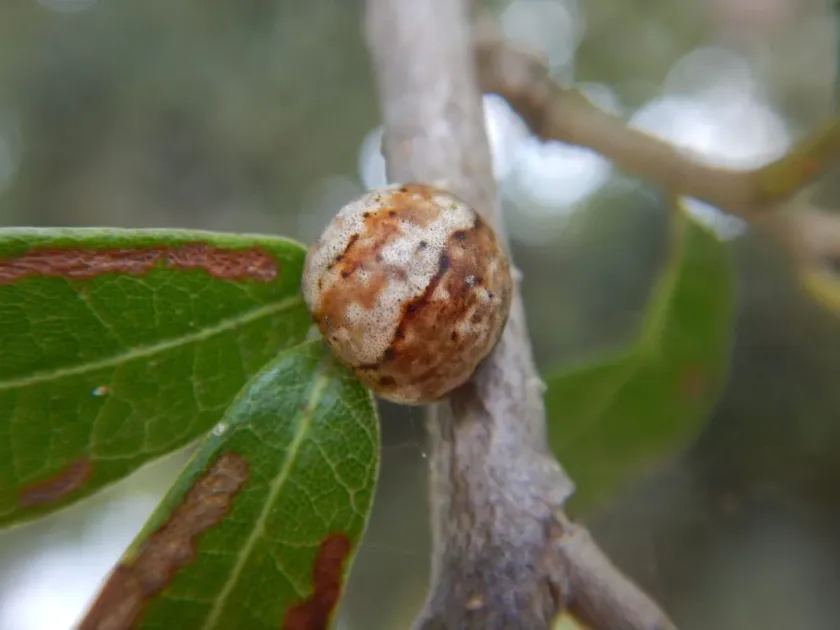
The females are easily identified by their globular, gall-like appearance. They often look like smooth, shiny brown or reddish buds attached to the twigs.
Male insects are notably different; they are winged and much smaller than females, which allows them to seek out females for reproduction.
The first-instar larvae, or crawlers, are the only mobile stage. They are flat and oval, equipped with legs to travel across the bark to find suitable feeding sites.
After egg-laying, the female body acts as a protective shield, covering the eggs and emerging crawlers against environmental hazards and predators.
What it damages
Oak kermes primarily affects various species of oak (Quercus). They are frequently found residing on young twigs and in the junctions of branches.
These pests damage the tree by piercing the plant tissue and sucking the sap, which saps the tree's vigor and hampers its overall development.
Infestation stresses the oak, potentially making it more susceptible to secondary fungal infections and attacks by other wood-boring insects.
In cases of heavy infestation, the shoots may become stunted, twisted, or distorted, and localized branch dieback is a common observation.
Young trees and saplings are particularly vulnerable; a high concentration of scale insects can significantly retard their annual growth rate.
When it appears
The insect overwinters as a fertilized female, hiding within bark crevices or on the twigs, often blending into the tree's natural texture.
As spring temperatures rise and sap flow begins, the females resume feeding and swell in size in preparation for the egg-laying season.
Crawlers emerge during the summer months, typically peaking in June and July, when they move to new locations to establish their own colonies.
After the brief mobile crawler phase, they settle down to feed, and the cycle continues until the arrival of autumn when the next generation matures.
The timing of the crawler emergence is critical for pest management, as this is the period when they are most exposed and easiest to treat.
Signs of infestation
The most distinctive sign is the presence of hard, ball-like growths on the branches, which can be easily mistaken for dormant buds or twig galls.
Sticky honeydew secretions found on the bark or surrounding leaves are a clear indication of a heavy infestation by sap-sucking scale insects.
The growth of sooty mold, a black fungus that thrives on the honeydew, gives the branches and twigs a dark, dirty appearance.
Yellowing leaves and the premature shedding of foliage in mid-summer are symptoms that the tree is struggling due to significant nutrient loss.
Visible branch dieback, particularly in the inner canopy, combined with the presence of scale shells, confirms a long-term colony settlement.
Control measures
Systemic insecticides are the most effective control method, specifically applied when the crawlers are active and searching for feeding sites.
For ornamental trees, manual removal of the visible female scales during the off-season can help reduce the population in smaller garden settings.
Dormant oil sprays applied in early spring can smother overwintering females, serving as a preventative measure to lower infestation pressure.
Maintaining tree vigor through proper irrigation and balanced fertilization helps trees recover and improves their natural resistance to scale insects.
Regular monitoring of oak trees during early summer is essential to catch the crawler stage before they settle and form their protective shells.
Taxonomy
- Latin name
- Kermes quercus
- Order
- Hemiptera (bugs, aphids, leafhoppers)
- Family
- Kermesidae
- EPPO code
- KERMQU
Discussion
No discussions yet — be the first.