
Oak kermes
Kermes pubescens
Description
How to identify
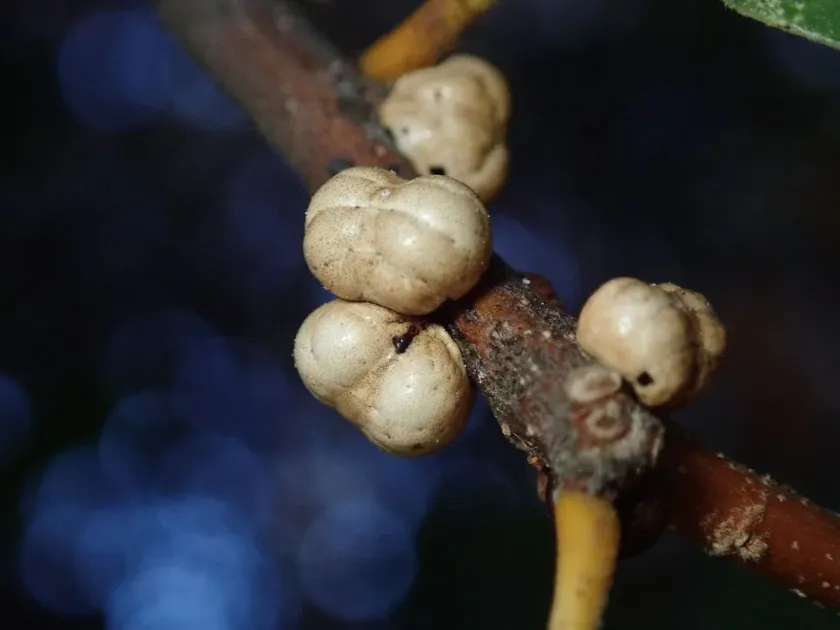
The oak kermes (Kermes pubescens) is a scale insect belonging to the family Kermesidae of the order Hemiptera. Adult females are known for their spherical shape, which often resembles a gall on the host plant's twigs.
The female's body is covered in distinctive fine hairs or pubescence, which provides the species with its scientific name and common appearance. They typically range in color from yellowish-brown to reddish-brown.
Males are significantly different, as they are winged and much smaller than the females. The first-instar larvae, often referred to as crawlers, are mobile and have well-developed legs to navigate the tree surface.
This species is highly host-specific, primarily infesting various species of oak. Unlike many other scale insects, they do not produce a hardened, flat protective shield, relying instead on their body structure for protection.
Reproduction involves a mating process, after which the female becomes sedentary. She produces eggs that are protected underneath her body as she matures and hardens into a capsule-like form.
What it damages
The primary hosts of this pest are various oak species. The insects feed by inserting their piercing-sucking mouthparts into the bark and cambium, extracting essential tree sap.
Heavy infestations can lead to significant physical damage to the tree's bark, causing cracking and deformation. These cracks serve as entry points for secondary pathogens, including fungi and bacteria.
Continuous sap extraction weakens the tree, resulting in stunted growth of young shoots and branches. Over time, heavy infestations can cause branch dieback and significantly reduce the vigor of the entire tree.
During the feeding process, the kermes secrete honeydew, a sugary substance that coats the leaves and bark. This byproduct encourages the growth of sooty mold, which blocks sunlight and hinders photosynthesis.
If left unmanaged, chronic infestations lead to the decline of the tree's health, making it increasingly susceptible to other environmental stresses and secondary insect attacks.
When it appears
The life cycle of the oak kermes is completed in one year. They spend the winter as second-instar larvae, which remain dormant in crevices of the bark or under bud scales on the branches.
In the spring, as the sap begins to flow in the oak tree, the larvae awaken and resume feeding. During this time, they undergo rapid growth and molting to reach maturity.
Mating usually takes place in early summer, when the winged males emerge to fertilize the females. Shortly after this, the females settle into a permanent feeding position and begin their maturation process.
Eggs are laid in mid-summer, typically in July. Once the eggs hatch, the new crawlers disperse across the tree branches to find optimal locations to establish themselves before the onset of autumn.
As autumn progresses, the crawlers settle into their overwintering sites, where they will remain dormant until the next spring, thus concluding their annual developmental cycle.
Signs of infestation
One of the most obvious signs of infestation is the presence of small, spherical, bump-like structures on the smaller branches. These are the mature females appearing as galls.
Sticky honeydew covering the leaves and twigs is a classic indicator of scale insect activity. This often leads to the development of a dark, powdery sooty mold covering the affected areas.
Premature yellowing and drop of leaves on specific branches often indicate localized stress caused by a high population of kermes insects feeding on the vascular tissues.
Bent or misshapen twig growth is another sign, as the insects frequently congregate around nodes and buds, interfering with normal growth patterns during the spring season.
Regular inspections using a magnifying glass can reveal the presence of tiny, scale-like larvae nestled in the bark fissures, which confirms the early stages of an infestation.
Control measures
Biological control is highly effective, as several species of ladybird beetles and parasitic wasps naturally predate on the kermes, helping to regulate their populations in woodland settings.
In ornamental or urban landscapes, the use of systemic insecticides can be highly effective when applied during the crawler stage, as they are the most vulnerable at this point in their life cycle.
Pruning out heavily infested branches is a practical cultural control method. This physical removal significantly reduces the local population density and prevents further spreading.
Dormant oil applications during the winter or early spring can smother the overwintering larvae, preventing them from emerging or resuming feeding when the growing season begins.
Maintaining overall tree health through proper fertilization and watering increases the tree's resilience, allowing it to withstand minor infestations without suffering permanent damage.
Taxonomy
- Latin name
- Kermes pubescens
- Order
- Hemiptera (bugs, aphids, leafhoppers)
- Family
- Kermesidae
- EPPO code
- KERMPU
Discussion
No discussions yet — be the first.