
Oak kermes
Kermes nawae
Description
How to identify
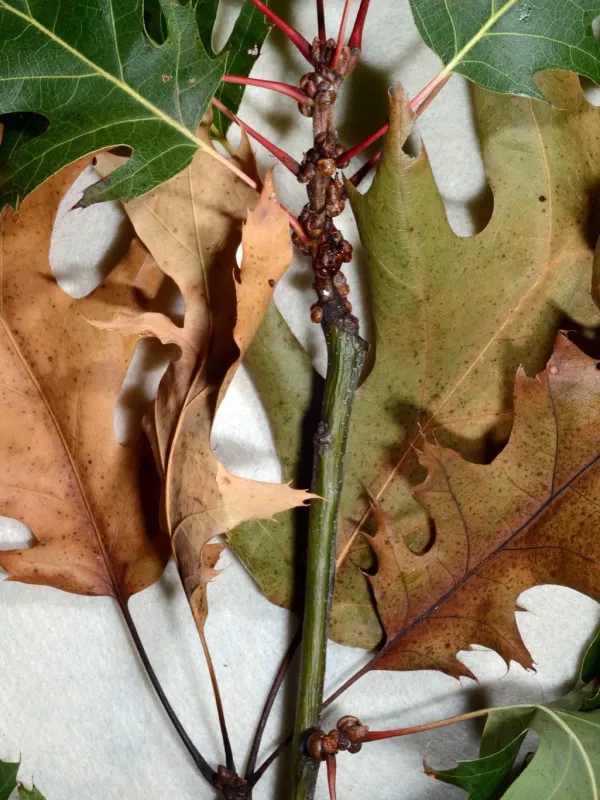
Oak kermes (Kermes nawae) belongs to the family Kermesidae, order Hemiptera. Adult females of this pest resemble smooth, spherical galls, measuring about 3–6 mm in diameter, which are often mistaken for young acorns.
The coloration of the females ranges from yellowish-brown to reddish-brown with a distinct dark pattern. They are virtually immobile and attach themselves firmly to the bark of one- or two-year-old shoots.
The males are significantly smaller than the females, possess developed wings, and are capable of flight during the mating season. Their life cycle is very short, making them difficult to detect during standard tree inspections.
First-instar larvae, known as crawlers, are mobile, allowing them to disperse across the tree canopy or be carried by the wind to neighboring plants.
The insect undergoes complete metamorphosis, and females spend most of their life cycle protected by a tough, scale-like shell that guards them from external threats.
What it damages
The primary host of the oak kermes is the Quercus (oak) genus. The damage manifests as a weakening of the tree's vigor caused by the continuous feeding on sap from young shoots.
Mass reproduction of the pest leads to the deformation of branches and a significant reduction in the tree's overall growth rate. Severe infestations result in premature leaf drop and the gradual dying back of the canopy.
Damaged bark areas become entry points for secondary infections, including fungal diseases and bacterial necrosis, which significantly accelerate the decline of the host tree.
The reduction in the tree's immune system makes it more vulnerable to other types of pests, such as wood borers, which often attack in complex infestations.
In urban landscapes, infested oaks lose their aesthetic value, which is critical for parks, forest gardens, and private green spaces.
When it appears
The species primarily overwinters as fertilized females or larvae hidden in bark crevices. In spring, as stable warm temperatures arrive, the insects enter their active feeding phase.
The emergence of crawlers occurs in late spring or early summer, when they actively colonize the fresh growth of the current season.
Female development continues throughout the summer until autumn, when they reach maturity and become fertilized.
In temperate climates, the generation is typically annual, although the exact timing can shift depending on the specific temperature conditions of the season.
The most effective time for visual monitoring and pest control is during the period of mass emergence of young crawlers on the surface of the bark.
Signs of infestation
The first sign of infestation is the appearance of specific spherical growths on young shoots that look like small, shiny beads or berries.
The presence of abundant honeydew on leaves and branches is a clear indicator of pest activity. Sooty mold often colonizes this honeydew, turning the bark black.
One may observe distortion or thickening of the affected shoots, indicating a disruption of sap flow within the plant tissues.
- Yellowing of leaves in mid-summer.
- Premature leaf fall.
- Dieback of branch tips in the upper crown.
If clusters of insects are found on the bark during inspection, it confirms an active infestation requiring immediate phytosanitary action.
Control measures
Effective management requires a combined strategy, including both silvicultural practices and the application of specialized chemical control agents.
In cases of low population density, mechanical removal of infested shoots followed by their destruction via burning at the site is highly effective.
Chemical protection is most effective during the crawler emergence period. At this stage, systemic insecticides with contact-stomach action are recommended.
Maintaining high standards of tree care is crucial: timely fertilization, proper watering, and preventing stress factors help boost the natural resistance of oak trees.
Biological control involves the encouragement of natural entomophagous predators, such as ladybird beetles (Coccinellidae), which actively feed on kermes larvae.
Taxonomy
- Latin name
- Kermes nawae
- Order
- Hemiptera (bugs, aphids, leafhoppers)
- Family
- Kermesidae
- EPPO code
- KERMNA
Discussion
No discussions yet — be the first.