

Pest · Coleoptera (beetles) · affects Potato, Apple, Winter wheat
Especially harmful
Apple fruit weevil
Rhynchites bacchus
Description
How to identify
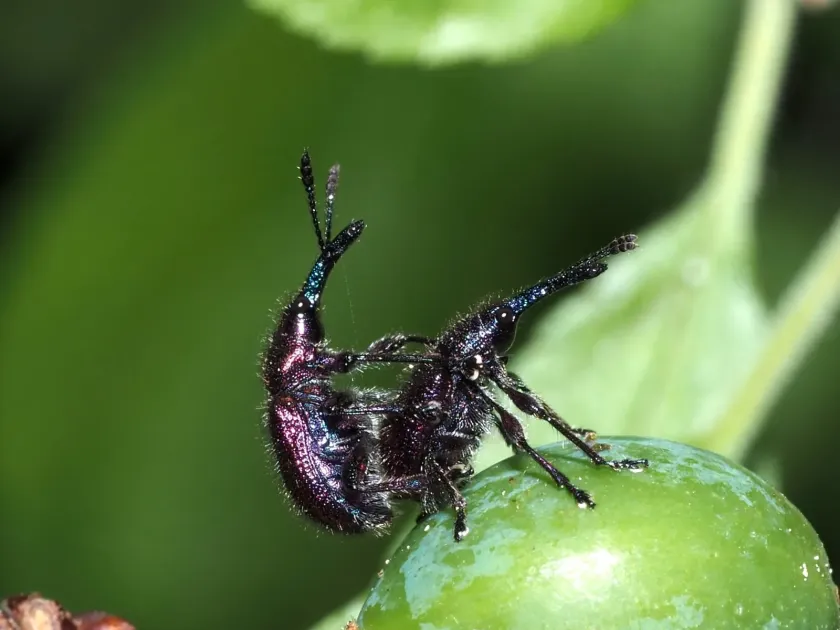
The apple fruit weevil (Rhynchites bacchus), also known as the purple apple weevil, belongs to the family Attelabidae, order Coleoptera. These beetles are 4–6.5 mm long with a distinct metallic, purple, or copper-colored sheen.
The body is densely covered with fine grey hairs. The snout is slender and elongated, a feature characteristic of the weevil family, used for both feeding and drilling into fruits.
Larvae are white, legless, curved, and have a brown head capsule. They develop primarily within fallen fruits, feeding on the internal tissues and seeds.
Adults overwinter in the soil or under leaf litter, emerging in early spring when temperatures rise above 10°C. They are highly active during the day.
The species completes one generation per year. Mating occurs in spring, followed by egg-laying in fruit buds or small fruitlets, often accompanied by the cutting of the fruit stalk.
What it damages
This pest mainly attacks apple, pear, plum, and apricot trees. Heavy infestations can lead to significant fruit loss, impacting the overall yield of the orchard.
Beetles cause damage by feeding on leaf buds, resulting in withered buds that fail to develop into flowers or foliage, thus weakening the tree's vigor.
In spring, the feeding activity on developing fruitlets leads to premature fruit drop. This is caused by the female's habit of cutting the stem after oviposition.
Larval development inside fruits creates corky areas on the surface and leads to tissue decay. Fruits that remain on the tree become deformed and unmarketable.
Entry wounds made by adults facilitate the introduction of fungal pathogens, specifically brown rot, which rapidly spreads through the crop during the summer.
When it appears
Emergence from overwintering sites begins in early spring, synchronized with the bud-burst stage of pome fruit trees. Peak activity occurs during flowering.
During warm days, beetles are highly mobile, flying between trees to feed and mate. Conversely, in cold or windy weather, they remain stationary or drop from the canopy.
Oviposition is a prolonged process, lasting from the flowering period through the initial weeks of fruit development, requiring sustained monitoring by growers.
During the summer months, adult beetles persist, causing further mechanical damage to ripening fruit through surface feeding, leaving pits and holes.
As autumn approaches, activity levels drop as beetles move toward the soil to hibernate at depths of up to 15 cm until the next spring season.
Signs of infestation
The earliest signs include small, deep punctures on buds and young leaves. Buds that have been heavily fed upon often fail to open and eventually dry out.
Widespread dropping of young fruitlets in late spring is a definitive indicator of an active infestation, often showing signs of the stem being severed.
Fruits exhibit dark, sunken pits or spots where adult feeding occurred. Over time, these areas often develop into necrotic corky scabs on the fruit skin.
When shaking branches in the morning, beetles may fall to the ground, often feigning death, which allows for quick visual inspection of the population.
Decaying fallen fruits containing larvae serve as a clear sign that the pest cycle has successfully established itself within the orchard environment.
Control measures
Sanitation is critical; regularly collecting and destroying fallen, infested fruit prevents larvae from entering the soil and completing their life cycle.
Tilling or cultivating the soil under tree canopies in autumn exposes overwintering beetles to cold temperatures and predators, significantly reducing the next season's population.
Sticky bands applied to tree trunks during the spring can help block or trap beetles climbing from their overwintering sites toward the canopy.
Chemical control via contact or systemic insecticides should be timed for the "green tip" stage and immediately post-bloom to protect the developing fruitlets.
- Regular orchard hygiene and sanitation.
- Encouraging natural predators like birds.
- Careful monitoring during the blooming window.
- Using bio-rational pesticides during the ripening phase.
In brief
10
Damages crops
Content graph
Damages crops · 10
Content graph
Connections · Apple fruit weevil
Most often together:
Marketplace
Products · 14


Actara 25 WG granules, Insecticide (thiamethoxam 250 g
Kemark
Insecticides
0
0
·
54
4 offers
2.22 €per 1 l
Buy

Biology
Taxonomy
- Latin name
- Rhynchites bacchus
- Order
- Coleoptera (beetles)
- Family
- Attelabidae
- EPPO code
- RNCHBA
Community
Discussion
No discussions yet — be the first.