

Pest · Diptera (flies) · affects Wild cabbage, Potato, Tomato
Especially harmful
Cabbage root fly
Delia radicum
Description
How to identify
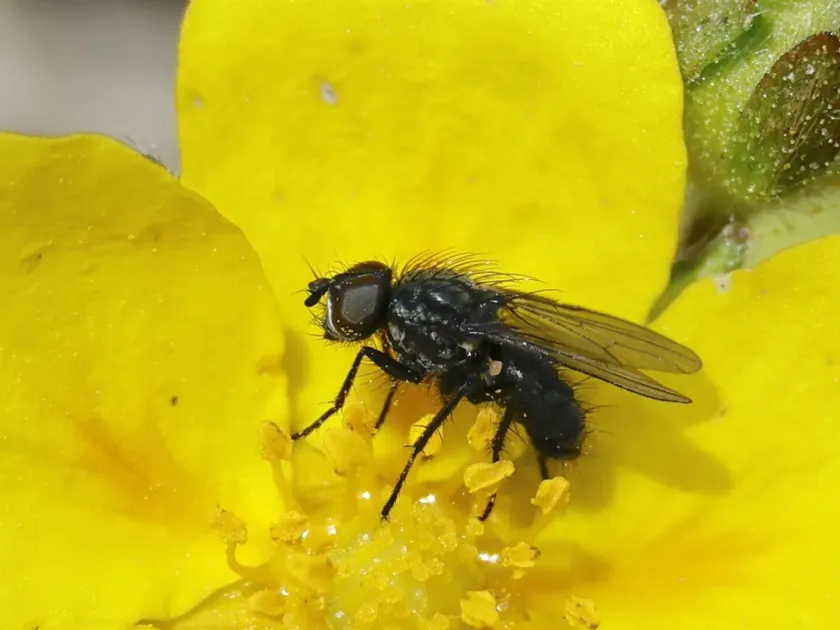
The Cabbage root fly (Delia radicum) belongs to the order Diptera, family Anthomyiidae. Adult flies are small, ash-gray insects, similar in appearance to common house flies, but with distinct dark longitudinal stripes on the thorax.
The eggs are white, elongated, and measure about 1 millimeter. Females lay them in clusters in the soil crevices or directly near the stems of host plants, which is the primary site of infestation.
The larvae are legless, white to yellowish maggots that grow up to 8 millimeters long. This larval stage is the one responsible for the significant damage to crops.
Pupation occurs in the soil inside brown, barrel-shaped puparia. These puparia serve as the stage in which the insect survives unfavorable conditions or winter dormancy.
The life cycle includes a complete metamorphosis. Depending on the geographical region and climate, the cabbage root fly typically completes two to three generations per year.
What it damages
The primary hosts are members of the Brassicaceae family. All types of cabbage, including broccoli, cauliflower, Brussels sprouts, and kale, are highly susceptible to infestation.
Beyond cabbage, the pest also attacks radishes, turnips, swedes, and rutabagas. Infestations can also occur on wild cruciferous weeds, which serve as alternative food sources.
Larvae feed by boring into the roots and the base of the stems. This feeding behavior destroys the vascular system of the plant, preventing the uptake of water and nutrients.
Young plants or seedlings are particularly vulnerable and can be killed outright by heavy infestations. In mature plants, the damage results in stunted growth and reduced yields.
The tunnels created by larvae allow secondary pathogens, such as bacteria and fungi, to enter the root system, causing rot that exacerbates the primary damage.
When it appears
The first emergence of overwintering flies usually coincides with the flowering of lilacs and dandelions, signaling that the soil has reached the required temperature for activity.
The first generation is most dangerous to early-season seedlings. At this stage, the plant's root system is delicate and can be easily overwhelmed by larval feeding.
The second generation typically appears in mid-summer, posing a severe threat to late-planted varieties of cabbage and root crops that are developing their edible parts.
A partial third generation may occur during long, warm summers or in specific temperate zones, extending the period of risk for late-season vegetable production.
Favorable conditions include mild temperatures and moist soil. Extended periods of drought can sometimes limit the activity of adult flies, though eggs can still survive in cooler, deeper soil layers.
Signs of infestation
The first symptom is noticeable wilting during the hottest part of the day, with plants often appearing to recover during cooler morning or evening hours.
Foliage may take on a characteristic bluish or yellowish tint as the root system fails to transport enough water. In severe cases, the entire plant may collapse.
When pulling an infested plant from the soil, the roots will often break off easily, appearing decayed or riddled with tunnels. The presence of white maggots near the root collar is definitive.
Growth stops entirely as the infestation progresses. This is frequently followed by the death of the plant, especially in young seedlings or radishes that are nearing harvest.
In addition to wilting, the base of the stem may appear sunken or darkened, indicating where the larvae have entered or caused secondary bacterial decay.
Control measures
Crop rotation is a fundamental management practice. Moving brassica crops to a new site every three to four years helps prevent the buildup of pest populations in the soil.
Physical barriers such as insect-proof netting or fleece covers are highly effective at preventing female flies from reaching the soil to lay their eggs near the plants.
Good soil management, including deep cultivation after harvest, helps disrupt the life cycle by exposing puparia to natural predators or desiccating them.
Chemical control involving authorized insecticides can be applied as a root drench or soil treatment, provided the timing coincides with peak fly emergence and legal restrictions.
- Remove all cruciferous weeds from the field borders to minimize alternative hosts.
- Use biological controls such as predatory nematodes which target larvae in the soil.
- Apply mulches or collars around the plant base to discourage egg-laying behavior.
Content graph
Connections · Cabbage root fly
Most often together:
Marketplace
Products · 3


Biology
Taxonomy
- Latin name
- Delia radicum
- Order
- Diptera (flies)
- Family
- Anthomyiidae
- EPPO code
- HYLERA
Community
Discussion
No discussions yet — be the first.