
Castor bean tick
Ixodes ricinus
Description
How to identify
The castor bean tick (Ixodes ricinus) belongs to the family Ixodidae, the hard ticks. While not a plant pest, it is a significant medical and veterinary concern that directly impacts the agricultural working environment.
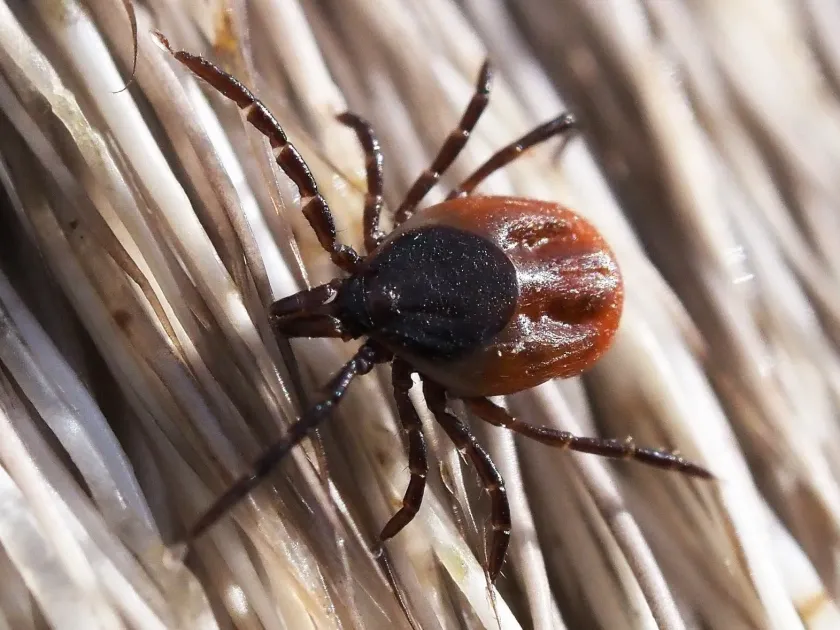
Adult ticks have a flat, oval body. Females measure about 3-4 mm in their unfed state and can reach up to 10-12 mm when engorged with blood. Their color is dark brown to black, making them difficult to spot on vegetation.
The life cycle is complex, involving three stages: larva, nymph, and adult. Each active stage requires a blood meal from a vertebrate host to develop and transition to the next level of the life cycle.
Ticks hibernate in the leaf litter, under the surface of the soil, or within dense grass. They emerge as soon as temperatures rise in early spring to begin their quest for a host.
They are resilient survivors capable of waiting in ambush for months at a time, climbing onto low-lying plants to attach themselves to passing livestock or farm workers.
What it damages
The castor bean tick causes no direct damage to crops. Instead, the damage is focused on the health and safety of farm staff and livestock, often limiting the use of certain agricultural fields or pastures.
Infection risks include Lyme disease and tick-borne encephalitis, which pose a severe risk to the labor force and can lead to operational downtime for agricultural businesses.
Livestock frequently suffer from tick-borne diseases, such as babesiosis, which results in reduced milk yield, weight loss, and general weakness in cattle, severely impacting farm productivity.
The presence of high tick populations often forces farmers to restrict grazing schedules or invest heavily in protective acaricides for their herds.
Management of these parasites is a necessary cost for maintaining a healthy and productive farm environment, preventing both human health issues and animal performance drops.
When it appears
The seasonal activity of Ixodes ricinus generally begins in early spring, once temperatures exceed 5°C to 7°C, with peak activity occurring between April and June.
Mid-summer heat and dry conditions typically lead to a reduction in tick activity, as they move into cooler, more humid soil layers to prevent dehydration.
A second period of activity often occurs in late summer and early autumn as temperatures cool down, continuing until the arrival of the first heavy frosts.
Activity levels are highly dependent on relative humidity; ticks are sensitive to desiccation and prefer moist habitats, often found along field margins and near wooded areas.
Farm operators should conduct regular monitoring during the active season, particularly when working in fields adjacent to forests or overgrown scrubland.
Control measures
Effective control relies on habitat management, such as frequent mowing of grass along road verges and pasture perimeters to reduce suitable tick micro-habitats.
Chemical control involving authorized acaricides is necessary for high-risk areas, such as barns and peripheral pasture zones, to reduce the overall population of the parasite.
Rodent control is vital, as small mammals serve as the primary host for immature tick stages (larvae and nymphs), significantly contributing to the population cycle.
- Maintain short grass around field edges and working areas.
- Ensure livestock are treated with appropriate systemic anti-tick medications.
- Use protective clothing treated with repellents for field workers.
- Create dry buffer zones (gravel or wood chips) to prevent tick movement from forests.
Integrated pest management (IPM) strategies, combining vegetation maintenance and strategic chemical applications, provide the best protection against tick-related risks on a farm.
Taxonomy
- Latin name
- Ixodes ricinus
- Family
- Ixodidae
- EPPO code
- IXODRI
Discussion
No discussions yet — be the first.