
Green Isotoma
Isotoma viridis
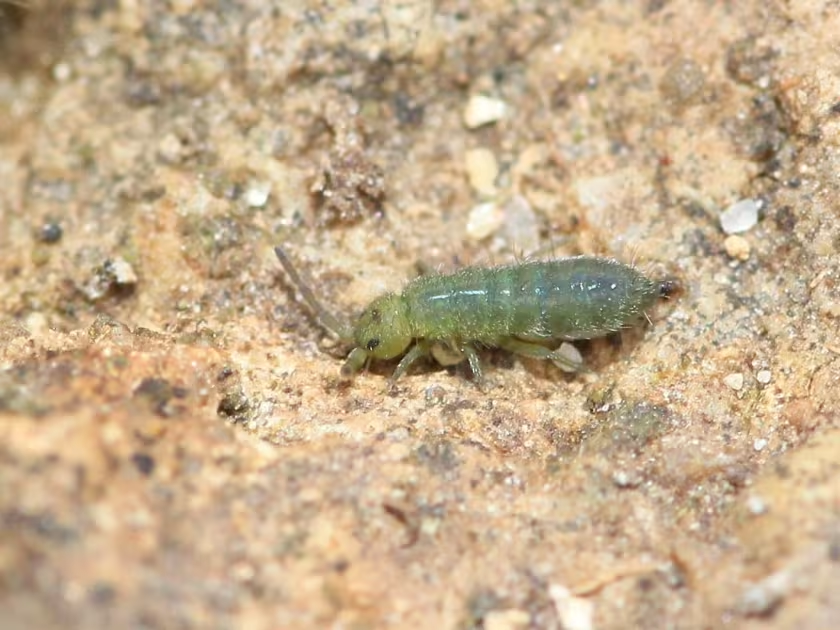
Description
How to identify
The Green Isotoma (lat. Isotoma viridis) belongs to the class Entognatha, order Collembola (springtails), and family Isotomidae.
It is a tiny arthropod measuring 2 to 3 mm in length, characterized by a greenish-yellow or olive coloration that provides camouflage within plant debris.
The pest has an elongated, segmented body equipped with a furcula (a spring-like organ on the abdomen), which allows the insect to perform sudden jumps.
Unlike many other springtail species, Isotoma viridis moves actively across the soil surface and aerial parts of plants, preferring damp and shaded areas.
This species is a typical representative of soil fauna, but when population densities are high, it can shift to feeding on cultivated plant tissues.
What it damages
This pest primarily damages young seedlings, seeds, sprouts of vegetable and flower crops, as well as the tender tissues of greenhouse transplants.
Major damage occurs under conditions of high substrate moisture, when springtails start feeding on root hairs and the lower parts of young stems.
Both adults and larvae cause damage by gnawing on the epidermis of leaves and stems, which leads to necrosis and subsequent wilting of the plants.
They pose the greatest threat in protected ground environments and nurseries, where humidity creates ideal conditions for rapid mass reproduction.
Indirect damage occurs as these feeding lesions create entry points for fungal and bacterial pathogens, which often lead to rotting processes.
When it appears
The activity of the Green Isotoma is directly linked to environmental humidity and soil temperature, with peak populations occurring during spring and autumn.
In greenhouse environments, the pest can remain active and continue reproducing throughout the entire calendar year if a food source is present.
Reproduction takes place in the soil, and a substrate moisture content exceeding 70-80% is a critical factor that triggers rapid population outbreaks.
Seasonal appearances of mass congregations on the surface often coincide with periods of frequent watering of seedlings and the application of organic fertilizers.
Adults and eggs overwinter in the upper soil layers or within decaying plant material, where they can maintain sufficient moisture levels for survival.
Signs of infestation
The presence of this pest can be detected by characteristic tiny, round holes on cotyledons and true leaves of seedlings, resembling flea beetle damage.
When inspecting the soil surface in pots or greenhouses, one can observe "jumping dust"—masses of tiny light-colored individuals that jump away when touched.
Seedlings may show stunted growth, yellowing of leaf margins, and gradual wilting for no apparent reason related to water deficiency.
The appearance of a moldy layer on the soil surface often signals excessive moisture, which acts as a warning sign for potential Green Isotoma infestation.
A generally depressed state of plants combined with high organic matter content in the soil indirectly indicates the presence of this Collembola species.
Control measures
The primary control measure is the optimization of irrigation regimes to prevent water stagnation, which makes the environment unsuitable for the pest.
It is recommended to use drainage systems and cultivate the topsoil to promote drying, which significantly reduces the Green Isotoma population.
An effective agrotechnical practice is the sterilization of potting mixes before use, through steaming or freezing, to eliminate eggs and larvae.
Biological control can be achieved by drenching the soil with solutions containing entomopathogenic fungi, such as Beauveria bassiana.
- Application of systemic insecticides (in case of severe infestations).
- Covering the soil surface with dry sand or wood ash.
- Removing all plant debris from greenhouses promptly.
- Using yellow sticky traps for population monitoring.
Taxonomy
- Latin name
- Isotoma viridis
- Family
- Isotomidae
- EPPO code
- ISTAVI
Discussion
No discussions yet — be the first.