
Pyrenean bush-cricket
Isophya pyrenea
Description
How to identify
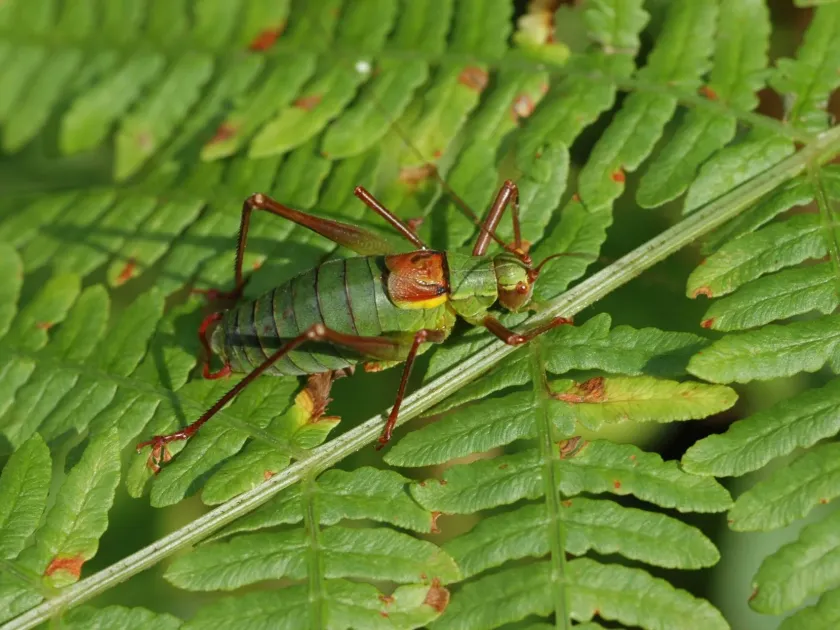
The Pyrenean bush-cricket (Isophya pyrenea) belongs to the order Orthoptera and the family Tettigoniidae. This insect is of medium size and features a green coloration that serves as effective camouflage.
Adults possess powerful hind legs adapted for jumping and well-developed chewing mouthparts. Females have a distinct saber-shaped ovipositor used for laying eggs within plant tissues or the soil.
Nymphs resemble the adults but are smaller in size and lack fully formed wings. Their color can range from light green to brownish, depending on environmental humidity and temperature.
These insects are primarily nocturnal or crepuscular, hiding within dense vegetation during the day, which makes them difficult to detect in the early stages of infestation.
Identification requires careful examination of morphological features, as this species can be easily confused with other members of the genus Isophya.
What it damages
The Pyrenean bush-cricket is a polyphagous pest, meaning it feeds on a wide range of agricultural crops. Commonly affected plants include cereals, legumes, and various vegetables.
Significant damage occurs during periods of population outbreaks, when high densities of insects cause severe defoliation. This leads to reduced yields and plant vigor.
In addition to cultivated crops, these crickets feed on various wild grasses and weeds, which serve as reservoirs for the pest near field margins.
Damage manifests as ragged holes in leaves, buds, and young shoots. Under high infestation pressure, entire stems can be stripped of foliage, causing critical plant stress.
Beyond mechanical damage, the feeding activity creates entry points for fungal and bacterial pathogens, leading to secondary infections in the crop.
When it appears
The life cycle of the species is strictly linked to seasonal climate changes. Eggs typically overwinter in the upper soil layers or within plant residues, showing high cold tolerance.
Nymph hatching occurs in spring as soon as temperatures become favorable. The insect undergoes several developmental stages before reaching adulthood.
The peak of damage by adults usually occurs during summer months, which coincides with active feeding and reproduction.
The species is univoltine, meaning it produces only one generation per year, which is a critical factor for timing pest control efforts.
Monitoring should begin in early spring to identify the emergence of nymphs and prevent their spread across the agricultural site.
Signs of infestation
The primary sign of infestation is the presence of characteristic irregular holes on leaf margins. Unlike some caterpillars, the damage caused by these crickets is typically rough.
- Presence of insect excrement on leaves and soil surface.
- Direct observation of the crickets while scouting the fields during twilight.
- Damage to generative plant parts such as flower buds and fruit sets.
- Noticeable reduction in plant growth rate due to loss of leaf area.
- Presence of shed nymphal skins on stems.
The audible "stridulation" (chirping) of males in the evening is a reliable indicator of population density and warrants closer inspection of the area.
Field scouting should follow a diagonal pattern, with specific attention paid to field edges where populations often establish themselves initially.
Density counts should be performed by calculating the number of individuals or damaged plants per square meter to assess the economic threshold.
Control measures
Cultural control methods involve thorough soil cultivation, which disrupts egg-laying sites and reduces the overwintering population for the next season.
Maintaining clean field margins by regularly mowing weeds is a highly effective way to reduce the alternative food sources for the bush-crickets.
When the economic threshold is exceeded, application of approved insecticides may be necessary to protect the crop quality and yield.
Timing is crucial: treatments are most effective against early nymphal stages, as younger insects are more susceptible to chemical interventions than hardened adults.
Integrated Pest Management (IPM) strategies, which include biological control and habitat modification, are recommended to provide long-term sustainability.
Taxonomy
- Latin name
- Isophya pyrenea
- Order
- Orthoptera (locusts)
- Family
- Phaneropteridae
- EPPO code
- ISPYPY
Discussion
No discussions yet — be the first.