
Isophya
Isophya
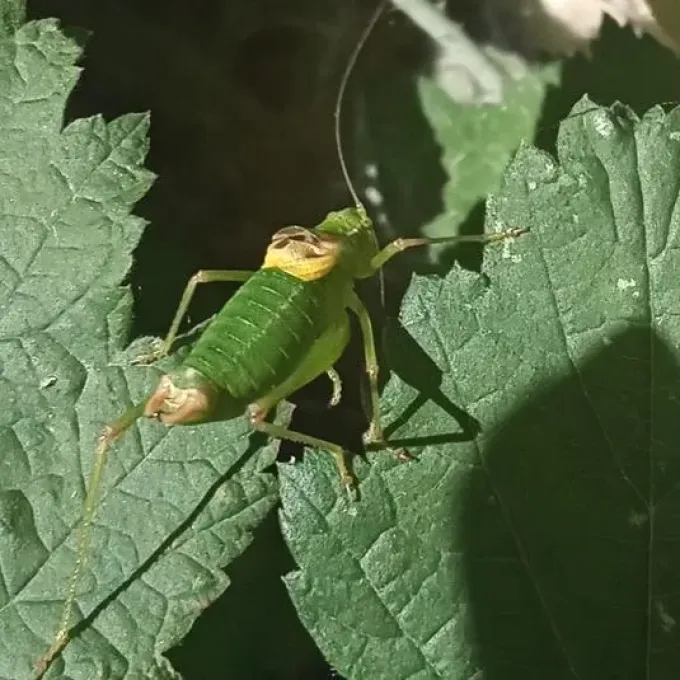
Description
How to identify
Isophya belongs to the family Tettigoniidae (bush-crickets) of the order Orthoptera. These are medium-sized insects, typically green in color with well-developed hind jumping legs.
Morphologically, members of the genus are characterized by shortened elytra, especially in females, whose ovipositors are often sickle-shaped. The head is large, with a powerful chewing mouthpart adapted for plant tissue consumption.
The insects' coloration often blends with the grassy background, making them difficult to spot in their natural habitat. Adults possess well-developed auditory organs and sound-producing apparatuses.
Development occurs via incomplete metamorphosis. Nymphs resemble miniature versions of adults but lack wings and have immature reproductive organs.
The life cycle includes the egg stage, several nymphal instars, and the adult stage. Eggs are usually deposited in the soil or inside plant tissues, where they successfully overwinter until the following spring.
What it damages
Isophya is a polyphagous pest capable of damaging a wide range of agricultural crops. It causes the most significant damage to cereals, legumes, and industrial crops like flax or sugar beets.
These pests prefer young, succulent plant parts, actively feeding on leaf blades. At high population densities, they can completely destroy seedlings or significantly reduce the foliage surface area.
In addition to leaves, insects damage generative plant organs: inflorescences, flower buds, and developing grains. This leads to direct yield losses and reduced product quality.
Under high infestation pressure, bush-crickets can damage stem epidermis, weakening plant immunity and creating entry points for phytopathogenic fungi and bacteria.
The pest poses a particular danger during dry years, when natural forage on wild grasses is depleted, and insects migrate en masse to cultivated fields.
When it appears
Isophya activity begins in spring, when nymphs emerge from overwintering eggs. This is when pests are most vulnerable to control measures.
Peak damage occurs during summer months, as nymphs pass through several instars and reach adulthood. During this time, green mass consumption reaches its peak.
Reproduction and egg-laying take place in the second half of summer and early autumn. Adults live for several weeks, actively feeding and ensuring population reproduction.
The overwintering stage is the egg, which remains in the soil or plant debris, showing high resistance to low temperatures and moisture.
Pest population monitoring should be carried out annually, starting in early spring, to timely detect breeding hotspots.
Signs of infestation
The first sign of pest presence is the appearance of holes of various shapes and sizes on leaf blades. Leaves look chewed along the edges or have distinct perforations.
The presence of insects can easily be detected visually during morning or evening hours. Bush-crickets move actively in the canopy and emit characteristic chirping sounds.
Insect excrement is often visible in fields, accumulating on leaves and the root zone, which additionally promotes the development of secondary infections.
In areas of massive infestation, significant thinning of crops and stunted growth of plants are observed due to the lack of food availability.
Inspection of inflorescences reveals damaged flower buds, which appear eaten, leading to malformed fruits and grains later in the season.
Control measures
Integrated pest management (IPM) is applied to control Isophya, including agrotechnical, biological, and chemical methods.
- Deep autumn plowing to destroy eggs in the soil.
- Timely weed control where pest hotspots concentrate.
- Application of approved systemic or contact insecticides when the economic threshold is reached.
- Use of entomophages for natural suppression of bush-cricket populations.
- Crop rotation and spatial isolation of fields.
Chemical treatment is most effective at the early nymphal stages when insects are less mobile and more sensitive to insecticides.
Agrotechnical measures, such as mowing field borders and meadows, help reduce pest migration from natural habitats to cultivated fields.
Monitoring fields using light traps or visual counts per square meter allows for timely decision-making regarding protective measures.
Taxonomy
- Latin name
- Isophya
- Order
- Orthoptera (locusts)
- Family
- Phaneropteridae
- EPPO code
- ISPYSS
Discussion
No discussions yet — be the first.