
Cottony cushion scale
Icerya purchasi
Description
How to identify
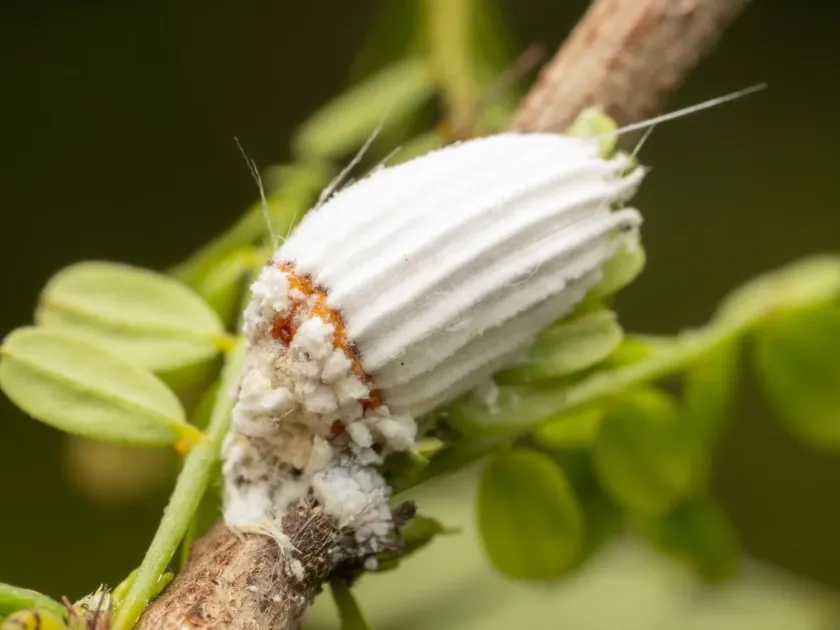
The cottony cushion scale, Icerya purchasi, is a notorious pest belonging to the family Margarodidae. The adult female is easily distinguished by its brownish body and a large, white, fluted ovisac containing hundreds of eggs.
Male cottony cushion scales are rare and winged, capable of flight, which aids in the spread of the population across orchards. However, the females remain largely sedentary once they have selected a suitable feeding site.
The crawlers (first-instar nymphs) are bright red, mobile, and move actively across the plant to find succulent veins on leaves and stems to begin feeding. Their small size makes them difficult to spot in the early stages of an infestation.
The species is primarily parthenogenetic, meaning females can produce viable eggs without mating with a male. This biological trait allows a single individual to initiate a significant infestation on a healthy plant.
The life cycle is influenced by environmental temperature, with faster development occurring in warmer climates. In greenhouse settings, the scale can complete multiple overlapping generations throughout the year.
What it damages
This pest is a major threat to citrus production, including lemons, oranges, and limes. It infests both the leaves, stems, and trunks, extracting vital sap and causing severe physiological stress to the plant.
Beyond citrus, Icerya purchasi has a very broad host range, including woody ornamentals like roses, Pittosporum, acacias, and magnolias. It can cause significant damage in gardens, parks, and agricultural nurseries.
Feeding damage leads to leaf yellowing, stunting of shoot growth, and fruit drop. In severe cases, the entire tree can become weakened, making it susceptible to secondary pests and various pathogens.
The scale secretes copious amounts of honeydew as it feeds. This substance covers the plant surface, attracting ants and facilitating the growth of sooty mold, which creates a black, unsightly layer on leaves.
Sooty mold interferes with the plant's ability to photosynthesize effectively, further compounding the damage caused by sap extraction. In commercial agriculture, this leads to significant economic loss and reduced fruit quality.
Signs of infestation
The most diagnostic sign of an infestation is the presence of white, fluted egg sacs on the undersides of leaves or along the woody branches. These structures are highly visible due to their contrasting white color.
Leaves that feel sticky to the touch or appear shiny due to honeydew accumulation are clear indicators of scale activity. This stickiness often draws large numbers of ants to the infected tree.
The presence of black sooty mold on the foliage is a secondary sign that suggests the infestation has reached a moderate to high level. This layer of fungus often obscures the green color of the leaves.
Wilting, curling, and early senescence of leaves are commonly observed in areas of the plant where the colony density is highest. If left unmanaged, twigs and small branches may show signs of dieback.
Direct inspection of the foliage during the warmer months often reveals the movement of bright red crawlers on the stems, indicating that the population is actively expanding to new parts of the host.
Control measures
The most famous and successful example of biological control in history involves the vedalia beetle, Rodolia cardinalis. This predator specifically feeds on Icerya purchasi and can effectively suppress populations.
Chemical control should be implemented judiciously, as broad-spectrum insecticides can kill beneficial insects like the vedalia beetle. Systemic insecticides are generally effective when applied at the appropriate crawler stage.
Pruning out and disposing of heavily infested branches is a key horticultural practice. This reduces the number of pests and improves airflow within the canopy, making the environment less favorable for the scale.
Integrated Pest Management (IPM) is essential for greenhouse environments. This includes regular scouting, strict quarantine of new plant material, and the careful use of horticultural oils to suffocate the insects.
- Application of neem oil or insecticidal soaps to soften the waxy covering.
- Ant management to prevent them from protecting scale colonies from predators.
- Using sticky traps to monitor adult male activity in orchards.
- Maintaining plant vigor through proper irrigation and nutrition to increase resilience.
Taxonomy
- Latin name
- Icerya purchasi
- Order
- Hemiptera (bugs, aphids, leafhoppers)
- Family
- Monophlebidae
- EPPO code
- ICERPU
Discussion
No discussions yet — be the first.