
Drosicha
Drosicha contrahens
Description
How to identify
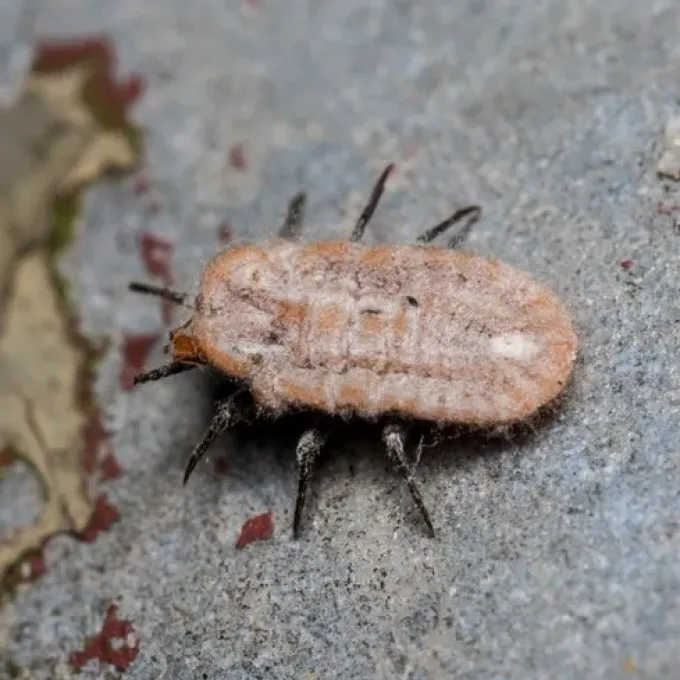
Drosicha (Drosicha contrahens) belongs to the giant scale insect family (Monophlebidae) in the order Hemiptera. These insects are characterized by their relatively large size, with adult females reaching lengths of up to 15 mm.
The body of the female is oval and typically covered in a dense, white waxy or powdery secretion. Adult males are winged, much smaller than females, and display higher levels of mobility during the mating season.
Larvae, known as crawlers, are mobile in their first instar and actively seek suitable feeding sites on branches or foliage. As they develop, they lose mobility and settle down to feed on plant sap.
The life cycle is closely linked to seasonal changes, with the species predominantly distributed across East Asian territories. Winter is typically spent in the egg or early larval stage, protected within waxy ovisacs.
Identification is easiest by spotting the white, cotton-like masses clustered along twigs, bark crevices, and branch forks, which distinguish them from common mealybugs.
What it damages
Drosicha is a polyphagous pest, meaning it attacks a wide variety of plants, including citrus, apples, pears, peaches, and various decorative trees and shrubs.
In addition to orchard crops, it frequently infests forest species such as oaks and maples, where large colonies can cause significant stress to the host plant.
Both larvae and females cause damage by piercing the plant tissue with their mouthparts and extracting vital sap, which weakens the plant and reduces its overall vigor.
The excretion of honeydew by the insects serves as a substrate for sooty mold growth, which covers leaves in a black, powdery layer, effectively blocking the plant's ability to photosynthesize.
Severe infestations lead to stunted growth, leaf chlorosis, premature defoliation, and in extreme cases, the death of individual branches or the entire host tree.
When it appears
The activity begins in early spring as temperatures rise, triggering the emergence of overwintering crawlers that migrate to younger, more succulent plant parts.
Summer marks the period of most intensive feeding and rapid population growth, as the warm climate supports successive stages of insect development.
By late summer and early autumn, mating occurs. Females then produce thick, white waxy ovisacs where they deposit eggs to ensure the survival of the next generation through the winter months.
The number of generations per year can vary depending on local thermal conditions, making early-season monitoring crucial for effective management.
Agronomists emphasize that the spring migration period is the most vulnerable phase for the pest, making it the ideal window for initial intervention.
Signs of infestation
The most prominent sign is the presence of white, cotton-like fluff visible on the bark of stems, branch crotches, and near the leaf petioles.
Sticky honeydew on the foliage is a secondary indicator. This sticky residue often attracts ants, which can act as a natural alarm system for the presence of scale insects.
Affected leaves often show signs of wilting, yellowing, and eventual curling as the nutritional status of the host declines due to sap loss.
The development of a black, sooty fungal coating on the branches or leaves provides clear evidence that a scale colony has been feeding on the plant for a significant duration.
Close inspection of the bark reveals stationary, oval-shaped females that may appear as crust-like bumps, often embedded within the waxy secretions they produce.
Control measures
Integrated pest management starts with cultural practices, such as pruning heavily infested limbs and cleaning away loose, dead bark where the pests tend to hibernate.
Systemic insecticides are the most effective chemical intervention, as they are absorbed by the plant and ingested by the scale insects during their sap-feeding process.
Application of horticultural oils or paraffin-based sprays helps to suffocate the insects by creating a coating that blocks their respiratory systems.
Encouraging biological control agents, such as predatory lady beetles (Coccinellidae), can significantly reduce population levels without relying solely on chemical sprays.
- Regular tree health inspections
- Sanitary pruning of infested branches
- Timely application of systemic pesticides
- Application of dormant oils during winter/early spring
- Managing ant populations to minimize honeydew protection
Taxonomy
- Latin name
- Drosicha contrahens
- Order
- Hemiptera (bugs, aphids, leafhoppers)
- Family
- Monophlebidae
- EPPO code
- DROCCO
Discussion
No discussions yet — be the first.