
Drosicha corpulenta
Drosicha corpulenta
Description
How to identify
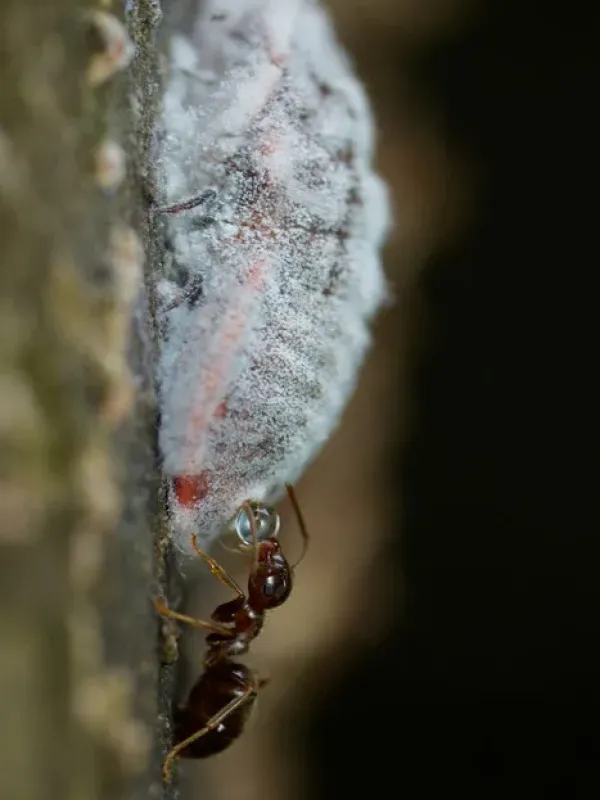
Drosicha corpulenta, commonly known as a type of giant mealybug, belongs to the family Margarodidae. The adult female is large, reaching up to 12 mm in length, with an oval, convex body covered in a dense, white waxy powder.
The coloration of the female is typically dark brown or blackish. Males are significantly different, appearing as small, winged insects with a fragile structure, though they are rarely seen by orchardists compared to females.
Nymphs, often referred to as crawlers in their first stage, are active and possess flat, elongated bodies that allow them to move quickly over the bark and foliage to find suitable feeding sites.
As the nymphs develop, they secrete more wax, which eventually coats their bodies and makes them appear as fluffy white masses stuck to the surface of the branches or leaf stems.
The species is well-adapted to varied environments, and its ability to thrive on both wild and cultivated tree species makes it a persistent inhabitant in its native range.
What it damages
This pest is highly polyphagous, targeting a wide range of fruit-bearing trees such as apples, pears, peaches, plums, and various citrus varieties. It also infests ornamental trees like maples and oaks.
The damage is caused by both nymphs and adult females extracting plant sap. This feeding process drains the tree's energy, leading to stunted growth, deformed shoots, and the yellowing of leaves.
Severe infestations weaken the tree's overall vigor, making it more susceptible to environmental stress, winter damage, and secondary infections by pathogens and other insects.
The excretion of honeydew is a major issue, as it covers leaves and branches, facilitating the growth of sooty mold, which blocks sunlight and interferes with the plant's photosynthetic ability.
In cases of extremely high pest density, individual branches may die back, and the overall productivity of the orchard can be significantly reduced due to the stress exerted by the colony.
When it appears
Drosicha corpulenta typically overwinters in the egg stage, located within the soil near the base of the host tree, protected by waxy secretions that ensure survival through colder months.
The emergence of nymphs begins in early spring, synchronized with the budding of the trees. This is the period when they move from the ground up to the host tree to begin feeding.
Development continues through the late spring and early summer. During this time, the nymphs feed voraciously, pass through several growth stages, and eventually mature into adults.
Mating occurs on the bark of the trees, and shortly thereafter, the females descend towards the soil or the root collar area to deposit their eggs in specialized egg sacs.
There is usually one generation per year, meaning that management strategies can be timed effectively to target the vulnerable crawler stage before they become protected by thick waxy layers.
Signs of infestation
The most visible sign of infestation is the appearance of fluffy, white, cotton-like masses on the bark of tree trunks, crotches, and the undersides of leaves.
The presence of sticky honeydew on the foliage and the subsequent development of black sooty mold are clear indicators that a mealybug colony is present and actively feeding.
Increased ant activity on tree trunks is a reliable secondary sign, as ants are known to tend to these mealybugs to harvest the honeydew, often protecting them from natural predators.
Stunted growth or curling of young spring shoots, combined with premature leaf drop, suggests that the tree is suffering from heavy sap extraction by the insects.
Gardeners may observe clusters of slow-moving or stationary insects that look like white blobs on the bark, which remain fixed in place for extended periods while feeding.
Control measures
Mechanical control is effective in small orchards and involves carefully scrubbing the bark to remove overwintering individuals and using traps to prevent migration.
Chemical control focuses on the early spring crawler stage. Systemic insecticides are generally preferred as they are absorbed by the tree and provide protection against the feeding pests.
Sticky bands applied around the trunks are a non-chemical barrier that can effectively catch nymphs migrating from the soil, preventing them from establishing colonies in the canopy.
Encouraging natural predators such as lady beetles (Coccinellidae) and lacewings is an important component of integrated pest management to keep population levels low without excessive chemical use.
Regular monitoring of the orchard is essential. If populations are high, multiple applications of appropriate insecticides during the crawler emergence phase are necessary to break the life cycle.
Taxonomy
- Latin name
- Drosicha corpulenta
- Order
- Hemiptera (bugs, aphids, leafhoppers)
- Family
- Monophlebidae
- EPPO code
- DROCCP
Discussion
No discussions yet — be the first.