
Egyptian fluted scale
Icerya aegyptiaca
Description
How to identify
The Egyptian fluted scale (Icerya aegyptiaca) is a member of the giant scale family (Margarodidae). This pest is a significant threat to various agricultural and ornamental crops worldwide.
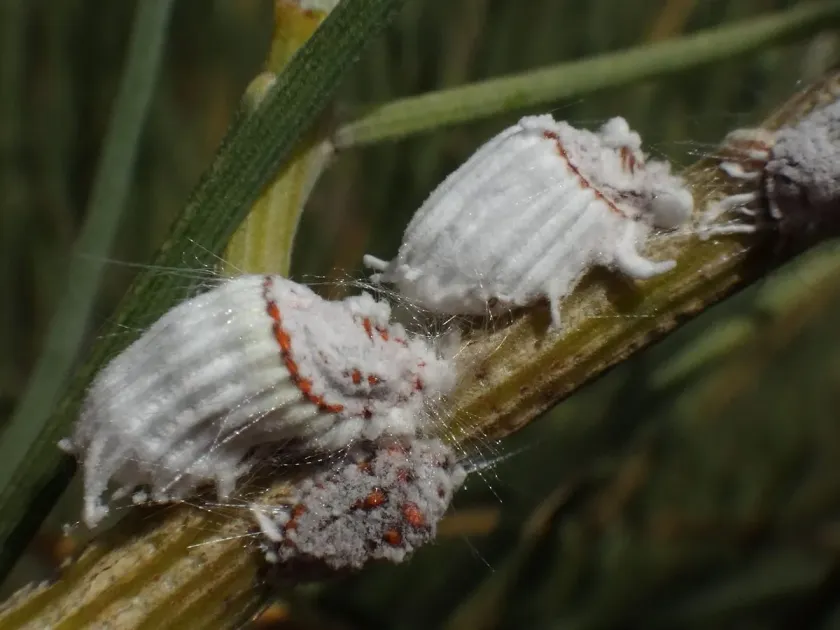
Adult females are easily identified by their appearance: they are covered in white, waxy, cottony secretions that form an egg sac, giving them a distinct white or fluffy look.
The body color beneath the wax ranges from orange to reddish-brown, though this is often obscured by the heavy wax covering that protects the insect from environmental factors.
Males are rarely seen; they possess wings and differ significantly in morphology from the sedentary, wingless females that typically remain fixed on host plants.
First-instar nymphs, known as crawlers, are highly mobile and bright in color, allowing them to disperse quickly to different parts of the plant or nearby hosts.
What it damages
This species is a polyphagous pest, meaning it feeds on a wide range of hosts, including citrus trees, avocado, fig, and various tropical and subtropical ornamental species.
The insects feed by sucking sap from the plant's tissues, usually settling on the undersides of leaves, along leaf veins, on stems, and even on the surface of fruit.
Infested plants suffer from direct nutrient loss, while the saliva injected by the scale can cause toxic reactions, leading to leaf drop, wilting, and distorted shoot growth.
A major indirect impact is the excretion of honeydew, a sticky substance that promotes the growth of sooty mold, a dark fungus that covers the leaves and blocks photosynthesis.
Severe infestations weaken the plant, reducing its overall health, fruit production, and market value due to the presence of wax and sooty mold residues on the harvest.
When it appears
The life cycle of the Egyptian fluted scale is highly dependent on ambient temperature, allowing for continuous generations in tropical and subtropical climates.
Population peaks are typically observed during the spring and summer, coinciding with the flush of succulent new growth which is highly favorable for feeding.
In greenhouses or controlled indoor environments, the pest can reproduce throughout the year, making it difficult to manage without constant monitoring.
The insect overwinters as adults or nymphs in bark crevices or at the base of buds, where they can survive adverse conditions until the weather warms again.
The speed of generation turnover increases significantly in the absence of specialized natural enemies, which makes biological regulation a cornerstone of integrated management.
Signs of infestation
The most prominent sign of an infestation is the presence of white, cottony, wax-like masses found on leaves, branches, and stems of the host plant.
The accumulation of sticky honeydew on foliage, followed by the development of black sooty mold, is a clear indicator of a heavy scale population.
Plants often exhibit stunted growth, chlorosis (yellowing of leaves), and premature leaf abscission as the scale population extracts vital nutrients.
Ant activity on branches is a common secondary sign, as ants often tend to the scale colonies to harvest the sweet honeydew they produce.
- White, cottony wax sacs on branches and leaves.
- Shiny, sticky honeydew on the foliage.
- Black sooty mold covering leaf surfaces.
- Yellowing, curling, and early leaf drop.
- Distorted or stunted young shoot growth.
Control measures
Biological control is highly effective for this pest, specifically the introduction of the predatory ladybird beetle Rodolia cardinalis, which is a specialized predator of fluted scales.
Systemic insecticides are commonly employed in commercial agriculture, as they are absorbed by the plant and kill the scale insects as they feed on the sap.
Sanitation practices, such as pruning and destroying heavily infested branches, are essential to reduce the pest population and prevent spread to uninfested areas.
Strict quarantine protocols should be maintained when moving nursery stock to prevent the accidental introduction of this scale insect into new orchards or gardens.
Horticultural oils can be used to treat infested plants; these oils work by coating the insects and suffocating them, providing a safe alternative to harsh chemical treatments.
Taxonomy
- Latin name
- Icerya aegyptiaca
- Order
- Hemiptera (bugs, aphids, leafhoppers)
- Family
- Monophlebidae
- EPPO code
- ICERAE
Discussion
No discussions yet — be the first.