

Description
How to identify
Sawflies of the genus Hoplocampa belong to the order Hymenoptera, family Tenthredinidae. Adult insects are relatively small, typically measuring between 4 to 6 mm, and exhibit yellowish-brown or black coloration.
The larvae, often referred to as false caterpillars, are distinct from moth caterpillars by the number of abdominal prolegs. Sawfly larvae possess 7–8 pairs of abdominal prolegs, whereas true caterpillars have 5 or fewer.
The head of the larva is well-defined and dark-colored, while the body is generally white or yellowish. Adults are equipped with a saw-like ovipositor used to make incisions in plant tissues for egg-laying.
These pests overwinter as larvae inside tough cocoons located in the soil at a depth of 5–15 cm. Pupation occurs in early spring, shortly before the host plants begin to bloom.
Adult emergence typically aligns with the flowering period of fruit trees, ensuring that newly hatched larvae have immediate access to developing fruitlets. There is only one generation per year.
What it damages
Hoplocampa sawflies primarily target pome fruits. The most significant species are the apple sawfly (Hoplocampa testudinea) and the pear sawfly (Hoplocampa brevis).
The damage is caused primarily to the fruitlets. The first-instar larvae bore into the young fruit, creating winding tunnels before eventually feeding on the seed chamber.
A single larva can destroy several fruitlets by moving from one to another. This feeding behavior leads to a massive fruit drop in June, which is frequently mistaken for natural fruit thinning.
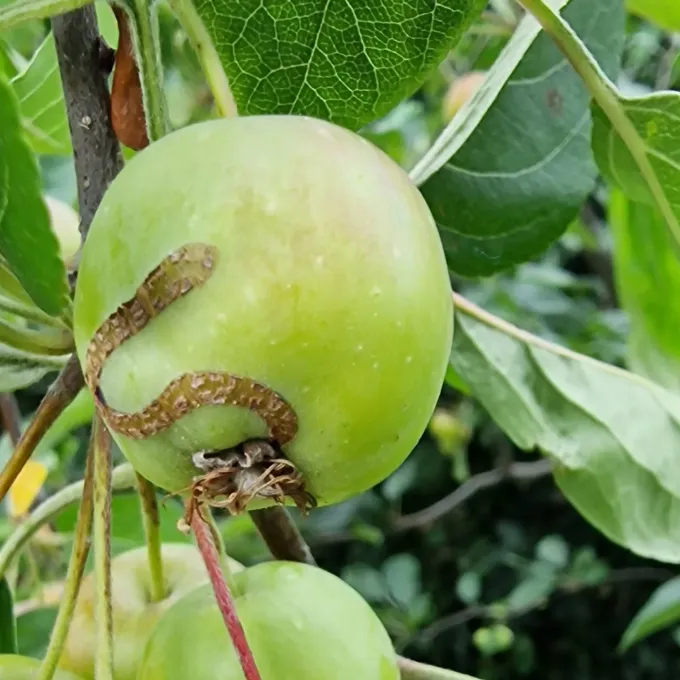
Where the larvae have entered or exited, dark, corky scars form on the surface of the fruit, causing deformation. These fruits are aesthetically unappealing and often unsuitable for storage or market.
Beyond physical consumption, the entry wounds act as gateways for secondary pathogens, such as fungi and bacteria, which can lead to fruit rot and further decrease yield quality.
When it appears
The peak emergence of adult sawflies occurs during the flowering stage of apples and pears. During this time, they feed on nectar and pollen before beginning the process of oviposition.
Females lay eggs singly into the calyx of the flower or just under the skin of the fruitlet. Embryonic development lasts between 7 and 15 days, depending on local weather conditions.
Larvae emerge during the fruitlet formation stage. Their feeding period lasts for approximately 3–4 weeks as the fruit grows, after which they migrate into the soil to pupate.
Warmer, drier weather tends to accelerate larval development, while cool, wet springs may prolong the duration of the damage period throughout the fruit development cycle.
Once feeding is complete, the larvae drop to the ground and burrow into the soil beneath the tree canopy. They construct a silk cocoon and remain in diapause until the following season.
Signs of infestation
The earliest sign of an infestation is the appearance of small holes on the surface of young fruitlets, accompanied by frass (larval excrement) that resembles wet, dark sawdust.
Close inspection of fallen fruitlets often reveals the larvae inside or characteristic winding tunnels within the flesh. Infested fruits on the tree grow slower and exhibit distorted shapes.
The presence of adults can be monitored during the blooming period by using white sticky traps, which attract the insects due to their sensitivity to light and color.
Premature fruit drop in early summer is a strong indicator of a significant pest population, signaling an urgent need for an assessment and potential control measures.
In cases of severe infestation, large, corky scars will traverse the surface of the fruit, making them easily identifiable as sawfly-damaged even from a distance.
Control measures
The primary control method involves the application of insecticides during critical windows: immediately after the petals have fallen, before the larvae penetrate deep into the fruitlets.
Cultural practices, such as cultivating or tilling the soil beneath the tree canopy in the autumn, can help disrupt the cocoons and reduce the overwintering survival rate.
Regularly collecting and destroying infested fallen fruit in June is a highly effective way to remove larvae from the orchard and decrease the population density for the next year.
The use of pheromone or sticky traps is recommended for monitoring population dynamics, allowing growers to time their insecticide applications with maximum precision.
Biological control agents, such as entomopathogenic fungi or nematodes, can also be applied as an eco-friendly alternative to traditional chemical treatments during peak periods of larval activity.
Content graph
Connections · Hoplocampa sawflies
Most often together:
Marketplace
Products · 26
Biology
Taxonomy
- Latin name
- Hoplocampa
- Order
- Hymenoptera
- Family
- Tenthredinidae
- EPPO code
- HOPLSP
Community
Discussion
No discussions yet — be the first.