
Japanese leaf katydid
Holochlora japonica
Description
How to identify
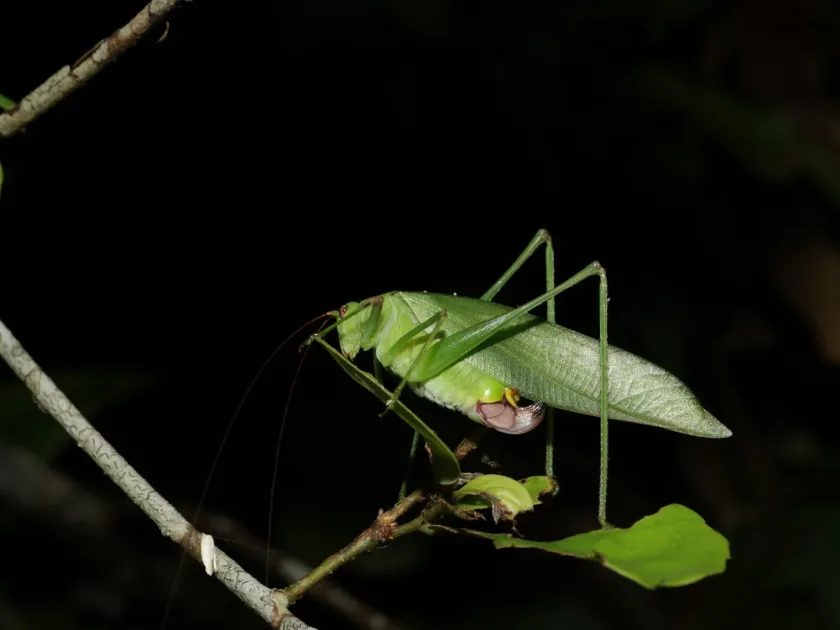
The Japanese leaf katydid (Holochlora japonica) is a member of the order Orthoptera and the family Tettigoniidae. These insects possess a vivid green color that perfectly mimics the surface of a leaf, rendering them nearly invisible in dense foliage.
Adults have a slender body, 30–45 mm in length, with long wings that extend beyond the tip of the abdomen. Their antennae are thin and exceptionally long, significantly exceeding the body length, which is a key characteristic of the family.
Nymphs resemble smaller versions of the adults but lack fully developed wings. Throughout their growth, they undergo several molting stages, gradually increasing in size and developing wing pads.
They primarily inhabit tree canopies and tall herbaceous vegetation. Due to their camouflage and body shape, they are difficult to detect in the early stages of infestation.
Reproduction involves laying eggs directly into plant tissues. The female uses her ovipositor to make slits in leaves or stems, inserting the eggs inside, which is a specific biological trait of this species.
What it damages
This species is a polyphagous pest capable of attacking a wide range of woody and shrubby plants. Its host range includes citrus trees, tea bushes, various fruit trees, and ornamental plants.
Major damage is caused by adults and older nymphs, which actively feed on leaf blades. They can consume entire sections of soft leaf tissue, leaving only coarse veins, which significantly impairs the plant's photosynthetic capacity.
Beyond leaf consumption, significant harm occurs during egg-laying. The slits made by females in young shoots and leaves serve as entry points for secondary infections, causing necrosis and premature leaf drop.
On citrus plantations, this pest can damage not only vegetative parts but also fruit sets, leaving surface scars. This reduces the market value of the crop and causes fruit deformation during maturation.
Mass infestations can lead to severe defoliation, which, during dry periods, causes young shoots to desiccate and reduces the overall cold hardiness of fruit trees during winter.
When it appears
Katydid activity is closely tied to regional climate conditions. In warmer southern areas, nymph hatching begins in late spring when average temperatures become consistently high.
The highest population density is observed during summer months, when nymphs are actively feeding and growing. During this time, they are at their most voracious and noticeable due to their feeding signs.
The lifecycle generally concludes in autumn. Adults mate, and females proceed to lay eggs in plant tissues. The overwintering stage is the egg, which remains protected inside stems or leaves against external environmental factors.
Monitoring for the pest should begin in late spring. It is crucial to pay attention to the condition of young shoots, as they are most frequently attacked at the beginning of the season.
High humidity and moderately hot weather facilitate rapid generation development. In such conditions, the number of individuals can quickly reach threshold levels requiring intervention.
Signs of infestation
The primary sign of infestation is jagged, uneven grazing along the edges of leaf blades. Unlike caterpillars, katydids often leave torn, irregular edges, chewing through the tissue in a chaotic manner.
Specific linear slits can be found on leaves and young shoots, indicating egg-laying sites. These areas may darken and deform over time, revealing the presence of the pest in the canopy.
Inspecting plants in the evening or at night, when katydids are most active, allows for the detection of the male's characteristic chirping, which helps locate clusters of individuals.
The presence of frass (small dark pellets) on the surface of leaves located below feeding sites is another indirect sign of active infestation.
Sudden shedding of young leaves with mechanical damage to the edges often points to nymphal activity, as they typically gather in groups in the upper parts of the tree canopy.
Control measures
An integrated protection system includes cultural practices. Regular sanitary pruning and the removal of damaged shoots in autumn help reduce the number of overwintering eggs in the orchard.
Biological control methods are highly effective. Utilizing natural enemies such as predatory bugs or specific parasitic wasps helps keep the katydid population below the economic threshold.
When population density is high, the use of contact-stomach insecticides is justified. It is recommended to use products based on pyrethroids or neonicotinoids, strictly observing pre-harvest intervals.
Spraying the canopy is best performed in the evening hours when the insects are actively feeding, which increases the likelihood of direct contact between the pest and the insecticide solution.
- Monitoring with pheromone traps if data on migration is available.
- Practicing crop rotation and avoiding overly dense plantings that hinder air circulation.
- Encouraging insectivorous birds (like starlings or tits) in the garden to help manage population levels.
Taxonomy
- Latin name
- Holochlora japonica
- Order
- Orthoptera (locusts)
- Family
- Tettigoniidae
- EPPO code
- HOLOJA
Discussion
No discussions yet — be the first.