
Convergent lady beetle
Hippodamia convergens
Description
How to identify
The convergent lady beetle (Hippodamia convergens) is a species of ladybird beetle in the family Coccinellidae. It is widely recognized for its beneficial role in agriculture as a voracious predator.
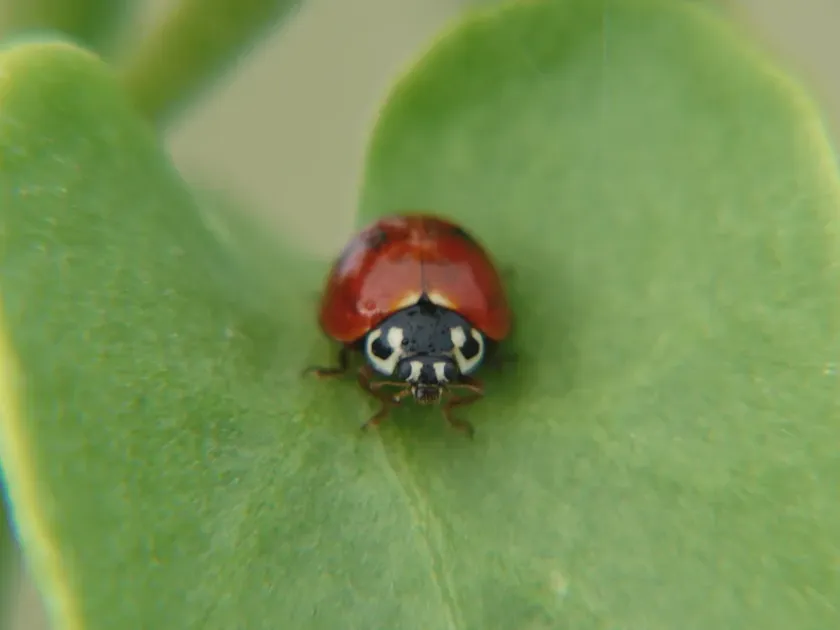
Adult beetles have an oval shape with orange-red wing covers featuring black spots. The primary diagnostic feature is the presence of two converging white or yellow lines on the pronotum, forming a triangle.
Larvae appear quite different from adults, having an elongated, alligator-like body with dark, spotted coloration. They are extremely active predators that roam plants in search of prey.
Eggs are typically laid in clusters on the undersides of leaves. They are bright yellow or orange, serving as a sign of future aphid control in the immediate vicinity.
As members of the order Coleoptera, these insects are not pests. They play a critical ecological role in controlling populations of various soft-bodied insects in garden and farm settings.
What it damages
The convergent lady beetle does not cause damage to agricultural crops. They are strictly predatory and do not feed on plant tissue, leaves, or roots, making them harmless to your yields.
Their primary diet consists of aphids, which are destructive pests that weaken plants and transmit viral diseases. By consuming aphids, these beetles actively protect crop health.
In addition to aphids, both larvae and adults may consume spider mites, whiteflies, and insect eggs, providing a broad spectrum of natural pest suppression.
Because they do not damage crops, they are considered one of the most important biological control agents for commercial vegetable and grain production systems.
Farmers who observe these beetles in their fields can consider it a positive sign of a healthy, naturally balanced environment that requires fewer chemical interventions.
When it appears
The activity of the convergent lady beetle usually commences in early spring when temperatures rise and aphid populations begin to establish themselves on young plants.
During the peak summer season, these beetles undergo rapid reproduction cycles. When food is abundant, their population density increases significantly to match the supply of aphids.
As temperatures drop in autumn, the beetles initiate a migration phase. They often seek out protected areas, such as leaf litter or cracks in logs, to undergo diapause throughout the winter.
The life cycle involves complete metamorphosis, progressing through egg, larval, pupal, and adult stages. Depending on the climate, there can be multiple generations per year.
Early season presence is critical for preventing aphid outbreaks. Establishing populations of these beetles early in the growing season is a key goal for integrated pest management.
Control measures
No control measures are needed for the convergent lady beetle; rather, conservation measures should be prioritized to ensure their survival on the farm.
Avoid the use of broad-spectrum insecticides, which kill both pests and beneficial predators. These chemicals can disrupt the natural balance and lead to secondary pest outbreaks.
Implementing Integrated Pest Management (IPM) practices allows for the selective control of harmful pests while preserving the habitat for lady beetles and other beneficial insects.
Planting nectar-rich flower borders around fields provides necessary supplementary food sources for adult beetles during periods when aphid populations are low.
By protecting natural overwintering sites and minimizing chemical usage, farmers can rely on these beetles as a sustainable, cost-free method of crop protection.
Taxonomy
- Latin name
- Hippodamia convergens
- Order
- Coleoptera (beetles)
- Family
- Coccinellidae
- EPPO code
- HIPPCN
Discussion
No discussions yet — be the first.