
Helopeltis westwoodii
Helopeltis westwoodii
Description
How to identify
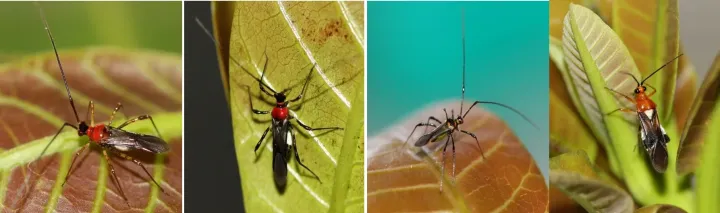
Helopeltis westwoodii is a species of mirid bug belonging to the order Hemiptera. It is recognized by a distinctive thoracic process, which is a spine-like structure projecting upwards and backwards from the scutellum.
Adult insects have a slender build, long legs, and antennae. Their coloration ranges from reddish-brown to dark brown, providing excellent camouflage against the foliage and shoots of host plants.
The life cycle proceeds through egg, five nymphal instars, and adult stages. Females insert eggs into soft plant tissues, such as leaf petioles or tender shoots, making the egg-laying sites nearly invisible.
Nymphs are highly active and resemble miniature, wingless versions of the adults. They start feeding immediately after emergence, moving rapidly across the plant canopy in search of nutrient-rich sites.
Development time is highly sensitive to environmental factors like temperature and humidity. Under tropical conditions, a generation can be completed in about three to four weeks, enabling rapid population growth.
What it damages
This pest primarily attacks cocoa, tea, and various other fruit and ornamental crops in its native range. It is considered a significant threat to plantation economy due to its feeding habits.
Both adults and nymphs feed by piercing the plant tissues with their stylets and injecting saliva containing digestive enzymes. This process leads to localized tissue death (necrosis) around the feeding puncture.
Feeding on fruit pods results in the appearance of dark, sunken spots that cause malformation and prevent the proper development of the beans inside, leading to substantial yield loss.
Shoot damage is equally destructive, resulting in the death of terminal buds and die-back of branches. This weakens the tree significantly and reduces its overall productive capacity over time.
The punctures created by the bug act as entry points for various pathogenic fungi and bacteria, leading to secondary infections that further devastate the plant tissue and reduce total yield.
Control measures
Cultural control practices, such as the regular pruning of infested shoots and branches, are essential for reducing the population density of the pest at its source.
Biological control utilizing natural predators, such as ants, predatory bugs, and various parasitic wasps, can be highly effective when integrated into a long-term pest management program.
Chemical control remains an option during outbreaks, but it must be applied with caution. The use of systemic insecticides should be rotated to prevent the development of pesticide resistance.
Monitoring using pheromone or sticky traps allows farmers to detect early infestation waves, enabling targeted and timely interventions that minimize the need for broad-spectrum chemical sprays.
- Maintain optimal spacing between trees to improve airflow.
- Remove alternative weed hosts from the vicinity of plantations.
- Implement integrated pest management (IPM) to preserve natural enemies.
Taxonomy
- Latin name
- Helopeltis westwoodii
- Order
- Hemiptera (bugs, aphids, leafhoppers)
- Family
- Miridae
- EPPO code
- HELOWE
Discussion
No discussions yet — be the first.