
Tea mosquito bug
Helopeltis antonii
Description
How to identify
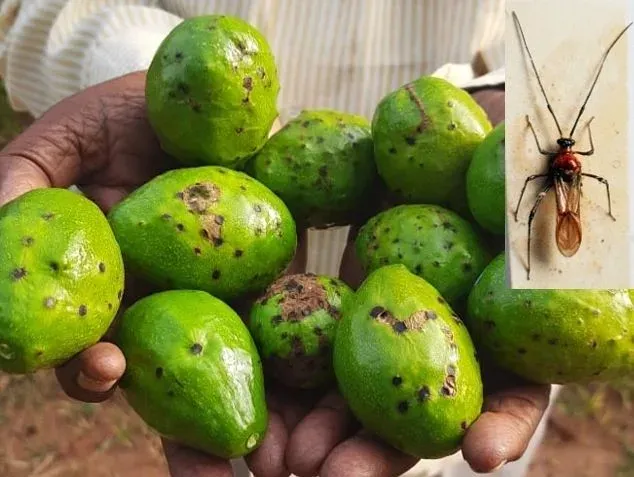
The tea mosquito bug (Helopeltis antonii) belongs to the order Hemiptera and the family Miridae. Adult insects are characterized by a slender body, long antennae, and a coloration ranging from reddish-brown to dark brown.
A definitive identification feature is the prominent, pin-like knob or scutellar spine on the thorax, which is directed upward and backward, setting it apart from other mirid species.
Females insert their eggs into the soft tissues of tender shoots and leaf petioles using their specialized ovipositors, making the egg clusters difficult to spot without close inspection.
The nymphs go through five distinct stages of development, resembling miniature versions of the adults but lacking fully developed wings.
The entire life cycle is highly influenced by environmental factors; in tropical regions, the insect can breed continuously throughout the year if host plants are available.
What it damages
This pest is a major threat to tea plantations, but it also causes significant damage to other economically important crops such as cocoa, cashew, cotton, and various fruit trees.
Damage is inflicted primarily by both nymphs and adults feeding on the youngest, most succulent parts of the plants, which are nutrient-rich.
The bug injects toxic saliva into plant tissues during feeding, causing localized necrosis and the formation of characteristic dark spots around the puncture sites.
High infestation levels lead to reduced foliage growth, loss of plant vigor, and ultimately a decrease in both yield and the quality of the harvested produce.
In cashew crops, the pest targets inflorescences, leading to the shedding of flowers and fruits, which significantly reduces the final harvest potential.
When it appears
The population of the tea mosquito bug usually peaks during periods of high humidity and moderate temperatures, which are ideal for their rapid development.
While their activity tends to decrease during harsh, dry seasons, the bugs can survive on alternative host weeds or within shaded areas of the plantation.
An ambient temperature range of 25 to 30 degrees Celsius creates optimal conditions for the pest to complete its life cycle efficiently.
The periods of active flush growth in tea are the most critical times for monitoring, as the abundance of fresh foliage supports a sharp increase in bug numbers.
Field scouting should be prioritized during the start of the monsoon or warm, humid seasons to catch early outbreaks before they become unmanageable.
Signs of infestation
The first signs of infestation are small, dark, circular spots on young leaves that expand over time into large, irregular necrotic lesions.
Affected leaves often curl, deform, and drop prematurely, which significantly reduces the photosynthetic efficiency of the plant.
Lesions on petioles and young stems often appear as dark, sunken areas, sometimes accompanied by the exudation of plant sap in the puncture wounds.
If terminal buds are severely damaged, the growth of the shoot is stunted or entirely halted, leading to the development of secondary buds and an uneven canopy structure.
- Dark, necrotic lesions on tender leaves.
- Leaf curling and premature abscission.
- Blackened spots on young succulent stems.
- Stunting of terminal shoot growth.
- Flower and fruit drop due to damage to inflorescences.
Control measures
Effective management of the tea mosquito bug requires an integrated pest management (IPM) approach that combines cultural, biological, and chemical methods.
Cultural practices include the systematic pruning of infested branches and the removal of alternative weed hosts from within and around the plantation boundaries.
Conserving and encouraging natural enemies such as predatory ants, spiders, and fungal pathogens is vital for long-term population suppression.
When chemical intervention is necessary, the use of selective insecticides that target the pest while preserving natural predators should be preferred.
Strict adherence to safety guidelines and pre-harvest intervals is essential to ensure that residues are kept within safe limits for consumer health.
Taxonomy
- Latin name
- Helopeltis antonii
- Order
- Hemiptera (bugs, aphids, leafhoppers)
- Family
- Miridae
- EPPO code
- HELOAN
Discussion
No discussions yet — be the first.