
Helopeltis anacardii
Helopeltis anacardii
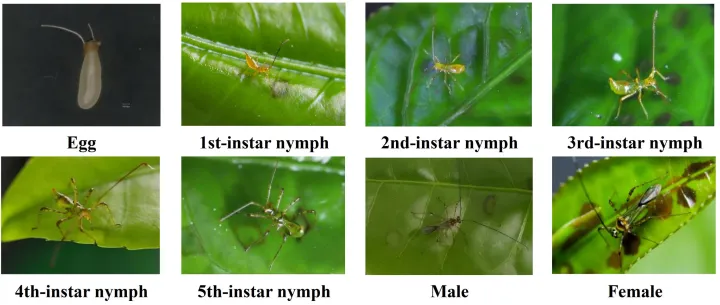
Description
How to identify
Helopeltis anacardii belongs to the order Hemiptera and the family Miridae. This pest is easily recognized by a characteristic knob-like structure on the scutellum, which resembles a long pin or spike.
Adult insects have a slender body, measuring approximately 7–10 mm in length. Their coloration ranges from yellowish to reddish-brown, providing effective camouflage against the young leaves and twigs of host plants.
The life cycle encompasses the egg stage, five nymphal instars, and the adult stage. Females insert their eggs directly into the tender tissues of shoots or leaf petioles, making them highly protected from many contact insecticides.
Nymphs resemble smaller, wingless versions of the adults. They are highly mobile and begin feeding on plant sap almost immediately after hatching from the egg.
Due to a short generation time and high reproductive capacity, this pest can reach destructive population levels very quickly in tropical growing environments.
What it damages
The primary host for this pest is the cashew tree (Anacardium occidentale). However, it is known to infest various other plant species within the Anacardiaceae family in its native range.
The bug specifically targets the most succulent parts of the plant, including terminal buds, young leaves, inflorescences, and developing fruit, causing direct yield losses.
Feeding involves injecting saliva containing enzymes into the plant tissue. These enzymes cause localized necrosis, allowing the pest to extract nutrients more easily from the sap.
Heavy infestations lead to the death of young shoots, premature flower drop, and the formation of scarred or deformed nuts, which drastically reduces their market value.
Furthermore, feeding wounds often act as infection sites for secondary pathogens, such as fungi and bacteria, which can exacerbate the physical damage to the tree.
Signs of infestation
The first visual symptoms of Helopeltis anacardii are small, dark brown or black spots on young foliage. Over time, these spots expand into necrotic patches as the tissue dies.
Inflorescences show signs of distress through rapid wilting and drying of flowers. When infestation occurs during the early fruit-setting stage, the developing nut often turns black and abscises.
Heavily affected shoots show significant curling and distortion. The tree often responds to the tissue damage by secreting gum (exudate) at the puncture sites.
In the early morning or late afternoon, active adults and nymphs can often be observed on the undersides of young leaves or near the tips of tender stems.
- Black necrotic spots on young leaves and shoots.
- Curled, distorted leaves and stunted terminal growth.
- Premature abscission of flowers and young fruit.
- Gum exudation from feeding puncture points.
- Dieback of tender apical buds.
Control measures
Chemical control remains the most common strategy, utilizing systemic and contact insecticides. Applications must be timed to coincide with flushes of new growth and peak flowering stages.
Cultural practices, such as proper pruning, improve air circulation within the canopy. This reduces humidity levels, creating a less favorable microclimate for the pest to reproduce.
Biological control relies on conserving natural predators, including specific species of predatory ants and spiders that inhabit the canopy and effectively prey on nymphs.
Integrated Pest Management (IPM) involves using monitoring traps to determine population density, allowing farmers to apply insecticides only when economic thresholds are met.
To ensure long-term effectiveness, it is critical to rotate insecticides with different modes of action to prevent the development of resistance in the Helopeltis populations.
Taxonomy
- Latin name
- Helopeltis anacardii
- Order
- Hemiptera (bugs, aphids, leafhoppers)
- Family
- Miridae
- EPPO code
- HELOAA
Discussion
No discussions yet — be the first.