
Harpalus tridens
Harpalus tridens
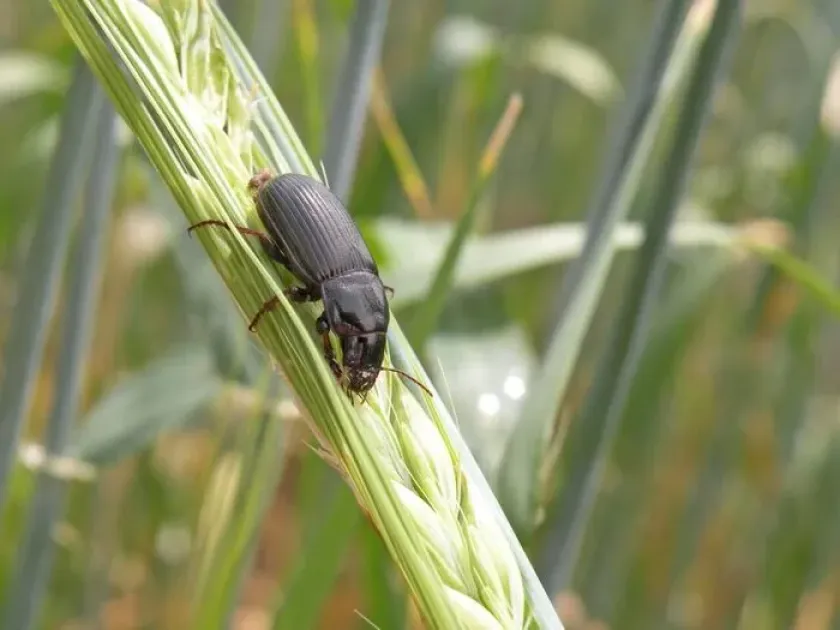
Description
How to identify
Harpalus tridens belongs to the order Coleoptera and the family Carabidae (ground beetles). The adult beetle is 10–12 mm long, characterized by a dark brown or black coloration with a distinct metallic sheen.
The body of the insect is oval and flattened, with wing covers (elytra) exhibiting pronounced longitudinal grooves. The head is equipped with powerful mandibles adapted for chewing.
The larvae are worm-like, yellowish-white, with a well-developed head and three pairs of thoracic legs. They primarily lead a cryptic lifestyle, living in the surface soil layers or among plant debris.
Identification in the field requires inspection during nighttime hours, as the adults are predominantly nocturnal, hiding under clods of earth or in dense vegetation during the day.
It is crucial to distinguish this species from beneficial predatory ground beetles, as many other carabids are important natural enemies that consume other crop pests.
What it damages
Damage is caused by both adults and larvae, although the species can exhibit a varied diet. In the agricultural sector, Harpalus tridens poses a threat to cereal grain crops.
Adult beetles damage grains during the maturation stage, gnawing out the contents of the kernels in the ear, which leads to reduced yields and lower quality of harvested grain.
Larvae, living in the soil, can damage germinating seeds by consuming the embryo, and they may also sever the roots and bases of young stalks in winter crops during the autumn season.
Damaged seedlings often turn yellow and die, leading to thinning of the stand and necessitating reseeding in cases of high population density.
The greatest economic impact is observed under drought conditions, as the pest increases its feeding on vegetative plant parts to compensate for moisture deficiency.
When it appears
The life cycle of the species is closely linked to the phenology of cereal crops. Overwintering typically occurs as adults and older-stage larvae in the soil or under plant remains.
Mass emergence of overwintered beetles is observed in spring once soil temperatures reach levels conducive to their activity. This period marks the start of supplemental feeding.
The flight of beetles and the egg-laying process are spread over time. Females deposit eggs in the surface soil, selecting areas with sufficient moisture levels.
Larval development proceeds through several instars, culminating in pupation within soil chambers. A new generation of beetles emerges in the second half of summer.
In the autumn, young beetles feed actively on the seedlings of winter crops before entering dormancy, making these crops particularly vulnerable during their establishment phase.
Signs of infestation
The primary sign of infestation is the presence of empty, gnawed grains in the ears, which appear as unevenly eaten hulls devoid of endosperm.
Seedlings may show traces of chewing at the stem base, leading to wilting and subsequent drying of entire plants across specific areas of the field.
Excrement and plant tissue fragments are often found on the soil surface near damaged plants, providing clues to the pest's localization.
Visual inspection during evening hours may reveal the beetles themselves active on the soil surface or climbing the plants to feed on ears.
- Yellowing of leaf tips in young plants.
- Localized patches of thinned seedlings.
- Damaged ears during the wax ripeness phase.
Control measures
Agronomic practices remain the foundation of population management. Crop rotation is essential, specifically avoiding the planting of winter cereals immediately after other cereal predecessors.
Stubble cultivation and deep plowing after harvest effectively destroy a significant portion of the larvae and pupae residing in the topsoil layers.
The use of high-quality insecticidal seed treatments provides effective protection for seedlings during the critical early stages of their development.
Chemical control during the growing season is justified only when the damage threshold is exceeded, which is determined based on the crop growth stage and adult beetle density.
For population monitoring, soil sampling and light traps are recommended, allowing agronomists to forecast the necessity and timing of protective measures.
Taxonomy
- Latin name
- Harpalus tridens
- Order
- Coleoptera (beetles)
- Family
- Carabidae
- EPPO code
- HARPTR
Discussion
No discussions yet — be the first.