
Fruit-eating ground beetle
Harpalus rufipes
Description
How to identify
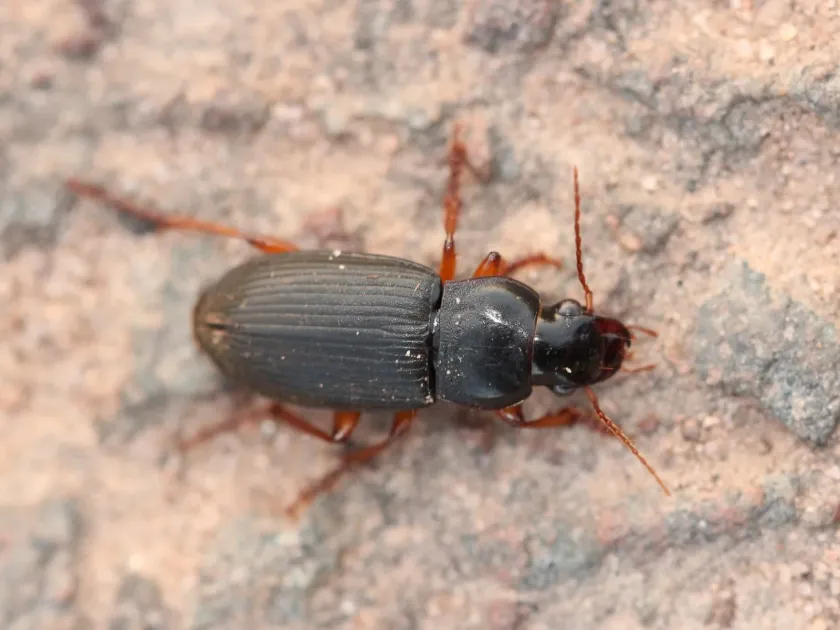
The adult beetle measures between 11 and 16 mm in length. Its body is elongated and oval in shape, with a dark brown to black coloration, while the legs and antennae are distinctly reddish-brown, which gives the species its common name.
The beetles possess well-developed mandibles and functional wings, enabling them to migrate effectively between fields. The elytra are covered with fine, dense hair, giving them a matte appearance, and feature distinct punctured rows.
Larvae are of the campodeiform type, reaching 20–25 mm when fully grown. They are dirty-white in color with sparse hairs, while the head and thoracic segments are a noticeable dark brown.
This species belongs to the ground beetle family (Carabidae) within the order Coleoptera. Unlike most ground beetles, which are predators, this species is known for its phytophagous habits, making it a significant agricultural pest.
For accurate field identification, entomologists often use soil excavations or light traps. Proper identification is crucial, as this beetle must be distinguished from beneficial predatory species in the same family.
What it damages
The fruit-eating ground beetle is a polyphagous pest that causes considerable damage to various crops. Cereal crops, particularly wheat, barley, and rye, are highly susceptible to both larval and adult feeding.
Strawberries are particularly vulnerable to this pest. Adult beetles cause significant economic damage by hollowing out cavities in ripening berries, rendering the fruit unmarketable and susceptible to secondary fungal infections.
Vegetable crops, including sugar beets, potatoes, corn, and sunflowers, are also frequent targets. The beetles often attack seeds, sprouts, and cotyledons, which can lead to poor crop emergence.
Larval feeding in the soil can be devastating, as they consume the roots of young plants. This causes the plants to wilt, stunt, or die, resulting in patchy, sparse fields that often require replanting.
The severity of the damage depends on the population density and the growth stage of the crop. Early-season attacks on germinating seedlings are generally the most critical in terms of yield loss.
When it appears
The species primarily overwinters as adult beetles or late-stage larvae deep within the soil, typically at depths of 20–30 cm. Activity resumes in the spring as soil temperatures reach approximately 10–12 degrees Celsius.
Mating and egg-laying occur in late spring and early summer. Females deposit eggs in the soil near host plants, ensuring that the emerging larvae have immediate access to food sources.
Adults are predominantly nocturnal. During the summer months, they actively feed and migrate across fields, attracted by the presence of succulent seeds and maturing fruit crops.
Larvae pass through three instars while feeding in the soil. Development usually continues until autumn, at which point the insects prepare for winter hibernation or pupate in the soil.
Only one generation occurs per year. Soil moisture levels are vital for larval survival, and high-rainfall seasons often lead to an increase in population density and subsequent crop damage.
Signs of infestation
One of the primary signs of infestation in cereal fields is the hollowed-out germ of the seeds, which prevents normal germination and leads to visible gaps in the rows of the crop.
On strawberries, the most obvious signs are irregularly shaped holes and cavities chewed into the fruit. It is common to find beetles hiding inside these cavities during the day.
Plants affected by larval root feeding show symptoms of yellowing and wilting. When examined, the roots often appear gnawed or stunted, indicating subterranean damage by the larvae.
Adults can be observed by inspecting the soil surface or moving debris during evening hours. They are highly active at night and tend to congregate under plant residue or clods of earth during the day.
The presence of damaged seeds scattered on the soil surface is a strong indicator of beetle activity, as they often cache or store seeds in their burrows for feeding.
Control measures
- Implementation of crop rotation to break the pest's lifecycle.
- Deep autumn plowing to disturb larvae and destroy overwintering sites.
- Rigorous weed control to eliminate alternative food sources.
- Use of systemic insecticide seed treatments to protect young seedlings.
- Targeted insecticide applications during peak activity periods based on economic thresholds.
Chemical control strategies typically involve the use of pyrethroid or organophosphate insecticides. These applications must be timed to coincide with the period of peak adult activity to be most effective.
Adjusting sowing dates is an essential agronomic practice. By carefully timing planting, farmers can ensure that the most vulnerable growth stages of the crop do not overlap with the peak population of the beetle.
Monitoring programs using pitfall traps or light traps help agriculturalists make informed decisions about when to apply protective measures, preventing unnecessary chemical use.
Integrated pest management (IPM) is the most sustainable approach, combining cultural practices, biological monitoring, and cautious chemical interventions to maintain population levels below the damage threshold.
Taxonomy
- Latin name
- Harpalus rufipes
- Order
- Coleoptera (beetles)
- Family
- Carabidae
- EPPO code
- HARPRU
Discussion
No discussions yet — be the first.