
Red-legged ground beetle
Harpalus rubripes
Description
How to identify
The red-legged ground beetle (Harpalus rubripes) is a member of the family Carabidae, commonly found in various agricultural landscapes.
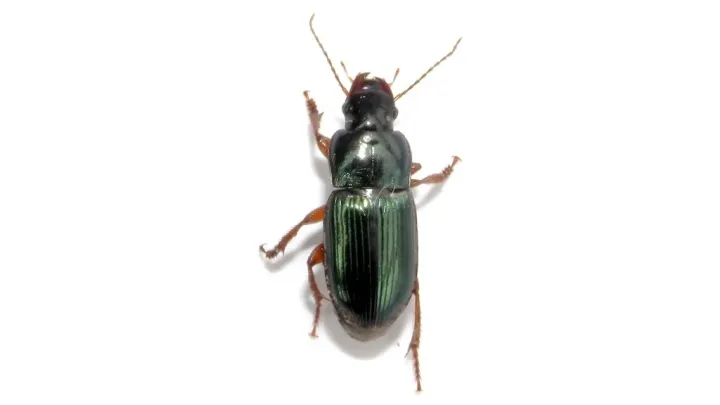
Adult beetles typically measure between 10 and 14 mm in length. Their body color ranges from dark bronze to black, often with a metallic sheen.
The most distinctive feature, which gives the species its common name, is the reddish-orange or yellowish color of the legs and antennae.
The larvae are mobile, worm-like, and equipped with strong mandibles adapted for feeding on both plant matter and small soil organisms.
Adults are nocturnal predators and scavengers, frequently emerging at night to forage in fields, while hiding in soil crevices or under debris during the day.
What it damages
The species primarily affects cereal crops, including wheat, rye, and barley, especially during their germination and ripening stages.
Larvae are particularly damaging to newly sown seeds and young seedlings, often consuming the plant base and causing significant crop loss.
Adult beetles can cause damage to the crop during the milk and dough stages of grain development by feeding on the soft kernels within the spike.
High beetle populations can lead to patchiness in fields, significantly reducing the density of the crop and overall yield potential.
Under heavy infestation, the cumulative damage from both larvae and adults can lead to severe economic losses for farmers.
When it appears
The species typically overwinters as larvae in the soil, often at depths between 20 and 30 centimeters to avoid extreme cold.
Activity begins in the spring as temperatures rise, with larvae migrating toward the surface to feed on plant roots and young shoots.
Adult emergence usually peaks in mid-summer, coinciding with the grain filling period of wheat and other cereal crops.
The life cycle continues into the autumn, when adult beetles migrate to newly sown winter fields to lay eggs in the soil.
Soil moisture plays a critical role in the beetle's development, with moderate rainfall generally supporting higher population survival.
Signs of infestation
One of the earliest signs of infestation is the presence of uneven patches in the field where young seedlings have withered or disappeared.
Close inspection of the plants may reveal damaged or hollowed-out seeds at the soil surface and chewed stems on young plants.
The presence of adult beetles under crop residue or clumps of soil is a clear indicator of a resident population in the field.
Fields with high weed pressure often show more severe damage, as weeds provide additional shelter and food sources for the beetles.
In mature crops, the presence of empty or partially eaten grain in the spikes is a diagnostic sign of adult beetle activity.
Control measures
Effective management begins with proper tillage practices, such as deep autumn plowing, which disrupts the larval wintering sites.
Strict weed control and the elimination of volunteer grain prevent the buildup of beetle populations before the main crop is planted.
Crop rotation is essential to prevent the accumulation of pests in specific fields, effectively breaking the beetle's life cycle.
Insecticide applications during the growing season may be necessary if monitoring reveals population numbers exceeding the economic threshold.
Seed treatment with systemic insecticides is a highly effective way to protect young seedlings from early-stage larval damage.
Taxonomy
- Latin name
- Harpalus rubripes
- Order
- Coleoptera (beetles)
- Family
- Carabidae
- EPPO code
- HARPRB
Discussion
No discussions yet — be the first.